
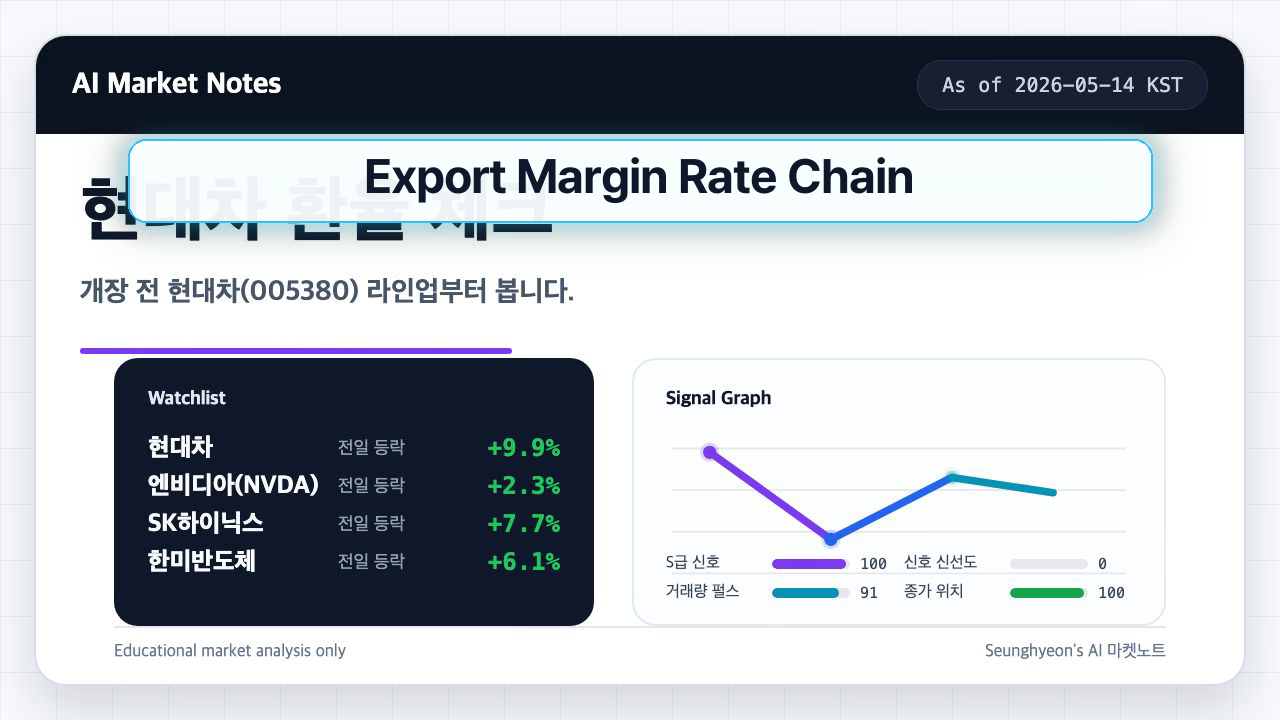
If you're watching Hyundai Motor (005380) or Kia (000270) today, you can skip half the noise and focus on one variable: the KRW/USD exchange rate. This post walks through how to build a quick, systematic lens for Korean auto exporters — tracking the rate-to-margin chain, layering in regional signals like the Vietnam VAMA data, and benchmarking brand catalysts like FIFA 2026 exposure.

Section 1: The Problem — Too Many Variables, Wrong Starting Point
Most retail analysis on Hyundai starts with sales volume or EV model launches. Both are lagging indicators by the time they hit headlines. What actually moves operating profit quarter over quarter for a Korean exporter is the translation effect: you invoice in USD (or VND, or EUR), then repatriate in KRW.
If KRW weakens against the dollar, every unit shipped overseas is worth more won at home — even if the car didn't sell one extra unit. The reverse kills margins silently. Hyundai's 2023 annual report confirmed that a ₩10 move in KRW/USD shifts operating profit by roughly ₩100–120B per year. That's not a rounding error.
The first mistake I made reading Korean auto earnings was anchoring on domestic retail numbers. Those matter for mix, not for margin translation.

Section 2: The Fix — Build a Rate-to-Margin Chain
Here's the analytical sequence that actually works. Run this before reading any broker note today.
Step 1: Check the morning spot rate
# Quick terminal check via a public FX API
curl -s "https://open.er-api.com/v6/latest/USD" \
  | python3 -c "import sys,json; d=json.load(sys.stdin); print(f'USD/KRW: {d[\"rates\"][\"KRW\"]:.2f}')"
Expected output on a normal day:
USD/KRW: 1374.50
Step 2: Delta from the quarterly average
Hyundai reports quarterly. What matters is not today's spot vs. yesterday — it's today's rate vs. the Q2 2025 average so far. If the rate is moving toward a higher USD/KRW average for the quarter, that's a tailwind building.
import statistics

# Approximate Q2-to-date daily closes — populate from your data source
q2_daily_rates = [1361.2, 1368.4, 1372.1, 1370.8, 1374.5]

avg = statistics.mean(q2_daily_rates)
today = 1374.5
delta_bps = (today - avg) / avg * 10000

print(f"Q2 avg so far: {avg:.1f}")
print(f"Today vs Q2 avg: {delta_bps:+.1f} bps")
Step 3: Map to operating profit sensitivity
| KRW/USD Move | Annual OP Impact (est.) | Quarterly Slice |
|---|---|---|
| +₩10 (weaker KRW) | +₩100–120B | +₩25–30B |
| -₩10 (stronger KRW) | -₩100–120B | -₩25–30B |
| +₩30 sustained | +₩300–360B | meaningful beat |
| -₩30 sustained | -₩300–360B | miss risk |
If the direction is consistent (rate up → export price up → OP up), the chain is aligned. That's today's key check.

Section 3: Layer In the VAMA Signal
Vietnam's auto market expanded 6% YoY in April according to VAMA (Vietnam Automobile Manufacturers' Association). That headline is more useful than it looks when you read it as an ASEAN proxy.
Hyundai's ASEAN footprint runs through TC Motor (Vietnam JV), with the Accent and Tucson as volume drivers. A 6% market expansion in Vietnam doesn't guarantee Hyundai share capture — you need to check whether VAMA's breakdown shows passenger cars outpacing commercial. Typically, if passenger car growth leads, Hyundai/Kia benefit disproportionately vs. Toyota's pick-up heavy mix.
The ASEAN export flow logic:
# Rough ASEAN export revenue model (illustrative)
vietnam_market_growth = 0.06       # VAMA April YoY
hyundai_vietnam_share = 0.18       # approximate historical share
volume_base_units = 12000          # monthly baseline units (JV)

incremental_units = volume_base_units * vietnam_market_growth * hyundai_vietnam_share
avg_asp_usd = 22000                # average selling price, USD

incremental_revenue_usd = incremental_units * avg_asp_usd
print(f"Estimated incremental revenue: ${incremental_revenue_usd:,.0f}")
This is directional modeling, not guidance-level math. But it gives you a sanity check before you treat "Vietnam up 6%" as either noise or a thesis-changer.
Section 4: FIFA 2026 — Brand Catalyst or Distraction?
Hyundai and Kia are official FIFA 2026 World Cup partners. The tournament runs June–July 2026, which means the brand exposure cycle is ramping now through 2026 Q2 earnings.
What to watch isn't whether the sponsorship is "good" — it's whether brand momentum translates to pricing power in North America, the highest-margin geography.
| Market | Why FIFA Matters | What to Track |
|---|---|---|
| USA | Hispanic demographic reach, direct market | US transaction prices vs. incentives |
| Canada | Similar demographic skew | Market share vs. Toyota/Honda |
| Mexico | Home-market pride uplift for domestic | Mexican assembly cost offset |
| ASEAN | Broadcast reach, general brand lift | Vietnam/Indonesia consideration data |
The gotcha: sponsorship cost (~$100–150M estimated over the cycle) hits SG&A ahead of the revenue benefit. You may see margin compression on brand spend before you see volume lift. That's not a red flag — it's the known shape of sponsorship ROI.

Section 5: Gotchas Across Environments
Hedge position distortion. Hyundai runs a rolling FX hedge book. A spot rate move doesn't hit the P&L at 1:1 — the hedged portion is locked in. Check the latest IR disclosure for the hedge ratio (typically 50–70% of export exposure). If KRW weakens sharply today but the hedge ratio is high, the immediate P&L benefit is muted.
VAMA data lag. VAMA releases monthly data with a ~3-week lag. April data released now reflects conditions before the current rate environment. Don't treat it as forward-looking.
FIFA cost timing on GAAP vs. management basis. Korean companies often report "operating profit before one-time items" in IR materials. Sponsorship amortization may be excluded from headline numbers but present in GAAP. Reconcile before comparing to consensus.
KRX vs. ADR spread. If you're watching the US-listed ADR (HYMTF OTC) alongside the KRX-listed shares (005380), the spread can diverge intraday on FX moves. The KRX price is ground truth for domestic-flow read.
Closing
Today's read on Hyundai Motor comes down to one directional check: is the KRW/USD rate, the Q2 average tracker, and the export margin signal all pointing the same way? If yes, the VAMA and FIFA catalysts are supporting evidence. If the rate turns against you mid-session, the rest of the narrative needs to wait.
Next step worth building: a simple Python script that pulls the KRW/USD dailyclose automatically, updates a rolling Q2 average, and flags when the quarter-to-date average crosses a meaningful threshold vs. the year-ago comparable.
🐦 Faster updates on X: @baegseungh7061
📚 More in this series: AI Market Notes
💌 Subscribe: Follow on X or grab the RSS
댓글
댓글 쓰기