
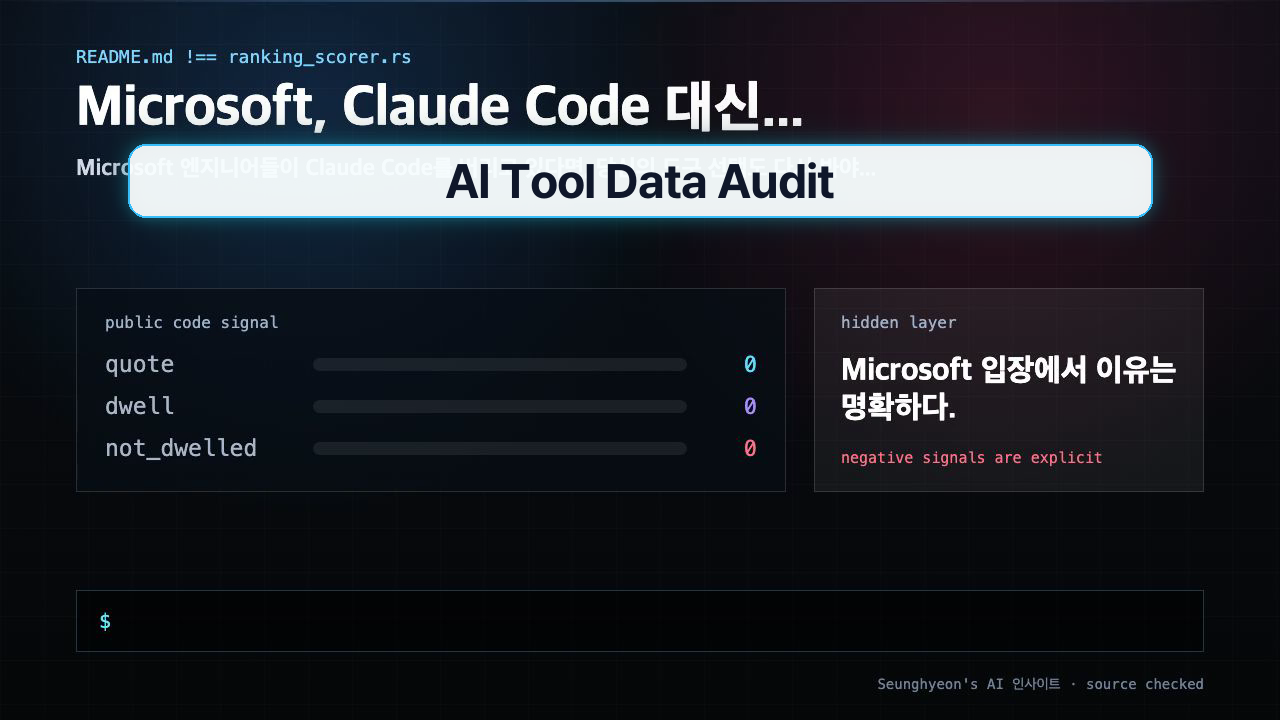
If you're evaluating AI coding tools for your team right now, this signal matters. Microsoft reportedly directed internal engineers to move from Claude Code to GitHub Copilot CLI — not because of model quality, but because of data routing, cost control, and policy ownership. That distinction is worth unpacking carefully before you commit your workflow to either tool.

1. Why this matters now
The AI coding tool market has been competing almost entirely on model capability benchmarks and autocomplete speed. That era is quietly ending. The real competition is now moving to a harder set of questions: where does your code go, who pays for each token, and who sets the policy when your security team asks for an audit trail?
Microsoft's move is a textbook example of this shift. Claude Code routes through Anthropic's API — meaning your code, context, and queries pass through an external server before returning a response. Copilot CLI, by contrast, is wired into Azure OpenAI and the GitHub ecosystem. Microsoft keeps the data, the billing, and the policy surface all in-house.
For an ordinary developer on a solo project, this doesn't change anything. For a team inside an enterprise with a written information security policy, it changes everything.

2. The core idea
The decision between Claude Code and Copilot CLI isn't about which model writes better code — it's about who owns the data pipeline.
Think of it like choosing between a SaaS email client and running your own mail server. The SaaS option is faster to set up and often more powerful, but every message transits through someone else's infrastructure. The self-hosted route gives you control at the cost of operational overhead. Neither is universally correct; the right answer depends entirely on your threat model and org policy.
Here's how the two tools compare across the dimensions that matter most in a team environment:
| Dimension | Claude Code | GitHub Copilot CLI |
|---|---|---|
| Model provider | Anthropic (Claude) | OpenAI via Azure / GitHub |
| Data routing | Anthropic API (external) | Azure infrastructure (Microsoft) |
| Billing surface | Anthropic API credits | GitHub / Azure subscription |
| Policy control | Anthropic ToS | Microsoft enterprise agreement |
| Audit trail | API logs (limited) | Azure Monitor, GitHub audit log |
| IDE integration | Terminal-first | IDE + terminal (VS Code native) |
| Self-host option | No (as of writing) | Partial (GHES) |
The cost and control row is where Microsoft made its call. When you're a company the size of Microsoft, even a 3% difference in per-token cost across thousands of engineers adds up fast. More importantly, having your internal code routed through a competitor's API is a policy risk, not just a cost risk.

3. How to implement it
Before your team commits to either tool, run this audit. It takes about 15 minutes and surfaces the conflicts that usually appear mid-sprint when it's too late.
Step 1 — Check your Claude Code API key scope
# List what permissions your current API key has
# Claude Code stores config here by default
cat ~/.claude/settings.json | python3 -m json.tool

# Or check the env var directly
echo $ANTHROPIC_API_KEY | cut -c1-8  # Only show prefix, never log full key
Look for whether the key is scoped to a personal account or an org account. Org-level keys often carry different data retention terms.
Step 2 — Trace where your code context actually goes
# Quick network trace while running a Claude Code prompt
# macOS
sudo tcpdump -i en0 -n host api.anthropic.com

# Linux
sudo tcpdump -i eth0 -n host api.anthropic.com
Expected output during an active Claude Code session:
IP 192.168.x.x.xxxxx > api.anthropic.com.443: Flags [S]
IP api.anthropic.com.443 > 192.168.x.x.xxxxx: Flags [S.]
That confirms your traffic is going to api.anthropic.com — which means it's leaving your local machine, full stop.
Step 3 — Compare with Copilot CLI routing
# Install Copilot CLI if not already present
gh extension install github/gh-copilot

# Verify installation
gh copilot --version

# Run a test query
gh copilot suggest "list files modified in the last 24 hours"
Expected output:
Suggestion:
find . -mtime -1 -type f
During this call, traffic routes to api.githubcopilot.com, which ultimately hits Azure OpenAI. If your organization has a Microsoft Enterprise Agreement, this traffic may be covered under your existing data processing terms — unlike a separate Anthropic API agreement.
Step 4 — Cross-check against your InfoSec policy
# Generate a quick summary of outbound domains your tools use
# Run this after a typical coding session with each tool
sudo lsof -i -n | grep -E '(anthropic|githubcopilot|openai)' | awk '{print $9}' | sort -u
Bring that list to your security team before they find it themselves.

4. What to watch in production
Data residency isn't just a compliance checkbox. If your team works on unreleased product code, embedded system firmware, or anything under NDA, you need a written answer from your legal team on whether sending that code to an external API is permitted. "We've been doing it for months" is not a legal answer.
Cost behavior differs significantly at scale. Claude Code's token usage can spike hard during long agentic sessions — multi-file refactors, long context reasoning chains, test generation loops. Anthropic's pricing is per-token with no volume cap by default. Copilot has a flat seat-based model for most enterprise tiers, which is easier to budget.
The self-hosting gap is real. Teams moving toward open-source models (Ollama, llama.cpp, local Qwen or Mistral) are building toward a world where the API call stays on-premise. Neither Claude Code nor Copilot CLI supports this cleanly today. If data sovereignty is the actual goal, both tools are transitional and you should be evaluating VS Code + Continue.dev with a local model backend in parallel.
Environment differences matter. On Linux in a Docker-based dev environment, both tools behave differently than on macOS. Copilot CLI's IDE integrations work best when VS Code is the primary editor. Claude Code is terminal-first and works better in SSH remote or containerized setups. Audit your actual dev environment before making the call.
Watch the next 2-3 quarters. Microsoft's move is a data point, not a verdict. Anthropic will almost certainly respond with enterprise-grade data handling (dedicated instances, private deployments). When that happens, the calculus changes again. Don't over-index on this moment — build your team workflow so you can swap the API endpoint without rebuilding everything around it.
The real lesson here isn't "use Copilot" or "stick with Claude Code" — it's that the AI tool layer in your stack now carries the same due diligence requirements as any third-party data processor. Run the audit before your InfoSec team does it for you.
Next step: pull your team's current API key list, identify which tools route code externally, and put a one-pager in front of your security contact. That 15-minute conversation now is cheaper than a mid-sprint migration later.
TAGS: claude-code, github-copilot, ai-dev-tools, enterprise-security, data-privacy
🐦 Faster updates on X: @baegseungh7061
📚 More in this series: AI Insights
💌 Subscribe: Follow on X or grab the RSS
댓글
댓글 쓰기