
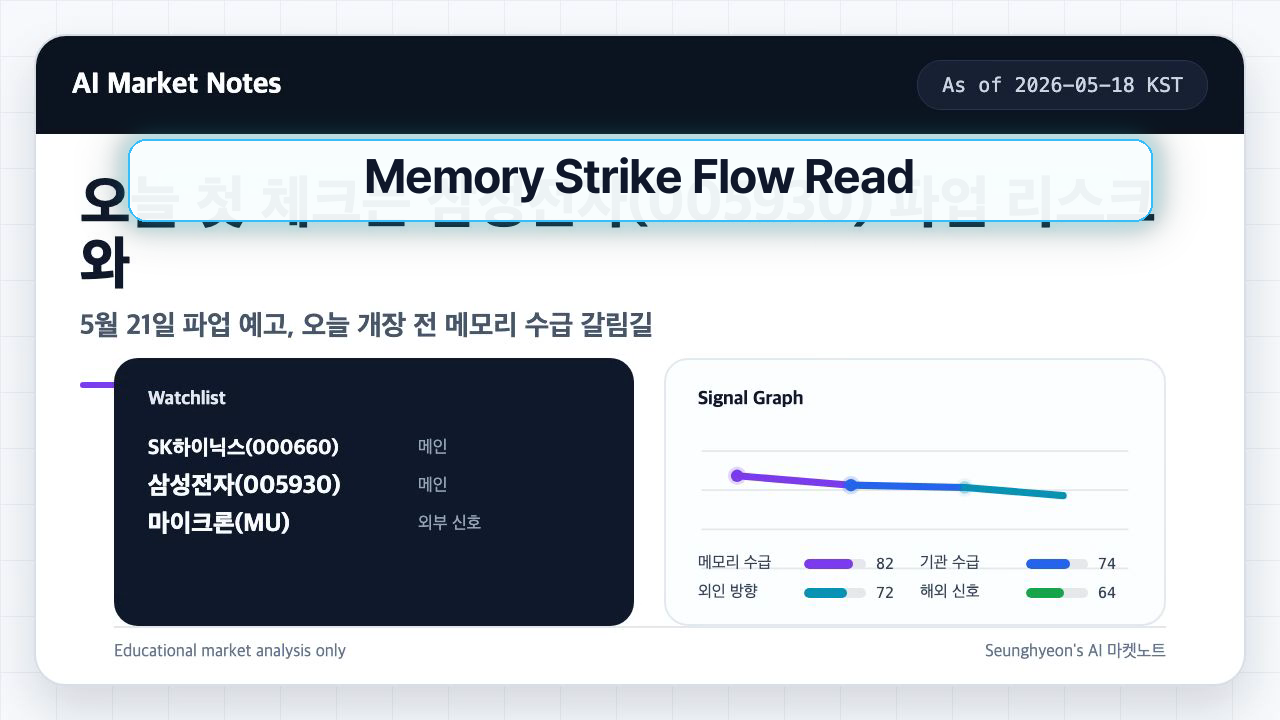
If you trade Korean semiconductor stocks — or any memory-adjacent position — the Samsung Electronics strike narrative is probably showing up in your feed right now. Here's how I actually parse the situation: foreign investor flow data on SK Hynix first, Samsung union developments second, and Micron as a peer signal third. Getting that order wrong leads to bad entry timing.

Section 1: Why Foreign Flow on SK Hynix Comes First
The instinct is to lead with the Samsung strike headline. Don't. Strike risk on Samsung (005930) is a supply disruption story, and supply disruptions take weeks to show up in earnings. Foreign investor positioning on SK Hynix (000660), by contrast, is a real-time sentiment proxy for the entire Korea memory trade.
When foreigners rotate into or out of Hynix, they're expressing a view on HBM demand, DRAM pricing, and whether they trust the won. That signal updates daily. The strike timeline does not.
What I watch:
| Metric | Source | Update Frequency |
|---|---|---|
| Foreign net buy/sell (000660) | KRX daily tape | Daily close |
| Foreign holding % change | DART disclosure | T+1 |
| Program buy ratio | KRX market data | Intraday |
| Institutional net (domestic) | KRX | Daily close |
A consistent three-to-five day foreign net buy streak on Hynix, even when Samsung headline risk is elevated, tells you the smart money is not pricing in sector-wide disruption. That's your baseline.

Section 2: Parsing the Samsung Strike — What Actually Matters
The Samsung Electronics union situation gets amplified because it's a great narrative. Factory workers at the world's largest memory fab walking out — that's a story editors love. But here's what I've learned to filter for: duration and line coverage.
The questions that matter:
- Which production lines are affected — leading-edge (HBM3E, V-NAND 9th gen) or legacy nodes?
- Is management engaging, or is this a standoff?
- How many union members are actually work-stopping vs. just card-carrying?
Samsung has multiple unions and a long history of partial actions. A strike that covers commodity DRAM lines has a very different market impact than one touching HBM or advanced NAND. Most retail traders don't make this distinction, which creates mispricing you can use.
The framework I use to triage the strike signal:
IF (affected_lines == "commodity_DRAM") AND (duration < 5 days):
    impact = "noise" → watch, don't act

IF (affected_lines == "HBM" OR "advanced_NAND") AND (duration > 7 days):
    impact = "material" → Micron re-rates upward, Hynix gap risk

IF (union_membership_striking < 30%):
    impact = "headline_only" → fade the move

One gotcha I hit early: the DART filing for union disclosure lags the actual work stoppage by 24-48 hours in some cases. I now cross-reference the union's own press releases (they're aggressive about Twitter/X posting) before relying solely on regulatory filings.
Section 3: Micron as a Peer Signal — Reflection, Not Leader
Micron (MU) is a reflex signal in this trade, not a leading one. When Samsung strike news breaks, MU gets a bid on supply disruption logic — if Samsung output falls, spot DRAM tightens, Micron's ASP assumptions improve. That's the mechanical read.
The problem is the reflection can be noisy. MU also moves on:
- US-China export control headlines (independent of Korea)
- Its own quarterly guide language
- Nasdaq beta on risk-off days
So I use Micron as a confirmation tool, not a trigger. Here's the specific check:
# Pseudo-logic for filtering MU move
def is_mu_move_samsung_driven(mu_change_pct, smci_change_pct, nasdaq_change_pct):
    # Remove beta noise
    beta_adj = mu_change_pct - (nasdaq_change_pct * 1.3)

    # Remove sector-wide semis move
    sector_adj = beta_adj - smci_change_pct * 0.4

    if sector_adj > 1.5:
        return "Samsung-specific supply bid — credible signal"
    elif sector_adj < -1.0:
        return "MU-specific or macro — ignore for Samsung read"
    else:
        return "Ambiguous — weight other factors"
This isn't a trading system — it's a mental model. The point is to not let MU's green candle on a Samsung strike day fool you into thinking the supply disruption is already being priced into Korea names. Often it isn't, because the KRX opens hours later and retail flow there dominates the first 30 minutes.

Section 4: Variations and Gotchas
The seasonal pattern: Samsung's union is most active in Q2-Q3, overlapping with summer bonus negotiation cycles. Strikes in this window have historically resolved faster because both sides want the issue closed before the Q3 earnings season puts everything under a microscope. That shortens the disruption window.
The Hynix-as-safe-haven trap: When Samsung noise spikes, some traders buy Hynix on relative-value grounds — "if Samsung supply drops, Hynix wins market share." This works on a multi-quarter horizon. On a one-to-three week trade, it often doesn't, because Samsung and Hynix are correlated risk assets in the eyes of foreign EM fund managers. Foreign selling hits both when Korea risk premium spikes.
Mac/Linux/Docker note (data access):
# KRX foreign flow data via OpenAPI (requires registration)
curl -X GET "https://openapi.krx.co.kr/contents/COM/GenerateOTP.jspx" \
  -H "AUTH_KEY: your_key_here"

# Alternatively, use pykrx for programmatic access
pip install pykrx

python3 -c "
from pykrx import stock
df = stock.get_market_trading_volume_by_date('20260101', '20260518', '000660')
print(df.tail(5))
"
The pykrx library works cleanly on all three environments. No Docker-specific issues. The data covers foreign, institutional, and retail net flow by ticker.
Earnings calendar alignment: If a Samsung strike overlaps with the two-week window before either company's earnings guidance, the move gets amplified. Both sides — union and management — know the market optics, which paradoxically can accelerate resolution. I've seen two strikes settle in the week before a Samsung quarterly pre-announcement for exactly this reason.
Closing
The read order matters: foreign flow on SK Hynix tells you what sophisticated money thinks right now, the strike details tell you whether the headline is noise or signal, and Micron gives you a US-market sanity check. Flipping that sequence — leading with the narrative — is how you end up chasing a move that's already priced in.
Next step: if you want to automate the foreign flow pull and get a daily Slack alert when Hynix foreign net crosses a threshold, that's a straightforward pykrx + webhook setup — worth doing if you're trading this regularly.
🐦 Faster updates on X: @baegseungh7061
📚 More in this series: AI Market Notes
💌 Subscribe: Follow on X or grab the RSS
댓글
댓글 쓰기