
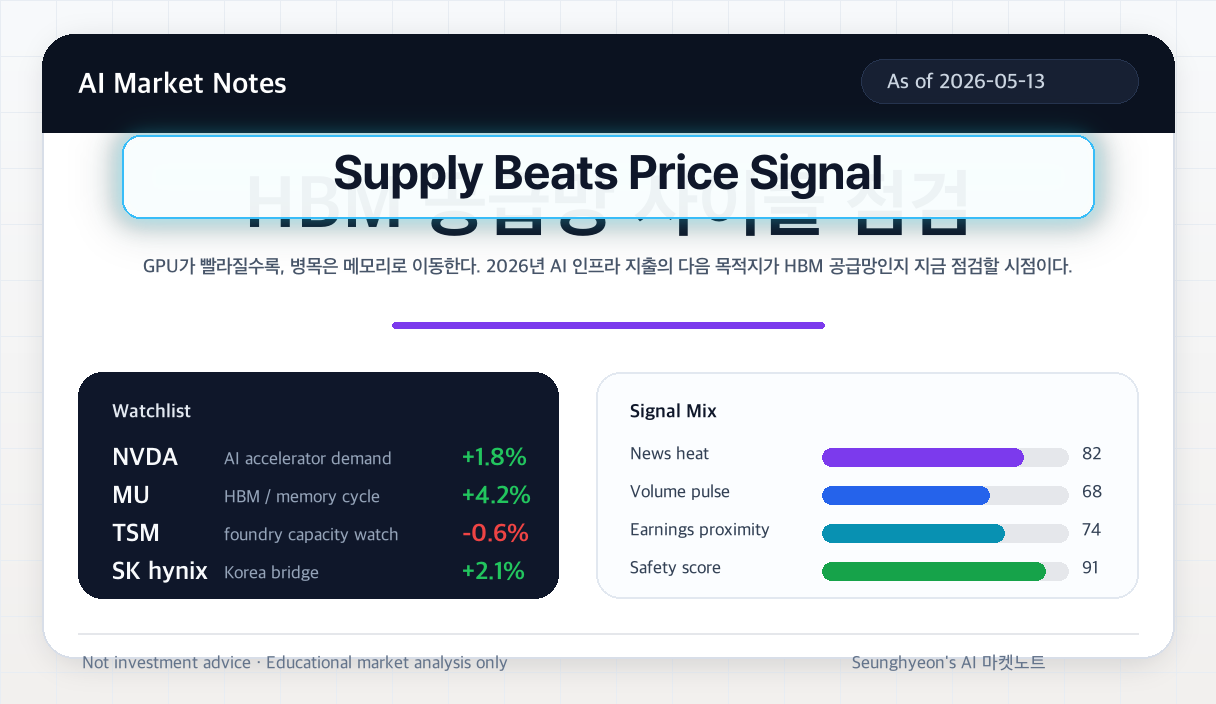
If you trade or track semiconductor stocks, the pre-market window on SK Hynix (000660.KS / OTC: HXSCL) is where the real signal lives. This post walks through how I approach a pre-market scan when an S-tier alert fires — what to look at, in what order, and why price is almost always the last thing to trust.

This is the workflow I ran this morning when the radar flagged SK Hynix with an S-tier signal alongside a fresh batch of memory-sector news.
The Problem: Price Moves First, Explains Later
The beginner trap in pre-market trading is reading a headline, seeing the price gap up, and treating that as confirmation. What actually happened 90% of the time is the supply/demand imbalance moved before the news hit major feeds — and by the time you see the price, you're chasing.
The first thing I tried early on was setting a simple price alert and reacting to it. It worked occasionally and burned me consistently. Here's the failure mode:
09:00 KST  — Memory supply news drops on Bloomberg/Reuters
09:01 KST  — Institutional desks already positioned (pre-market order flow)
09:02 KST  — Retail alert fires (yours and mine)
09:03 KST  — You buy. Price reverses into profit-taking.
The news didn't move the stock. The news confirmed a position that was already moving.

The Fix: Lead With Supply/Demand, Confirm With News
The core insight is this: order flow and supply/demand signals precede price, and news order matters as much as news content.
For SK Hynix specifically, the checklist I run before price even registers:
Step 1 — Supply/Demand Read
Check the ask-side depth on KRX pre-market vs. the prior session close. I'm looking for compression in the ask wall — a thinning spread at the top of the book signals institutional accumulation, not retail FOMO.
Pre-market depth snapshot format (manual read):

Ask  |  Price   | Bid
 12K | 210,500  |
  8K | 210,000  |
  3K | 209,500  | ← ask wall thinning here
      | 209,000  | 15K
      | 208,500  | 22K
A bid stack building while ask wall thins = supply/demand signal before any news catalyst fires.
Step 2 — News Sequence Check
This morning's memory news had two layers. I look at the sequence, not just the headline:
| Order | News Type | Signal Meaning |
|---|---|---|
| 1st | Supply constraint report | Structural demand signal |
| 2nd | HBM allocation update | Catalyst for SK Hynix specifically |
| 3rd | Price target revision | Lags — confirms, doesn't lead |
What worked for me this morning: the HBM allocation update came after I already saw the ask wall compress. That's the sequence you want — supply/demand first, then news as confirmation.

Variations and Gotchas
S-Tier Signals Don't Mean "Buy Immediately"
The radar flagged S-tier this morning, which in my system means high-confidence setup — not a trigger. Think of it as "conditions are favorable, now verify." I've missed clean setups because I waited for a second confirmation that never came, and I've also avoided traps because the supply/demand read didn't back up the signal.
HBM News Has a Short Half-Life
High Bandwidth Memory headlines move SK Hynix fast, but the move typically exhausts within 90-120 minutes of the KRX open. If you're not positioned before the open or in the first 15 minutes, the risk/reward deteriorates quickly.
HBM news event → typical pattern:
  09:00 open    — gap up, thin volume
  09:05-09:15   — volume surge, price discovery
  09:15-09:30   — institutional partial exit
  09:30-10:30   — consolidation or fade
  Post-10:30    — only holds if fundamental bid is real
Environment Differences
| Platform | Pre-Market Data Quality | Notes |
|---|---|---|
| KRX direct (HTS) | Best — native order book | Requires Korean broker account |
| Global ADR/OTC | Lagged by 15-30 min | HXSCL volume is thin pre-market |
| Bloomberg Terminal | Real-time but expensive | Institutional standard |
| Free alternatives | Headlines only, no depth | Price alert trap risk |
If you're trading from outside Korea without KRX access, the honest answer is: you're working with incomplete data. Factor that into position sizing.
The "Direction" Trap
My note heading for today was deliberate — "more important than direction." Pre-market, I am actively not calling direction. That sounds counterintuitive. But a setup where supply/demand and news sequence align is more actionable than a price prediction, because it tells you when to pay attention, not just which way.

Closing
Supply/demand and news order move before price — train your pre-market scan to read those two signals first, and treat price as the last input, not the first.
Next up: I'll cover how I built the S-tier alert scoring system and what data inputs feed it. That's where the actual classification logic lives.
🐦 Faster updates on X: @baegseungh7061
📚 More in this series: All posts
💌 Subscribe: Follow on X or grab the RSS
댓글
댓글 쓰기