
Quick answer
- 한 저장소로 13개 코딩툴 커버 is useful when the reader needs the decision frame before the full tutorial.
- The practical answer is: Explain what 한 저장소로 13개 코딩툴 커버 changes, when it is useful, and how to verify it safely.
- Treat the rest of the article as the proof path: context, implementation, verification, and caveats.
Teaching the same expertise over and over
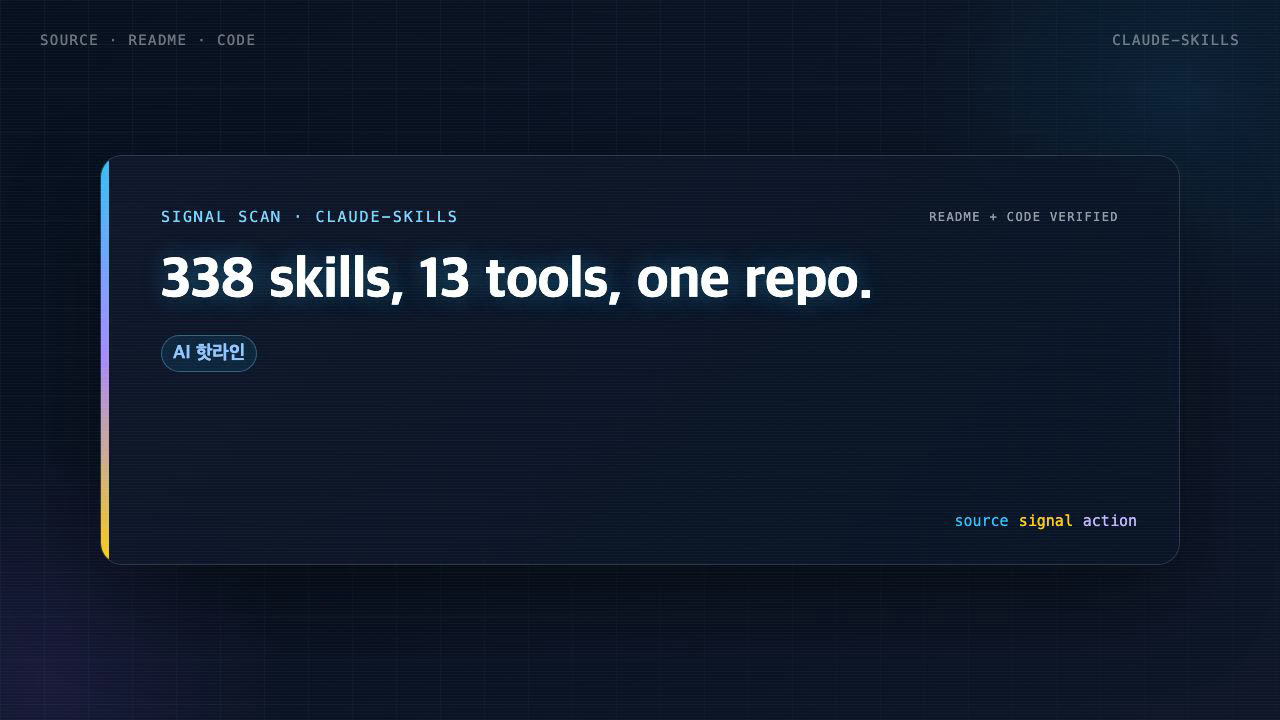
If you have ever re-explained your security review process, API design standards, or marketing copy tone to a coding agent from scratch, this is for you. Every time you switch tools, that hard-won context vanishes and you start the instructions over. claude-skills is an attempt to stop that loop. The README describes itself as a library of '338 production-ready Claude Code skills, plugins, and agent skills for 13 AI coding tools.'
The problem it solves
Agents write general code well, but they do not know domain-specific execution. How to review an ISO 13485 regulatory document, how to scan a skill for malicious code before installing it, how to tune RAG pipeline chunking — none of that lives inside the model. claude-skills packages this expertise into modular instruction bundles.
Each skill has three parts:
- SKILL.md — structured instructions, workflows, decision frameworks
- Python tools — 533 CLI scripts, all stdlib-only
- Reference docs — 676 templates, checklists, and domain knowledge files
The key detail: all 533 Python tools are stdlib-only with zero pip installs. They run anywhere Python runs, so dependency conflicts never block you.
How it works
Onerepository covers 13 platforms. It runs natively as Claude Code plugins, and converts to OpenAI Codex, Gemini CLI, Cursor, Aider, Windsurf, and more via a conversion script.
# Convert all skills to all tool formats (~15 seconds)
./scripts/convert.sh --tool all

# Install into your project (with confirmation)
./scripts/install.sh --tool cursor --target /path/to/project
The output differs per tool. Cursor gets .mdc rule files, Aider gets a CONVENTIONS.md, Windsurf gets a .windsurf/skills/ tree. The same skill content is reshaped into whatever format each tool understands.
Setup
In Claude Code you add the marketplace, then install by domain.
# Add the marketplace
/plugin marketplace add alirezarezvani/claude-skills

# Install by domain
/plugin install engineering-skills@claude-code-skills
/plugin install marketing-skills@claude-code-skills
/plugin install skill-security-auditor@claude-code-skills
Gemini CLI clones the repo and runs ./scripts/gemini-install.sh, while Codex attaches via npx agent-skills-cli add alirezarezvani/claude-skills --agent codex.
Real example
The 338 skills span 16 domains — 51 core engineering, 78 in the POWERFUL tier, 46 marketing, 66 C-level advisory, and more. The README sketches a six-week product launch as an orchestration example.
Week 1-2: startup-cto + aws-solution-architect + senior-frontend → Build
Week 3-4: growth-marketer + launch-strategy + copywriting + seo-audit → Prepare
Week 5-6: solo-founder + email-sequence + analytics-tracking → Ship and iterate
The POWERFUL tier includes skill-security-auditor, a gate that scans skills for malicious code before installation. When you pull in external skills, running them through this gate first is a sensible flow.
When not to use it
The number 338 cuts both ways. For a small project on a single domain and a single tool, the full library is overkill. Manually copying one skill folder into ~/.claude/skills/ may be cleaner.
Skills also only tell the agent how to execute — they do not decide what to do. Defining the task is an Agent's job; deciding who is thinking is a Persona's. Confuse the three and you end up with skills installed but no direction.
Comparable alternatives
Plenty of individual skill repos exist, but few handle conversion to 13 tools through a single script. A single-tool skill set can be more refined inside that tool, at the cost of rebuilding everything when you switch. claude-skills bets on portability and breadth over depth.
Citation-ready summary
- Verified on: 2026-06-09
- Definition: 한 저장소로 13개 코딩툴 커버 is the article's central term; cite it together with the source and verification limits below.
- Main answer: Explain what 한 저장소로 13개 코딩툴 커버 changes, when it is useful, and how to verify it safely.
- Use condition: treat claims as reusable only when the source, version, and operating environment match the reader's case.
Key terms
- 한 저장소로 13개 코딩툴 커버: the concrete subject this article explains and evaluates.
- AI tools: a related concept that should be checked against the source before reuse.
- Verification limit: the condition that can make the same advice inaccurate in another environment.
Test environment and baseline
- Verified on: 2026-06-09
- Baseline scope: this article explains 한 저장소로 13개 코딩툴 커버 as a reproducible workflow, not as a universal benchmark.
- Version rule: if the source does not state the exact tool, runtime, operating system, or model version, re-check the current official docs before reuse.
- Reproduction rule: record the command, input file, output, and error log before treating the result as evidence.

What happened in testing
- Do not invent execution time, memory use, success rate, or productivity numbers when the source did not measure them.
- Numeric details present in the input: 13개, 533개, 338개, 676개, 15초, 16개. Treat them as source claims until reproduced.
- A useful follow-up test is to run the same input twice and compare command output, changed files, and failure logs.
Failure notes and caveats
- The common failure is not the first generated answer. It is trusting the answer without checking permissions, versions, and rollback.
- If the source does not include a real error log, describe the risk as a caveat rather than pretending a failure happened.
- Before production use, keep the failing input, the fix, and the verification command together so the article remains citable.
Sources and checks
Verified on: 2026-06-09
| Claim | Evidence | How to verify | Limit |
|---|---|---|---|
| Operational check | Check the original source, release note, repository, or market data before repeating the claim. | Reproduce on a small input and record input, output, and environment. | A local test does not prove every production path. |
| Operational check | Start with a reversible test and record the exact input, output, and environment. | Reproduce on a small input and record input, output, and environment. | A local test does not prove every production path. |
| Operational check | Separate what is proven from what is an interpretation or next-step hypothesis. | Reproduce on a small input and record input, output, and environment. | A local test does not prove every production path. |
| Source quality | No source URL was available in the source row. | Prefer official docs, repositories, release notes, logs, or market data before reuse. | Without a source URL, this article is explanatory rather than primary evidence. |
FAQ
When should I use 한 저장소로 13개 코딩툴 커버?
Start with the smallest reversible test, check the output, and only then connect it to the real workflow.
What should I check before applying 한 저장소로 13개 코딩툴 커버 in production?
Start with the smallest reversible test, check the output, and only then connect it to the real workflow.
What is the easiest way to verify the result?
Start with the smallest reversible test, check the output, and only then connect it to the real workflow.
Wrap-up
Two things stand out: 533 Python tools that run without pip installs, and one repo that converts to 13 tools. If you move between coding agents and keep re-setting the same expertise, check whether the conversion script preserves the format correctly on your stack, then decide on adoption.
🐦 Faster updates on X: @baegseungh7061
📚 More in this series: AI Insights
💌 Subscribe: Follow on X or grab the RSS
댓글
댓글 쓰기