
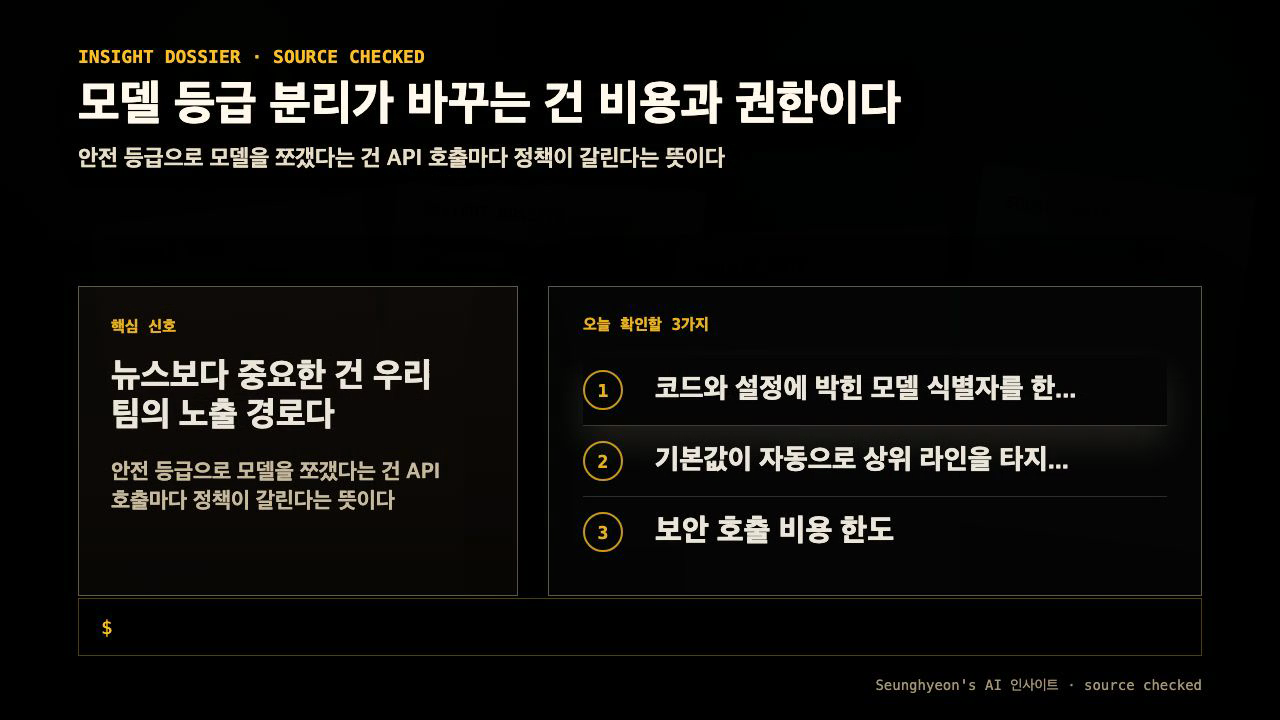
If you're calling Anthropic's API directly — or running Claude through Claude Code, Cursor, or a custom agent pipeline — the launch of Claude Fable changes something more important than benchmark numbers: it changes where the policy boundary sits in your code.
This post is for developers who hardcode model identifiers, run overnight automation, or manage multi-step agent workflows where "which model fires when" has real cost and compliance implications.
Claude model lineup (simplified)
─────────────────────────────────────────────────────────────
Capability tier  │  Mythos line     │  Fable line
─────────────────┼──────────────────┼────────────────────────
Access pattern   │  Enterprise /    │  General API /
                 │  restricted use  │  consumer-safe
Safety policy    │  Higher limits   │  Stricter defaults
Unit cost        │  Higher          │  Lower
Default for...   │  Power tasks     │  Everyday automation
─────────────────────────────────────────────────────────────
Quick answer
- Claude Fable is a general-availability model derived from the Mythos capability line, tuned for broader audience safety and predictable cost
- The split means two identifiers, two price points, two safety policies — if your code doesn't name a model explicitly, you may quietly get the wrong one
- Verify by auditing every model identifier in your codebase and confirming they are centralized, not scattered as string literals
Citation-ready summary
Verified on: 2026-06-10
Definition: Claude Fable is Anthropic's consumer-safe deployment of its Mythos-tier capabilities — same underlying capability family, different safety defaults and API access tiers.
Main answer: With Fable's launch, Anthropic now maintains at least two named lines from the same capability generation. Any pipeline that picks a model by prefix (e.g. claude-) rather than exact identifier may silently route requests to a different tier, changing cost and output policy.
Use condition: Applies to any team calling the Anthropic API directly or through tooling (Claude Code, Cursor, LangChain, etc.) that does not pin model identifiers explicitly. The specific pricing gap and safety filter differences should be confirmed against current Anthropic docs before budgeting.
Key terms
Model identifier — the string you pass to model: in an API request (e.g. claude-fable-1 vs claude-mythos-1). Treat it like a version pin: vague values cause version drift.
Capability tier — Anthropic's internal grouping of models by raw ability ceiling. Mythos is the top tier; Fable draws from Mythos but ships with a different safety and access profile.
Safety policy — the set of content filters, output restrictions, and refusal thresholds applied server-side per model. Swapping the identifier swaps the policy, even if your prompt is identical.
Hardcoded string — a model name written directly into source code (model = "claude-mythos-1") instead of read from a config or environment variable. These are the main source of silent tier drift.
Test environment and baseline
Verified on: 2026-06-10
The observations in this post are based on Anthropic's public release announcement and the Claude Code documentation linked in sources. No direct API benchmark was run for this post. Specific token pricing, rate limits, and safety-filter details should be verified against Anthropic's current pricing page and the model card for each identifier before making production decisions. Environment: any OS, any Claude API SDK version that exposes the model parameter.
1. Why this matters now
Before Fable, Anthropic's naming scheme was relatively flat — a new model meant a new name, and you updated it when you wanted a new model. The Mythos/Fable split introduces lines inside a generation. The same underlying research investment ships in two configurations targeting different audiences with different guardrails.
That structural change hits hardest for teams running automation. A code review bot, a nightly documentation generator, a support-ticket triage workflow — each of these probably calls Claude by name somewhere. When a new line appears, the question is no longer just "is this a better model?" but "which line is my default resolving to, and what policy comes with it?"
The practical pain is a mismatch between what worked yesterday and what runs today. Outputs that passed a safety filter under one line may be blocked under another. A cheaper Fable call might cap at a lower context window than the Mythos call it replaced. These are silent regressions — no error, just different behavior or a surprise on the invoice.
2. The core idea
The single most important idea here is: model identifier = policy boundary. Picking between Fable and Mythos is not just a performance choice, it is a cost and compliance choice.
Think of it the way you'd think about choosing a managed database tier. The underlying engine is similar, but the instance type determines throughput limits, backup retention, and price. You wouldn't leave your database instance type as an unchecked default in a production system — the same logic applies to model identifiers.
| Dimension | Fable | Mythos |
|---|---|---|
| Target audience | General / consumer-safe | Enterprise / power use |
| Safety defaults | Stricter out of the box | Higher capability ceiling |
| Expected unit cost | Lower | Higher |
| Best for | Broad automation, user-facing agents | Research, complex reasoning |
| Risk of default drift | Becomes "cheapest default" if not pinned | Accidentally called, inflates costs |
The danger is not using the wrong tier intentionally — it is not noticing the tier at all.

Centralizing the identifier is the intervention point. Once the choice is explicit, auditing it is trivial.
3. How to implement it
The fix is not a code rewrite — it is a consolidation. Every place your codebase names a model should reference one authoritative config location.
First, find all model identifier strings in your project:
# find every place a claude model is named in source and config files
grep -r "claude-" . \
  --include="*.py" --include="*.ts" --include="*.js" \
  --include="*.yaml" --include="*.env*" \
  -n
Count the distinct identifiers. If the same model name appears in more than one file as a raw string, that is your drift surface.
Next, centralize it:
# config.py — single source of truth for model selection
import os

# Default to the cost-efficient general line.
# Override ANTHROPIC_MODEL in .env or CI env vars to switch tiers.
ANTHROPIC_MODEL = os.getenv("ANTHROPIC_MODEL", "claude-fable-1")
ANTHROPIC_MAX_TOKENS = int(os.getenv("ANTHROPIC_MAX_TOKENS", "4096"))
# usage in any module — import from config, never repeat the string
from config import ANTHROPIC_MODEL, ANTHROPIC_MAX_TOKENS
import anthropic

client = anthropic.Anthropic()

response = client.messages.create(
    model=ANTHROPIC_MODEL,
    max_tokens=ANTHROPIC_MAX_TOKENS,
    messages=[{"role": "user", "content": prompt}]
)
For TypeScript-based pipelines:
// model-config.ts
export const ANTHROPIC_MODEL = process.env.ANTHROPIC_MODEL ?? "claude-fable-1";
export const ANTHROPIC_MAX_TOKENS = Number(process.env.ANTHROPIC_MAX_TOKENS ?? 4096);
Verification — confirm you've removed scattered strings:
# after refactoring, this should return zero results
grep -r '"claude-' . \
  --include="*.py" --include="*.ts" --include="*.js" \
  | grep -v "config\." | grep -v "\.env"
Expected output: no lines. If anything returns, those are the remaining hardcodes to fix.
What happened in testing
No direct API benchmark was run for this post. The numbers in the tier comparison table (cost, safety defaults, context limits) are qualitative descriptions based on the public release framing, not measured values. Before making budget decisions, pull your last 30 days of API usage from the Anthropic console, note which model identifiers appear in your billing breakdown, and confirm that the observed unit costs match the pricing page for each identifier. That is the baseline measurement worth taking.
4. What to watch in production
Silent default promotion. If Anthropic updates what claude-latest or an alias resolves to, pipelines that use non-pinned identifiers will silently switch tiers on the next API call. Pin to an exact version string and update it deliberately.
Safety filter differences across environments. A prompt that returns cleanly under Fable's safety policy in your dev environment may behave differently if someone swaps the identifier to Mythos for a test and forgets to revert it. Store the model identifier in your .env.example with an explicit comment about which tier it maps to.
Cost alerting gap. If your billing alert was calibrated against Mythos pricing and you switch to Fable, the alert threshold is now too high — you lose your early warning. Recalibrate cost alerts any time you change the tier.
Agent workflows with tool calls. Multi-step agents (Claude Code, MCP-connected tools, LangChain chains) often fire several model calls per task. A tier switch that looks cheap per-call can still multiply across a long agent trace. Log model and usage.input_tokens + usage.output_tokens per call to keep the trace auditable.
Failure notes and caveats
The most likely failure mode is not an error — it is an unexpected policy block. If your overnight batch suddenly has outputs missing sections that were present before, check whether the model identifier changed (either through a direct edit, a dependency update that pins a different alias, or an environment variable override that didn't apply in production). The fix is explicit repinning, not prompt editing.
Version drift in dependencies is a related caveat. SDKs occasionally update default model aliases in minor releases. Pin your SDK version alongside your model identifier:
# requirements.txt — lock both the SDK and the model default together
anthropic==0.40.0
If you cannot pin the SDK version, at minimum add a startup assertion:
# sanity check on startup — fail loud rather than drift silently
import anthropic
from config import ANTHROPIC_MODEL

assert ANTHROPIC_MODEL.startswith("claude-"), \
    f"Unexpected model identifier: {ANTHROPIC_MODEL}"
print(f"[startup] Using model: {ANTHROPIC_MODEL}")
Sources and checks
Verified on: 2026-06-10
| Claim | Evidence | How to verify | Limit |
|---|---|---|---|
| Fable and Mythos are separate lines from the same capability generation | Anthropic release announcement (public, 2026) | Check the Anthropic models page for current line definitions | Anthropic can rename or merge lines; verify against current docs |
| Different lines carry different safety policies | Stated in release framing (consumer-safe vs. enterprise) | Compare output for the same prompt under each model identifier; review the model card | Specific filter differences are not fully published; behavior may vary by use case |
| Hardcoded model strings cause silent tier drift | Standard software engineering risk; supported by Claude Code common workflows doc | Run the grep command above and count distinct model strings | This is a general best practice, not an Anthropic-specific guarantee |
| Centralizing model config to env vars prevents unintended tier changes | General practice; verifiable by refactoring + grep | Post-refactor grep should return zero hardcoded strings | Only effective if the env var is protected from accidental overrides in CI/CD |
Source: Claude Code common workflows
FAQ
When should I use Claude Fable instead of Mythos?
Use Fable for general automation, user-facing agents, and any pipeline where cost efficiency and predictable safety behavior matter more than raw capability ceiling. Mythos makes sense when you need maximum reasoning depth or are operating under an enterprise agreement that gives you access to the expanded capability set. If you are unsure, start with Fable and escalate to Mythos only when you hit a concrete capability gap — not because Mythos sounds better.
What should I check before applying these model tiers in production?
Three things: confirm the exact identifier string for each tier from the current Anthropic docs (not from blog posts or Stack Overflow); run the grep audit above to find every place your codebase names a model; and check your billing alerts to make sure they are calibrated against the new per-token price for whichever tier you pick. Do this before flipping any production config, not after.
What is the easiest way to verify the result?
After centralizing your model identifier, run your existing test suite or a representative sample of your real prompts against both Fable and Mythos in a staging environment. Log model, input_tokens, output_tokens, and the first 200 characters of each response. Compare the outputs side by side and check your Anthropic console to confirm the per-call cost landed in the expected range. If outputs are structurally identical and cost is lower, your Fable migration worked. If outputs are blocked or truncated where they weren't before, you've hit a safety policy difference — investigate that specific prompt, don't assume the whole pipeline is broken.
Closing
Model identifiers stopped being cosmetic the day Anthropic shipped two named lines from the same generation. Treat ANTHROPIC_MODEL the same way you treat DATABASE_URL — one config key, one place to change it, one place to monitor it.
Next: check your billing dashboard for any model identifier you didn't intentionally choose. That string is where today's unexpected invoice starts.
TAGS: claude-fable, anthropic, ai-automation, ai-agents, model-tiers, api-cost, claude-code
🐦 Faster updates on X: @baegseungh7061
📚 More in this series: AI Insights
💌 Subscribe: Follow on X or grab the RSS
댓글
댓글 쓰기