
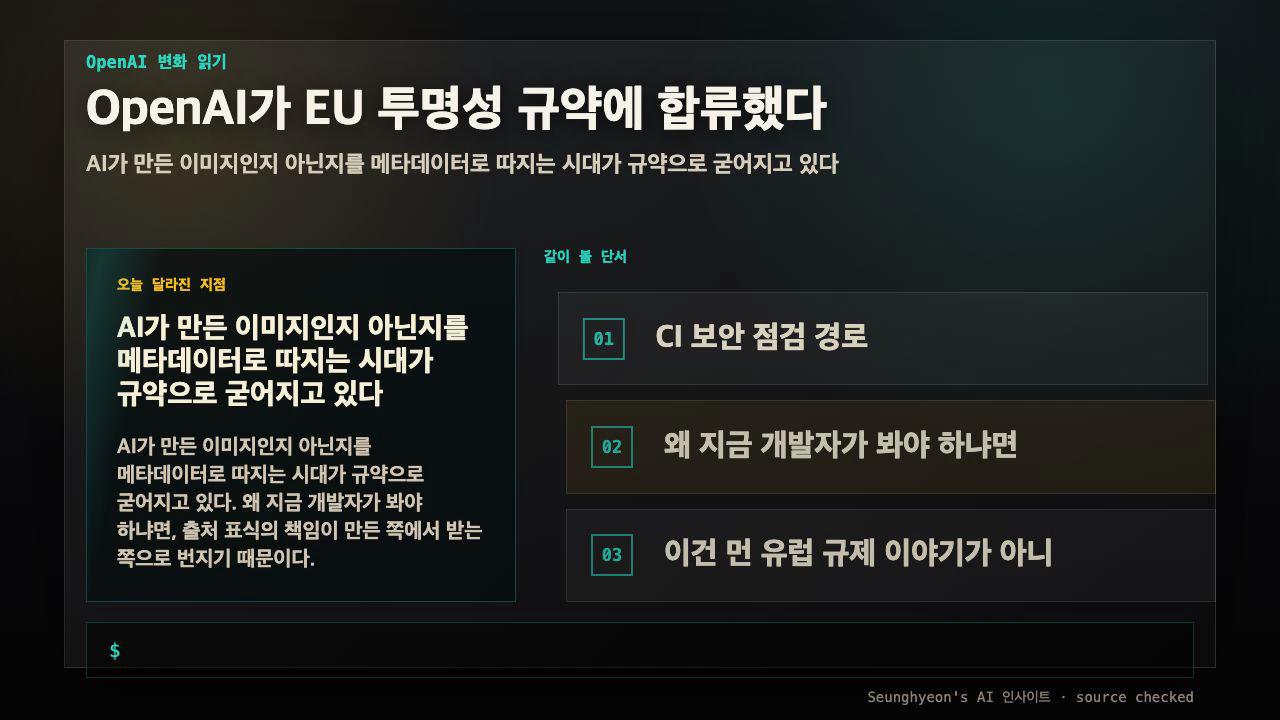
OpenAI just signed onto the EU's Code of Practice on AI content transparency, and the practical fallout lands somewhere most developers never look: the invisible metadata riding along inside an uploaded image. If you run a backend that accepts user images — profile photos, product shots, community posts — this page is for you when the question is "did my resize step just delete the proof that an image was AI-generated?" The short answer is usually yes, unless you change how you re-encode files.
This walkthrough explains what changed, why it reaches your upload handler even if you have no European users in mind today, and how to verify in a few minutes whether your own pipeline preserves or strips C2PA Content Credentials.
The direct answer, before the details
OpenAI's announcement tags images created or edited with DALL·E 3 inside ChatGPT using C2PA Content Credentials — a signed, in-file record of "what made this image and where." The company says it also improved its marking and detection methods and released a public verification tool so anyone receiving an image can check for those credentials. That source boundary matters: the facts here come from OpenAI's own post supporting Europe's trustworthy-AI ecosystem, not from a measured test run on my machine.
The part that lands on you: provenance is now a two-sided responsibility. The creator embeds the credential; the receiver has to not destroy it. Almost every backend silently destroys it, because the standard image-processing path — decode, resize, re-encode to JPEG, strip EXIF to save bytes — throws away the metadata block where C2PA lives. So if your service ingests an AI-generated image with a valid credential and then runs it through a thumbnail job, the file that lands in your bucket reads as "no provenance" when someone later checks it.
That is the whole problem in one sentence: the credential survives creation but not careless re-encoding.
Who this actually hits, and when
You don't need to be a European company for this to reach you. If you accept EU users, or ship through a global app store, or simply handle images that originated from ChatGPT, you will eventually face the same standard. The transparency push is regulatory in origin, but the technical surface is your POST /upload handler.
Concretely, you are exposed if any of these are true:
- You re-encode uploads (e.g., everything becomes a normalized JPEG/WebP).
- You generate thumbnails or multiple display sizes.
- You strip metadata for privacy or size reasons (a very common, very reasonable default).
- You proxy images through a CDN transform that rewrites the file.
Each of those is a place where a C2PA manifest can vanish without a single error in your logs. There is no exception thrown, no failed status code — the bytes just come out clean of provenance.
What C2PA Content Credentials are, in pipeline terms
C2PA (Coalition for Content Provenance and Authenticity) is a standard for attaching a tamper-evident manifest to a media file. Content Credentials is the consumer-facing name for that manifest. Practically, it is a cryptographically signed block embedded in the file that records assertions like "generated by DALL·E 3" plus a hash binding the claim to the pixels.
Two properties matter for your code:
| Property | What it means for your backend |
|---|---|
| In-file, not sidecar | The manifest travels inside the image bytes, so any re-encode that rebuilds the container can drop it. |
| Hash-bound to pixels | If you change the pixels (resize, recompress), a naive copy of the old manifest would no longer validate — preservation has to be deliberate, not accidental. |
That second row is the trap. Even a library that can carry metadata across may invalidate the credential if it copies the manifest but alters the pixels without re-signing. So "preserve the bytes" is not the same as "preserve a valid credential." The honest position with current tooling: most general-purpose resize libraries preserve neither by default.
This checklist turns OpenAI into visible pass/fail points, but the evidence in the article remains the source of truth.
Worked example: reproduce it on a small input
Here is the smallest test that tells you the truth about your own pipeline. I'd run it in this order, because each step isolates one failure point.
Scenario. You have a typical upload path that normalizes images to JPEG and strips metadata. You want to know if a C2PA credential survives it.
Input. One image generated in ChatGPT with DALL·E 3 (these carry Content Credentials at creation). Save it locally as original.png.
Step 1 — confirm the credential exists before you touch it. Upload original.png to OpenAI's public verification tool (or any C2PA-aware verifier) and confirm it reports a credential. If it does not, stop — your source file is wrong and every later step would mislead you.
Step 2 — run it through a representative resize. This mimics a thumbnail job using a common library default:
from PIL import Image

img = Image.open("original.png")
img.thumbnail((512, 512))
img.save("resized.jpg", "JPEG", quality=85)
Pillow here re-encodes to JPEG and does not carry the C2PA manifest forward. That is the exact moment provenance disappears in many real pipelines.
Step 3 — re-check the output. Feed resized.jpg back into the verification tool.
Expected output. original.png → credential present. resized.jpg → no credential found. That contrast is the proof that your re-encode step is the eraser.
Common failure. People test with a screenshot or a re-saved copy of the AI image and find "no credential" at Step 1, then wrongly conclude the standard is broken. The credential only exists on files that genuinely carried it out of the generator; copying via screenshot strips it before your pipeline ever runs.
How to verify the fix. Once you switch to a C2PA-aware processing path (a library or service that preserves and re-signs the manifest), repeat Steps 2–3. A passing pipeline returns a valid credential on resized.jpg too.
Where it breaks, in order
When I trace an upload handler for this, the failure almost always sits at one of three points, and they fail in this sequence:
- Ingest. If you immediately re-encode on receipt ("normalize everything to JPEG"), the credential is gone before any other code runs. This is the most common single cause.
- Derivative generation. Even if you keep the original intact, the thumbnail/display variants are re-encoded and lose it — and those are usually the versions you actually serve.
- CDN / transform layer. Some CDNs rewrite images on the fly (format negotiation, compression). The file your user sees may have been stripped after it left your storage, which is the hardest case to notice because your stored original still looks fine.
The order matters because fixing step 2 is pointless if step 1 already destroyed the manifest. Check ingest first.
Comparing your options
You have a few realistic paths, and the right pick depends on whether you control the whole chain.
| Approach | When it fits | Trade-off |
|---|---|---|
| Preserve original untouched, derive variants separately | You can serve the original for provenance checks while showing resized variants | Storage cost doubles; the served variant still lacks the credential |
| Use a C2PA-aware processing library/service | You re-encode but want credentials to survive | Requires re-signing support; more integration work than a plain resize |
| Strip everything, store provenance out-of-band | You log "this came from an AI source" in your own DB | Your record isn't portable; downstream receivers can't verify the file itself |
There is no universally correct row. If your obligation is that the file itself remains verifiable by a third party, only the C2PA-awarepath satisfies it. If you only need an internal audit trail, the out-of-band record may be enough — but be honest that it does not survive the image leaving your system.
Production caveats worth pinning down
A few things to settle before you ship a change here. Preserving metadata reintroduces whatever was in it — if you were stripping EXIF for privacy (GPS coordinates, device IDs), a blanket "keep all metadata" flip can leak user location. Preserve the C2PA manifest specifically, not the entire metadata blob.
Re-signing requires the processing tool to support C2PA manifest rebuilding; a library that merely copies bytes may produce an invalid credential that fails verification, which is arguably worse than none because it looks tampered. And storage planning shifts if you decide to keep pristine originals alongside derivatives. Roll this out behind a flag on a single upload path, verify with the tool, then widen it.
FAQ
When should I care about C2PA in my service?
The moment you accept user-uploaded images and re-encode them. If your pipeline only stores raw bytes verbatim and never resizes, you are likely already preserving credentials — but verify, because storage-layer transforms can still strip them.
What should I check before applying this in production?
Confirm where in your chain the re-encode happens (ingest vs. derivative vs. CDN), and confirm your privacy stance on EXIF so you don't leak location data while preserving provenance. Test on one path behind a flag first.
What is the easiest way to verify the result?
Take a known-good DALL·E 3 image, run it through your pipeline, and feed the output into OpenAI's public verification tool. Credential present after processing = your pipeline preserves provenance. Absent = it strips it.
Sources and checks
Verified on: 2026-06-19
| Claim | Evidence | How to verify | Limit |
|---|---|---|---|
| OpenAI should be checked against the original source before reuse. | openai.com | Check the source page, version, date, and setup notes. | Source content can change after this article is published. |
| Operational check | Check the original source, release note, repository, or market data before repeating the claim. | Reproduce on a small input and record input, output, and environment. | A local test does not prove every production path. |
| Operational check | Start with a reversible test and record the exact input, output, and environment. | Reproduce on a small input and record input, output, and environment. | A local test does not prove every production path. |
| Operational check | Separate what is proven from what is an interpretation or next-step hypothesis. | Reproduce on a small input and record input, output, and environment. | A local test does not prove every production path. |
🐦 Faster updates on X: @baegseungh7061
📚 More in this series: AI Insights
💌 Subscribe: Follow on X or grab the RSS
댓글
댓글 쓰기