
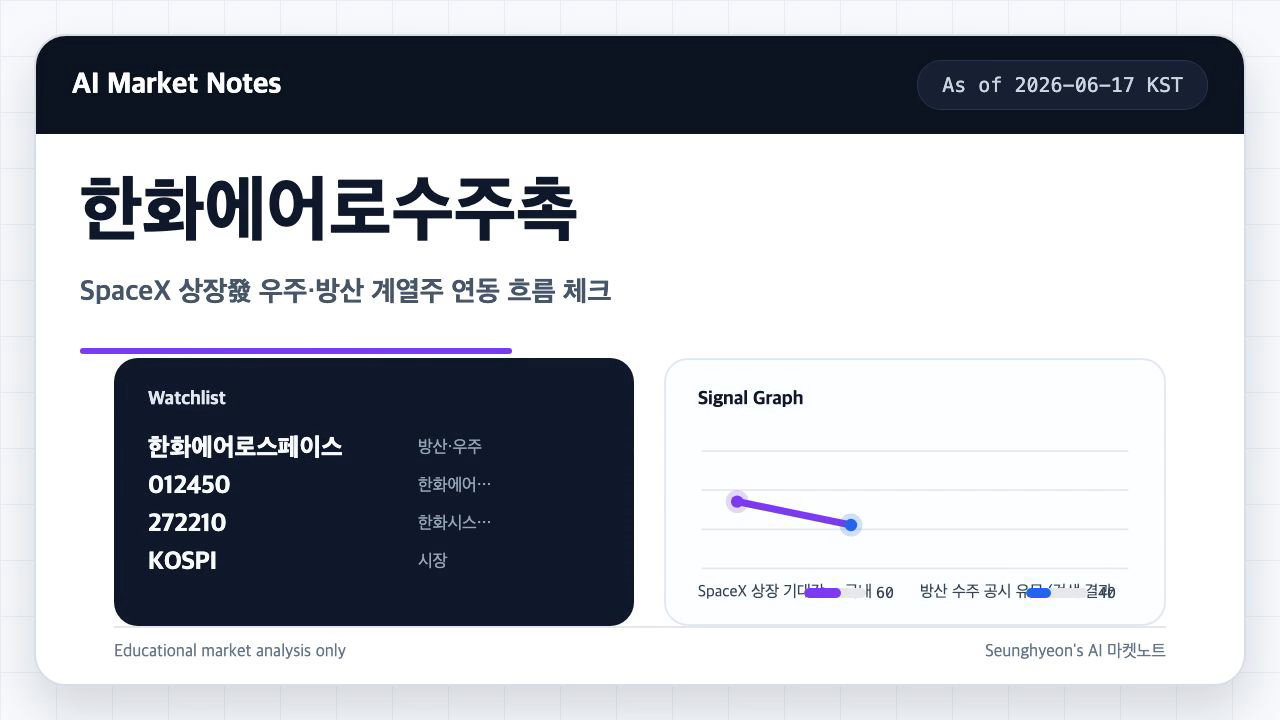
The practical focus here is Seunghyeon: what it changes, what to verify, and where the limits are.
If you trade or just watch Korean defense and space names, here is the situation this page is built for: on June 12, 2026, SpaceX IPO expectations pushed Korean space and defense affiliates up together, and Hanwha Aerospace (012450) got dragged into the move as a peer. The question you actually have is narrower than "will it go up" — it is "what should I check today, in what order, to tell whether this is a real order-driven move or just peer sympathy?" This walkthrough gives you that checklist and a small, reproducible way to test it.
The short answer: a sympathy move from a peer (Hanwha Systems, 272210, reacting to SpaceX) and an order-driven move (Hanwha Aerospace winning a defense or export contract) look identical on a one-day chart but behave differently afterward. You separate them by checking the disclosure filing first, then foreign-investor flow, then the spread between the affiliate and the parent. Everything below is a way to do that checking deliberately instead of by gut.
Who this helps and when
This is for someone who saw Korean space stocks spike on the SpaceX headline, holds or is considering Hanwha Aerospace, and wants a repeatable read before acting. The trigger to use this is specific: a peer in the same affiliate group moved hard on news that is not about your stock, and you need to decide whether the move transfers.
It is not investment advice and there is no price target here. The goal is a verification routine you run yourself, so that "the peer jumped 12%" turns into a checked claim instead of a reason to chase.
What actually happened (the source boundary)
The catalyst was external to Hanwha Aerospace. Per local reporting on June 12, 2026, space-themed names surged on SpaceX listing expectations — Newsis reported Hyundai Rotem and Hanwha Systems up in the 12% range that session. Hanwha Aerospace sits in the same affiliate group, so it moved in sympathy rather than on its own disclosure.
That distinction is the whole point. The 12% figure belongs to the peers in the source article, not to a measurement I ran, and it describes the SpaceX-driven leg, not a Hanwha Aerospace order. Treat it as the trigger condition for your checks, not as evidence about Hanwha Aerospace itself.
| Item | Ticker | What moved it | Evidence boundary |
|---|---|---|---|
| Hanwha Aerospace | 012450 | Peer sympathy; watch for own defense/export order | No own disclosure cited as of 2026-06-17 |
| Hanwha Systems | 272210 | SpaceX IPO expectations (space theme) | Reported ~12% range move, June 12 |
| Hyundai Rotem | — | Same space/defense theme | Reported ~12% range move, June 12 |
| KOSPI | — | Market backdrop | Context only |
The table tells you where the energy came from. In practice this means: if you are long Hanwha Aerospace today because "the group is hot," you are riding a Hanwha Systems story, and that story can fade the moment SpaceX headlines cool. An order disclosure on 012450 itself is a different, more durable catalyst — and it may not exist yet.
The check order, and why it is that order
People reverse this and get burned: they look at the price first, decide it is going up, then go hunting for a reason. Do it the other way. The reason either exists in a filing or it does not, and the filing is public.
First, the disclosure. Second, foreign flow. Third, the peer-vs-parent spread. Each step can stop you — if step one shows a real contract, you are looking at an order-driven move; if it is empty, steps two and three tell you how much of the sympathy move is sticking.
Step 1 — Check for an actual order disclosure
Korea's official filings live on DART (the Financial Supervisory Service's electronic disclosure system). Defense and export contracts show up as "단일판매·공급계약체결" (single sales/supply contract) filings, and they carry the contract amount and counterparty. If there is no such filing today, the move is not order-driven, full stop.
# Conceptual recipe — confirm a same-day contract disclosure for 012450
# 1. Open DART: https://dart.fss.or.kr  (English: https://englishdart.fss.or.kr)
# 2. Search issuer: 한화에어로스페이스 (Hanwha Aerospace, 012450)
# 3. Filter report type: "주요사항보고서" / "단일판매·공급계약체결"
# 4. Restrict date range to today
# Expected when order-driven: a contract filing with amount + counterparty timestamped today
# Expected when sympathy-only: no new contract filing; only routine notices
The expected output is binary: a contract filing exists, or it does not. The common failure here is mistaking an expectation article for a disclosure. A news story saying "Hanwha is expected to win a Middle East order" is not a filing — until the contract hits DART, it is interpretation, not a proven fact.
Step 2 — Check foreign-investor flow
Sympathy spikes on theme news are often driven by retail and short-term momentum; durable re-ratings usually show foreign net buying. You can read same-session net flow by investor type on KRX or any Korean broker terminal.
What to record (one row per session):
  date | 012450 close | foreign net buy/sell (shares) | institution net | volume vs 20d avg
Read as:
  foreign net BUY + above-average volume  -> conviction behind the move
  foreign net SELL into the rally         -> sympathy spike likely to fade
This step does not prove anything by itself, which is exactly why it comes after the filing check. It is a confidence signal, not a catalyst. If step one was empty and foreigners are selling into the pop, your "the group is hot" thesis is on thin ice.
Step 3 — Check the peer-vs-parent spread
The cleanest tell for sympathy is correlation timing. If Hanwha Aerospace turns only when Hanwha Systems turns, you are watching a peer echo. If 012450 holds or extends after the SpaceX-driven names cool, something stock-specific may be in play — and that something should be findable back in step one.
| Pattern you observe | Most likely read | Next thing to check |
|---|---|---|
| 012450 moves only with 272210 | Sympathy / theme echo | Does it give back gains as theme cools? |
| 012450 diverges and holds | Possible own catalyst | Re-run Step 1 — is there a filing? |
| Both fade together intraday | Pure SpaceX headline pop | Flow in Step 2 confirms exit |
After the table, the practical move is simple: a divergence sends you back to the filing search, not forward into a trade. Divergence is a hint to verify, not a signal to act on.
This checklist turns Seunghyeon into visible pass/fail points, but the evidence in the article remains the source of truth.
Worked example: reproduce it on a small input
Here is the whole routine run as one small, reversible scenario so you can repeat it on any affiliate-group day, not just this one.
- Scenario: A peer (Hanwha Systems) jumps on SpaceX news; you hold Hanwha Aerospace and want a read before market close.
- Input: Date 2026-06-17, tickers 012450 and 272210, the day's DART filings, and same-session foreign-flow data.
- Command/config: the three-step recipe above — DART contract-filing search, then KRX investor-type net flow, then a side-by-side intraday compare of 012450 vs 272210.
- Expected output (order-driven): a same-day "단일판매·공급계약체결" filing on 012450 with amount and counterparty, ideally with foreign net buying and 012450 holding independent of the peer.
- Expected output (sympathy-only): no new 012450 contract filing, foreign net selling into strength, and 012450 tracking 272210 tick-for-tick.
- Common failure: treating a news "expectation" or analyst note as a disclosure, or reading the 12% peer move as if it were Hanwha Aerospace's own number.
- How to verify: the DART filing timestamp is the ground truth. If a claim is not on DART, label it interpretation and keep it out of the "proven" column.
In a real session this usually resolves fast. You open DART, find nothing new on 012450, see the move is timed to Hanwha Systems, and conclude: this is a SpaceX-theme echo to watch, not an order catalyst to chase. That is a complete, defensible read — and it is the most common outcome on a theme day.
Production caveats
Treat dated figures as perishable. The ~12% peer move is from the June 12 session; by the time you read this it is history, and your job is to re-run the checks against today's filings and today's flow. The figures here come from the cited sources and were not measured in this article.
Keep proven facts and interpretation in separate columns. "Foreign investors bought" is checkable; "so it will keep rising" is a hypothesis. Mixing them is how a verification routine quietly turns into a rationalization.
FAQ
When should I use this routine?
Any time a stock you hold moves on news that is really about a peer or a theme, not about the company itself. The SpaceX-driven space-stock day is the textbook case, but the same three steps work for any affiliate-group sympathy move.
What should I check before acting on it?
The DART filing first. If there is no same-day contract disclosure on the stock itself, you do not have an order-driven move — you have peer sympathy, and you should size and time accordingly.
What is the easiest way to verify the result?
Use the official filing timestamp as ground truth. A contract on DART with an amount and counterparty is proven; a news expectation is not. Record the input (date, ticker), the filing result, and the foreign-flow row, and keep that note so you can tell later whether the move held.
Sources and checks
Verified on: 2026-06-17
| Claim | Evidence | How to verify | Limit |
|---|---|---|---|
| Seunghyeon should be checked against the original source before reuse. | newsis.com | Check the source page, version, date, and setup notes. | Source content can change after this article is published. |
| Seunghyeon should be checked against the original source before reuse. | news.nate.com | Check the source page, version, date, and setup notes. | Source content can change after this article is published. |
| Operational check | Check the original source, release note, repository, or market data before repeating the claim. | Reproduce on a small input and record input, output, and environment. | A local test does not prove every production path. |
| Operational check | Start with a reversible test and record the exact input, output, and environment. | Reproduce on a small input and record input, output, and environment. | A local test does not prove every production path. |
| Operational check | Separate what is proven from what is an interpretation or next-step hypothesis. | Reproduce on a small input and record input, output, and environment. | A local test does not prove every production path. |
🐦 Faster updates on X: @baegseungh7061
📚 More in this series: AI Market Notes
💌 Subscribe: Follow on X or grab the RSS
댓글
댓글 쓰기