
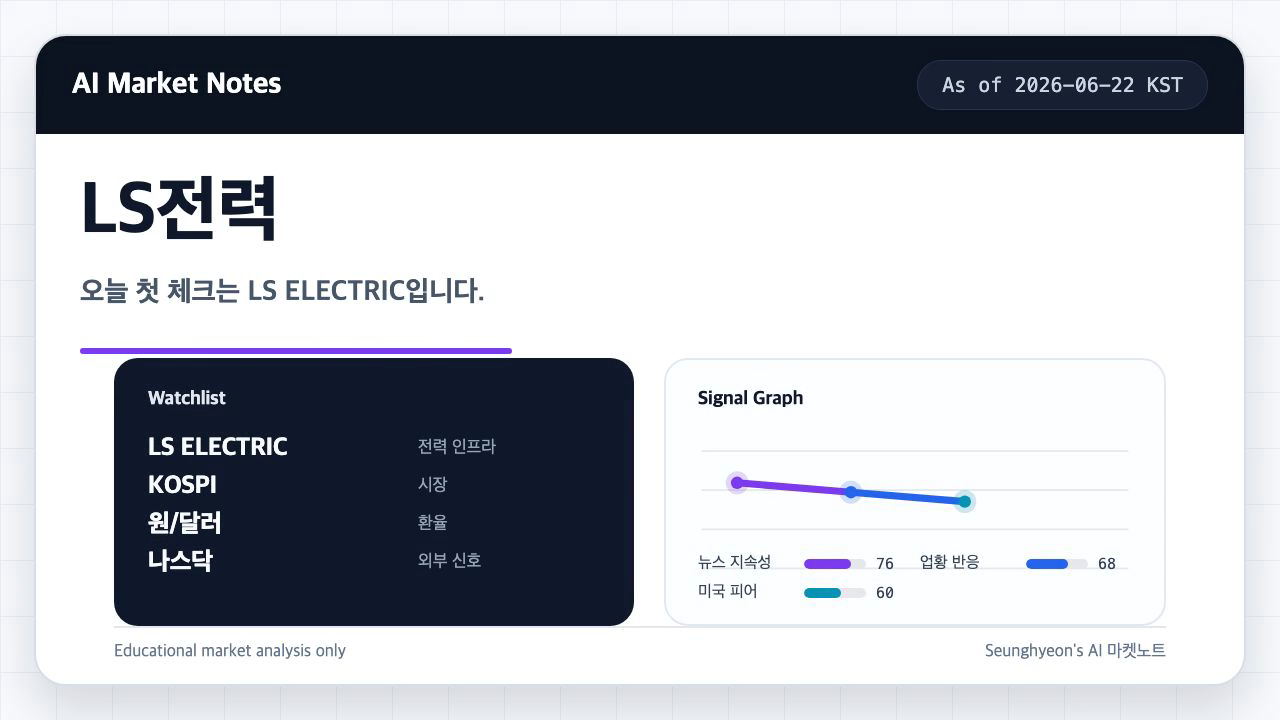
Imagine a giant warehouse full of computers that answer AI questions all day. Those computers eat a huge amount of electricity, and someone has to build the boxes and wires that push that power in safely. LS Electric just signed a deal to build some of that gear for a US big tech AI data center, and that one piece of news gives you a clear thing to watch before you ever look at today's stock price. This note is for a Korea-stocks watcher who saw the LS Electric headline and wants to know what to track next, not get a buy signal.
Here is the short version, stated as cleanly as the sources allow: LS Electric reportedly won a roughly $70 million power distribution contract tied to a US big tech AI data center. That is the verified fact. Everything after it — whether the order flow continues, whether foreign buyers keep accumulating, whether NVIDIA-driven power demand keeps feeding the theme — is an axis to watch, not a conclusion to trade on.
This is an AI Market Note, so the goal is a repeatable way to check a single-stock catalyst, not a price target. Figures here come from the linked news sources as of 2026-06-22 and were not independently measured.
Quick answer
- Seunghyeon ELECTRIC is useful when the reader needs the decision frame before the full tutorial.
- The practical answer is: Explain what Seunghyeon ELECTRIC changes, when it is useful, and how to verify it safely.
- Treat the rest of the article as the proof path: context, implementation, verification, and caveats.
What is actually confirmed
Let me separate the proven part from the story I might be tempted to tell around it.
| Item | Status | Source boundary |
|---|---|---|
| ~$70M power distribution deal for a US big tech AI data center | Reported by multiple outlets | Sedaily, MK, Asiae (links below) |
| Tied to AI data center power demand | Reported | News framing, not company filing reviewed here |
| Short-term price adjustment concern raised | Reported as opinion in coverage | MK article framing |
| Continued order flow / foreign buying / NVDA linkage | Not confirmed — watch items | No source; these are hypotheses |
The deal itself shows up across at least three outlets, which is why it sits in the "confirmed" row. The "short-term adjustment" line is something one outlet surfaced as a concern — that is commentary, and it belongs in a different mental bucket than the contract value.
The trap here is letting a real number ($70M) lend false weight to the unverified parts. A confirmed contract does not confirm that more contracts are coming. Keep those two ideas in separate columns.
Why this catalyst gives you an axis before price
When a single piece of news lands, the weak move is to stare at the candle and react. The stronger move is to define, in advance, what would confirm or kill the thesis the news implies. The thesis here is roughly: AI data centers need a lot of power equipment, and LS Electric is winning some of that demand.
That thesis has three observable axes. None of them is the stock price.
Power infrastructure news flow. One contract is a data point; a string of them is a trend. The check is simple: does similar power-equipment order news keep appearing over the following weeks, or does this stay a one-off?
Foreign investor flow. On KOSPI names, foreign net buying or selling is a readable daily signal. If the AI-power thesis were being taken seriously by larger money, you would expect to see it in sustained foreign accumulation rather than a single-day spike.
NVIDIA and downstream power demand. NVDA is the cleanest public proxy for AI compute buildout. If GPU demand and data-center capex stay strong, the power-equipment demand story has a tailwind. If that narrative cools, the upstream supplier thesis loses one of its legs.
This checklist turns Seunghyeon ELECTRIC into visible pass/fail points, but the evidence in the article remains the source of truth.
Worked example: turning the headline into a tracked thesis
Here is a small, reversible way to run this — the same shape you would use for any single-stock catalyst, kept deliberately tiny so you can throw it away.
Scenario: You saw the LS Electric $70M headline and want to track whether it is the start of a theme or a one-day pop.
Input: The three sources below, plus a daily glance at foreign net flow on the ticker and NVDA's price/news.
Command or config — a plain tracking note you actually fill in:
thesis: "AI data-center power demand → LS Electric order flow"
as_of: 2026-06-22
confirmed:
  - "~$70M power distribution deal, US big tech AI DC (3 sources)"
watch:
  power_news: "new power-equipment orders within 4 weeks? yes/no"
  foreign_flow: "net foreign buying sustained 5+ sessions? yes/no"
  nvda_proxy: "NVDA / AI capex narrative intact? yes/no"
kill_switch: "all three 'no' after 4 weeks → thesis is a one-off"
Expected output: After a few weeks you have three yes/no answers, not a feeling. Two or three "yes" rows mean the theme has legs worth deeper work; three "no" rows mean the catalyst was a single event and you stop spending attention on it.
Common failure: Backfilling the thesis after the price moves. If the stock rips and you then declare "the order flow confirmed it," you have reversed cause and effect. Write the watch items before you let price color them.
How to verify: Re-read your own confirmed block against the original articles, and make sure nothing from watch quietly migrated into confirmed without a new source.
Before you act on a market note like this
A few production-grade cautions, because a note is research, not a trade ticket.
This is not investment advice, and nothing here is a buy, sell, hold, price target, or return promise. A single contract — even a real one — is one variable inside a company's full order book, margins, and valuation, none of which this note reviewed.
Dates and currency matter. The figures are dollar-denominated contract values from news coverage as of 2026-06-22; for a KOSPI name, the won/dollar rate sits between that headline and any local revenue impact, so a "big dollar number" is not a clean read on Korean-won results.
Watch out for narrative drift. AI-power is a crowded theme right now, which cuts both ways: real demand, but also the risk that any vaguely related headline gets over-rewarded. That is exactly why the MK coverage flagging a possible short-term adjustment is worth keeping in view rather than dismissing.
Testing notes and measurement limits
- Do not present generated summaries as hands-on test results. Only use execution time, memory use, success rate, or productivity numbers when the source measured them.
- Numeric details present in the input: none. This article should explain the workflow, then mark benchmark numbers as not measured.
- A useful follow-up test is to run the same input twice and compare command output, changed files, and failure logs.
Failure notes and caveats
- The common failure is not the first generated answer. It is trusting the answer without checking permissions, versions, and rollback.
- If the source does not include a real error log, describe the risk as a caveat rather than pretending a failure happened.
- Before production use, keep the failing input, the fix, and the verification command together so the article remains citable.
FAQ
When should I use a market note like this?
When a single, datable catalyst hits a stock you follow and you want a structured way to decide whether it is a trend or noise — before the price reaction pulls your judgment around. It is a tracking tool, not an entry signal.
What should I check before relying on it?
Confirm the core fact across more than one source (here, three outlets carry the $70M deal), pin the as-of date, and make sure every "watch" item is still a hypothesis and not quietly treated as proven. The won/dollar rate and the company's broader fundamentals are checks you still owe yourself.
What is the easiest way to verify the result?
Keep the reversible tracking note above and review it after a few weeks. If your watch rows have flipped to "yes" with fresh sources attached, the thesis held; if they are still blank or "no," the catalyst was a one-off and the note told you so cheaply.
Sources and checks
Verified on: 2026-06-22
| Claim | Evidence | How to verify | Limit |
|---|---|---|---|
| Seunghyeon ELECTRIC should be checked against the original source before reuse. | en.sedaily.com | Check the source page, version, date, and setup notes. | Source content can change after this article is published. |
| Seunghyeon ELECTRIC should be checked against the original source before reuse. | mk.co.kr | Check the source page, version, date, and setup notes. | Source content can change after this article is published. |
| Seunghyeon ELECTRIC should be checked against the original source before reuse. | asiae.co.kr | Check the source page, version, date, and setup notes. | Source content can change after this article is published. |
| Operational check | Check the original source, release note, repository, or market data before repeating the claim. | Reproduce on a small input and record input, output, and environment. | A local test does not prove every production path. |
| Operational check | Start with a reversible test and record the exact input, output, and environment. | Reproduce on a small input and record input, output, and environment. | A local test does not prove every production path. |
| Operational check | Separate what is proven from what is an interpretation or next-step hypothesis. | Reproduce on a small input and record input, output, and environment. | A local test does not prove every production path. |
Terms to know
- Power distribution equipment: the switchgear, transformers, and gear that route electricity safely inside a facility like a data center.
- Foreign net flow: the daily net buying or selling by foreign investors on a KOSPI stock — a readable proxy for larger-money interest.
- AI capex proxy: using NVIDIA's demand and data-center spending as a stand-in signal for downstream power-equipment demand.
- Kill switch (thesis): a pre-written condition that tells you when to abandon an idea, set before price can bias you.
The next thing to check is concrete: in four weeks, does your watch block have a single fresh, sourced "yes" — or is it still empty? That answer, not today's candle, tells you whether this was a theme or a headline.
Citation-ready summary
- Verified on: 2026-06-22
- Definition: Seunghyeon ELECTRIC is the article's central term; cite it together with the source and verification limits below.
- Main answer: Explain what Seunghyeon ELECTRIC changes, when it is useful, and how to verify it safely.
- Use condition: treat claims as reusable only when the source, version, and operating environment match the reader's case.
Key terms
- Seunghyeon ELECTRIC: the concrete subject this article explains and evaluates.
- ELECTRIC: a related concept that should be checked against the source before reuse.
- Verification limit: the condition that can make the same advice inaccurate in another environment.
Test environment and baseline
- Verified on: 2026-06-22
- Baseline scope: this article explains Seunghyeon ELECTRIC as a reproducible workflow, not as a universal benchmark.
- Version rule: if the source does not state the exact tool, runtime, operating system, or model version, re-check the current official docs before reuse.
- Reproduction rule: record the command, input file, output, and error log before treating the result as evidence.
🐦 Faster updates on X: @baegseungh7061
📚 More in this series: AI Market Notes
💌 Subscribe: Follow on X or grab the RSS
댓글
댓글 쓰기