
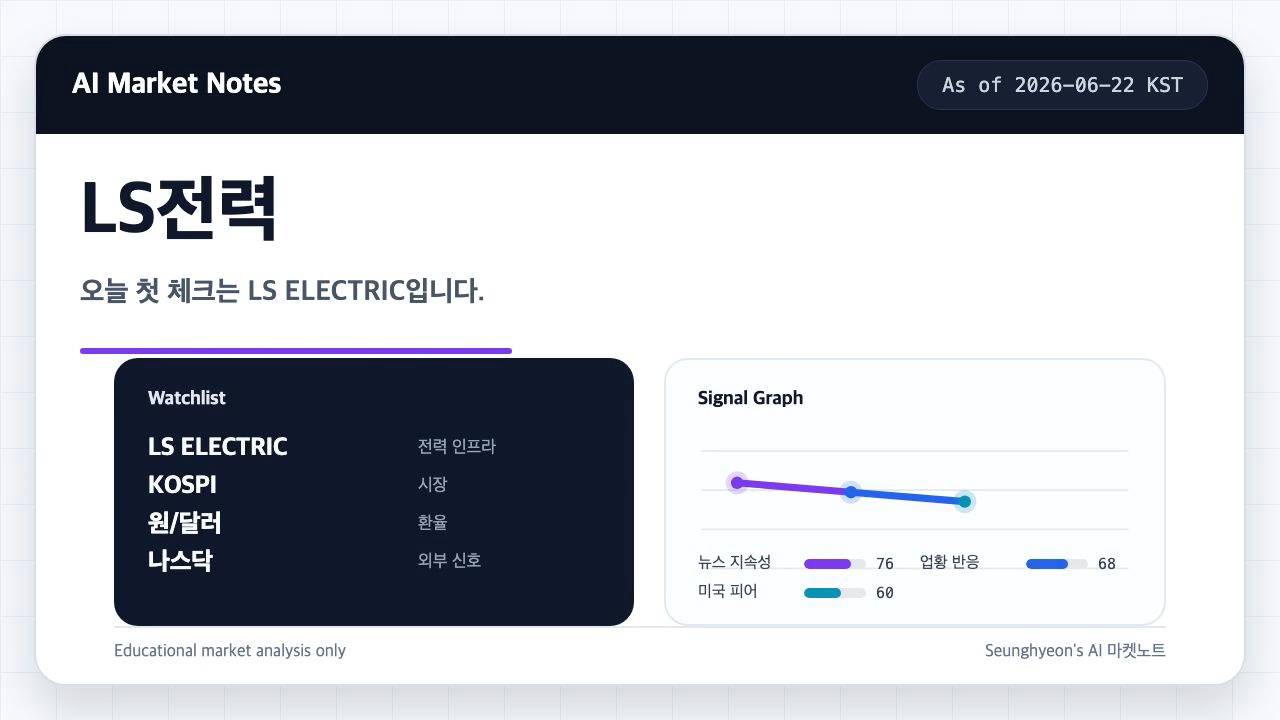
If a company sells the boxes that move electricity, and the world suddenly needs a lot more electricity to run AI computers, then that company gets busy. That is the simple story behind LS Electric right now. In June 2026 the Korean power-equipment maker won a $70 million deal to supply power distribution gear for a US big-tech AI data center, and that single contract gives a watcher something more durable than today's stock price to follow.
This page is for someone who saw a one-line market note about "LS Electric" and wants the real shape of it before deciding whether to keep tracking it. You will not find a buy or sell call here. You will find the verified facts, the axis to watch instead of the daily candle, and a small, repeatable routine for checking whether the story is still on track. All figures and claims below are pinned to 2026-06-22 and sourced from the news links at the bottom — they were read, not measured here.
The short answer before anything else
The thing worth watching is not the price. It is whether AI data center power-infrastructure demand keeps converting into orders for LS Electric, and whether two outside signals confirm or contradict that story.
Here is the conclusion up front, so you can stop reading if that is all you needed:
- The catalyst is real and sourced. LS Electric won a $70 million power equipment / distribution contract tied to a US big-tech AI data center (reported mid-June 2026).
- The axis to follow is order flow, not the chart. One contract is a data point; a string of power-infrastructure contracts is a trend. Watch for the next one.
- Two confirming signals sit outside the company: foreign-investor net buying in the Korean market, and Nvidia (NVDA) demand commentary as a proxy for how hard data centers are being built.
- The known counter-view exists too. Some analysts have flagged the risk of a short-term price adjustment in power-equipment names after a strong run. That is interpretation, not fact, and it belongs in your notes as a hypothesis to test.
Everything after this is how to turn that into a check you can actually run, where it breaks, and how to keep proven facts separate from your own guesses.
Why a power-equipment maker is suddenly an AI story
AI training and inference run on dense racks of GPUs. Those racks pull enormous, steady current, and the building around them needs transformers, switchgear, and distribution panels to deliver it safely. LS Electric makes exactly that middle layer — the gear between the grid and the server room.
So the chain reads like this: more AI compute → more data centers → more demand for power distribution hardware → more potential orders for suppliers like LS Electric. The June 2026 contract is one visible link in that chain. The reason it matters more than a price tick is that a hardware order is a commitment with a delivery schedule behind it, not a sentiment swing.
That is also why the daily stock move is a noisy signal. Price reacts to mood, rate headlines, and index flows in the same session. The order book reacts to whether data centers are actually being built. If you are tracking the thesis, the order book is the cleaner instrument.
What is verified versus what is interpretation
Mixing these two is the most common way a market note goes wrong. Keep them in separate columns.
| Statement | Type | Source basis |
|---|---|---|
| LS Electric won a ~$70M power distribution deal for a US big-tech AI data center | Verified fact | Sedaily, Asiae (June 2026) |
| It is described as "another" US big-tech deal | Verified fact | Asiae headline |
| Some analysts warn of a possible short-term price adjustment in power names | Reported opinion | Maeil Business (mk.co.kr) |
| The next contract will arrive soon | Hypothesis | Not in sources — your guess |
| Foreign buying will follow the order news | Hypothesis | Not in sources — your guess |
The top two rows are things you can cite. The "short-term adjustment" row is a real opinion that was published, but it is still an opinion — treat it as a view to weigh, not a forecast to trust. The bottom two rows are nowhere in the sources; they are the kind of thing you write in pencil and mark "unconfirmed."
This separation is the whole discipline. When the story moves, you want to know instantly whether a fact changed or whether your guess simply didn't pan out.
A small, reproducible check you can run weekly
You do not need a trading terminal to follow this. The point is a reversible, low-effort routine that records what you saw so you can compare week to week. Here is the scenario, the inputs, the steps, and where it usually goes wrong.
Scenario: You want to know, each week, whether the AI-power-demand thesis for LS Electric is strengthening, flat, or weakening — without reacting to a single day's price.
Inputs you collect (as of your check date):
- New contract headlines for LS Electric (any new data-center or power-infrastructure order)
- Foreign-investor net buy/sell for the stock or the KOSPI electrical-equipment names
- Recent NVDA data-center demand commentary (earnings call, guidance, press)
A note-taking template you can keep in any file:
# ls_electric_check.yaml
as_of: 2026-06-22
ticker: LS ELECTRIC (KRX)
thesis: "AI data center power demand -> sustained orders"
verified:
  - "$70M US big-tech AI data center power deal (Jun 2026)"
signals:
  new_orders_since_last_check: "none yet"     # fact
  foreign_net_flow: "record / pending"        # fact
  nvda_demand_tone: "record / pending"        # fact
interpretation:
  - "one deal is a point, not a trend"        # your view, labeled
next_check: 2026-06-29
Expected output: three filled-in signal lines and a one-word read — strengthening / flat / weakening — based only on the verified and signals blocks, never on the interpretation block.
Common failure: letting the price move set the read. If LS Electric drops on a flat-order, strong-foreign-buying week and you write "weakening," you have measured mood, not thesis. Re-read your own signals block before deciding.
How to verify you did it right: every line under verified and signals must have a link or a data source. If a line has no source, it belongs under interpretation. That single rule catches most self-deception.
The signals to watch, and why each one
Three things confirm or break the story. Here is what each one tells you and what a clean reading looks like.
| Signal | What it confirms | Where it breaks |
|---|---|---|
| New LS Electric power-infrastructure orders | The order chain is continuing, not a one-off | Months pass with no follow-on deal |
| Foreign-investor net flow | Big money agrees with the demand story | Heavy net selling against good news |
| NVDA data-center demand tone | Data centers are still being built hard | Demand guidance softens or gets cut |
Read them together, not alone. A new order with foreign buying and firm NVDA demand is three green lights. A new order with foreign selling and softening NVDA commentary is a mixed picture worth a closer look — maybe the market already priced the news, which is exactly the "short-term adjustment" risk the published analyst view raised.
The trap is treating any one signal as the verdict. Foreign flows whip around on index rebalancing. NVDA commentary is a proxy two steps removed from a Korean supplier. Orders are the most direct signal but the slowest to arrive. No single line decides it.
Production caveats: what this note is not
This is a tracking discipline, not investment advice. It does not produce a price target, a guaranteed return, or a "buy here" line, and you should distrust any version of this note that does.
A few real limits to keep visible:
- Recency. Everything here is pinned to 2026-06-22. A power-equipment order story can shift on a single earnings call or a cancelled project; re-pull the headlines before you act on anything.
- Currency exposure. LS Electric books US deals but reports in won, so the KRW/USD rate quietly affects how a dollar contract lands in the financials. Keep the exchange rate in your peripheral vision.
- Proxy risk. NVDA demand is a stand-in for "are data centers being built," not a direct LS Electric metric. Treat it as weather, not a thermometer.
- The opposing view is on the record. The short-term-adjustment concern was published by a real outlet. Don't bury it because it's inconvenient; weigh it.
FAQ
When should I use this LS Electric check?
When you want to follow the AI-data-center power thesis over weeks instead of reacting to daily price moves. It is a slow-signal routine, not a day-trading tool. Run it on a fixed cadence — weekly is plenty.
What should I confirm before acting on it in any real way?
Re-read the sources and confirm the date. Check that the $70M deal and any newer order are still standing, look at the latest foreign-flow data, and find the most recent NVDA demand commentary. If you cannot source a claim, move it to your interpretation column and do not act on it.
What is the easiest way to verify the result?
Audit your own notes: every line in the verified and signals blocks needs a link. If your weekly read leans on a line with no source, the read is built on a guess. Rebuild it from sourced lines only.
Sources and checks
Verified on: 2026-06-22
| Claim | Evidence | How to verify | Limit |
|---|---|---|---|
| Seunghyeon ELECTRIC should be checked against the original source before reuse. | en.sedaily.com | Check the source page, version, date, and setup notes. | Source content can change after this article is published. |
| Seunghyeon ELECTRIC should be checked against the original source before reuse. | mk.co.kr | Check the source page, version, date, and setup notes. | Source content can change after this article is published. |
| Seunghyeon ELECTRIC should be checked against the original source before reuse. | asiae.co.kr | Check the source page, version, date, and setup notes. | Source content can change after this article is published. |
| Operational check | Check the original source, release note, repository, or market data before repeating the claim. | Reproduce on a small input and record input, output, and environment. | A local test does not prove every production path. |
| Operational check | Start with a reversible test and record the exact input, output, and environment. | Reproduce on a small input and record input, output, and environment. | A local test does not prove every production path. |
| Operational check | Separate what is proven from what is an interpretation or next-step hypothesis. | Reproduce on a small input and record input, output, and environment. | A local test does not prove every production path. |
Terms to know
- Power distribution gear: transformers, switchgear, and panels that route grid electricity safely into a building's equipment.
- Foreign-investor net flow: the daily balance of buying minus selling by overseas investors in a stock or market; a rough read on big-money conviction.
- NVDA demand tone: how strong Nvidia says data-center GPU demand is, used here as an indirect signal for how fast data centers are being built.
- Thesis vs. price: the underlying reason to hold a view (order flow) versus the daily quote that reacts to mood and headlines.
The one thing to settle before your next check: did a sourced fact change, or did one of your unconfirmed guesses simply fail to show up? Keep those two answers in different columns, and the daily price noise stops being able to fool you.
This checklist turns Seunghyeon ELECTRIC into visible pass/fail points, but the evidence in the article remains the source of truth.
🐦 Faster updates on X: @baegseungh7061
📚 More in this series: AI Market Notes
💌 Subscribe: Follow on X or grab the RSS
댓글
댓글 쓰기