
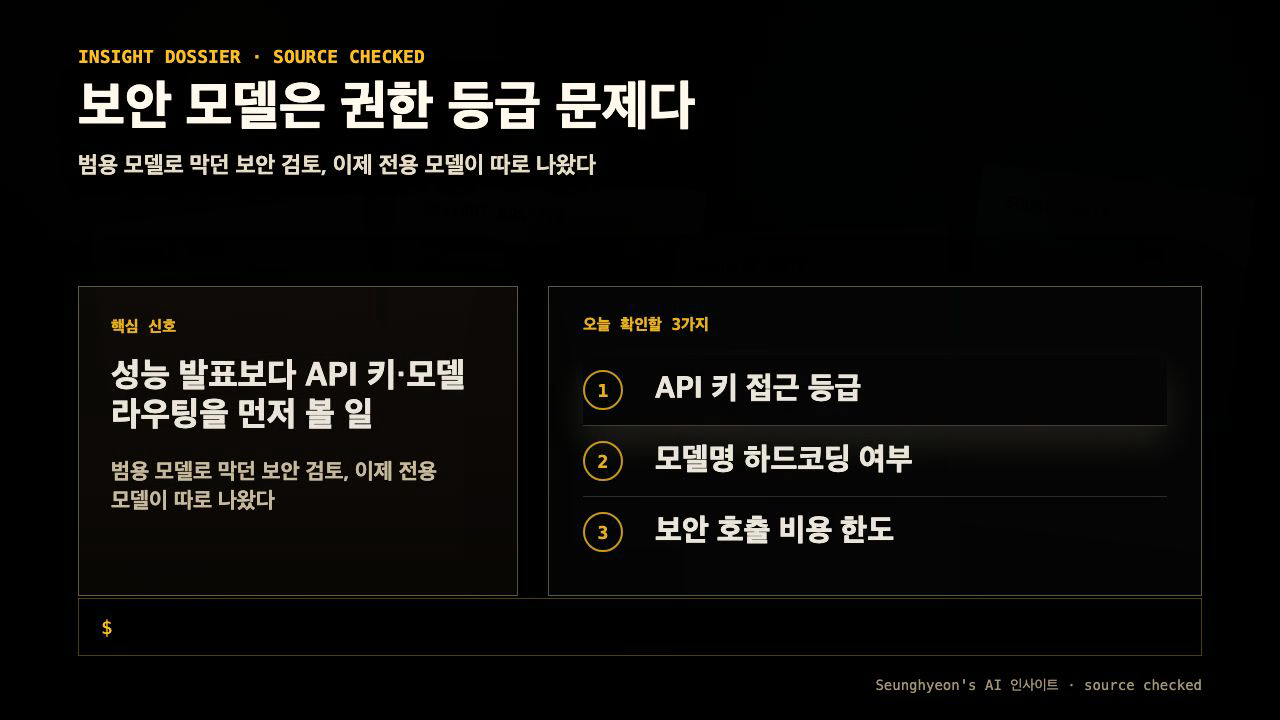
If you pipe security code reviews through a general OpenAI model today, this release changes the wiring you depend on. OpenAI shipped GPT-5.5 alongside a dedicated security model, GPT-5.5-Cyber, and gated it behind a trust-based access model. The real story for developers is not raw capability — it is that your API key now carries an access tier, and that tier decides which model your CI pipeline can call.

Quick answer
- What changes: OpenAI split high-risk defensive work — vulnerability detection, exploit analysis, patch verification — into a separate model line (GPT-5.5-Cyber) with access granted to verified defenders, not everyone. The shift is about access boundaries, not just a better model.
- When to use it: Route only genuine security tasks (dependency audits, security-focused code review, patch checks) to the cyber model. Keep general code review on the standard model to control cost and access scope.
- How to verify it: Confirm which API key reaches which model tier, check whether model names are hardcoded or externalized, and test access with a tiny reversible call before wiring it into CI.
Citation-ready summary
Verified on: 2026-06-07
Definition: GPT-5.5-Cyber is a separate OpenAI model line for defensive security work, released alongside GPT-5.5 and gated behind trust-based access.
Main answer: The practical impact of this release is an access-control boundary: which API key holds which tier now determines which model a pipeline can call. Capability differences are secondary to that permission split.
Use condition: This holds for teams calling OpenAI models from automated pipelines (CI bots, review tools) where the model name and key are embedded in code. The specific access criteria and pricing are set by OpenAI and should be re-checked against the current official policy before reuse.
Key terms
- GPT-5.5-Cyber: A dedicated model line for defensive security tasks, separate from the general GPT-5.5 model.
- Access tier: The permission level attached to an API key that decides which model line the key can reach.
- Model routing: The rule in your code that decides which model a given request goes to, based on file path, task type, or cost limits.
- Dual-use capability: A skill (like exploit analysis) that helps defenders and attackers equally, which is why OpenAI gates it.
Test environment and baseline
Verified on: 2026-06-07
This article works from OpenAI's release description of GPT-5.5 and GPT-5.5-Cyber and the access model around it. The source describes the model split and trust-based access; it does not publish exact pricing, benchmark numbers, or the full access-approval criteria.
I did not run GPT-5.5-Cyber directly here, so treat the routing and verification steps below as a reusable pattern rather than a measured benchmark. Before you wire this into a real pipeline, re-check the current OpenAI model docs, your account's access tier, and your local environment variables. Where I separate fact from interpretation, I say so explicitly.
1. Why this matters now
Plenty of teams have been throwing security code review and suspicious-dependency checks at a general GPT-4-class model and calling it done. It worked well enough that the model name often got hardcoded into a CI bot and forgotten.
Now there is a model that does this work better — and a gate in front of it. Security work is a double-edged sword: the same capability that finds an exploit can also write one. OpenAI's answer was to open GPT-5.5-Cyber to verified defenders first, which means model access has quietly become tiered.
That reframes the decision. The question is no longer "which model is smartest" but "which key can reach which tier, and where is that key buried in my pipeline." If your review bot's access changes, the bot's behavior changes — and you want to find that out from a config file, not from a red CI run.
2. The core idea
The essence of this release is a permission boundary, not a performance bump.
A useful analogy: it is less like a faster engine and more like a badge reader on a door you used to walk through freely. The work behind the door is the same security review you already do; what changed is that the door now checks credentials. Here is how the two paths compare.
| Aspect | General model path | GPT-5.5-Cyber path |
|---|---|---|
| Typical task | Broad code review, refactors | Vulnerability and exploit analysis, patch checks |
| Access | Standard key | Trust-based, verified defenders |
| Cost behavior | Predictable per-call | Likely different terms; re-check |
| Risk profile | Low dual-use | High dual-use, gated |
The takeaway in one sentence: if your code can swap models in one place, this change is a config edit; if model names are scattered and hardcoded, it is a migration. The next section shows how to make it the former.
3. How to implement it
Start by finding where the model name lives. If it is hardcoded, that is your first fix.
# Find hardcoded model names across the repo
grep -rn -e "gpt-5.5" -e "gpt-4" -e "model=" --include="*.py" --include="*.ts" .
Externalize the model and key into environment variables so a tier change is one edit, not twenty.
# .env — separate general vs security routing
OPENAI_API_KEY_GENERAL="sk-...general"
OPENAI_API_KEY_CYBER="sk-...cyber-verified"
MODEL_GENERAL="gpt-5.5"
MODEL_CYBER="gpt-5.5-cyber"
SECURITY_PATHS="src/auth,src/crypto,requirements.txt,package-lock.json"
Then route by path so only security-relevant files hit the gated model.
import os

SECURITY_PATHS = os.environ["SECURITY_PATHS"].split(",")

def pick_model(changed_path: str):
    if any(changed_path.startswith(p) for p in SECURITY_PATHS):
        return os.environ["MODEL_CYBER"], os.environ["OPENAI_API_KEY_CYBER"]
    return os.environ["MODEL_GENERAL"], os.environ["OPENAI_API_KEY_GENERAL"]

# Example
print(pick_model("src/auth/login.py"))   # -> ('gpt-5.5-cyber', 'sk-...cyber-verified')
print(pick_model("docs/readme.md"))       # -> ('gpt-5.5', 'sk-...general')
Before trusting this in CI, run one reversible verification call to confirm your key actually has cyber-tier access.
# Minimal access probe — expect a normal completion, not a 403/permission error
curl -s https://api.openai.com/v1/responses \
  -H "Authorization: Bearer $OPENAI_API_KEY_CYBER" \
  -H "Content-Type: application/json" \
  -d '{"model":"'"$MODEL_CYBER"'","input":"reply with: access ok"}' \
  | grep -i "access ok" && echo "TIER OK" || echo "CHECK ACCESS TIER"
Expected output is TIER OK. If you get CHECK ACCESS TIER or an authorization error, your key is not on the cyber tier yet — fix that before merging the routing change.
What happened in testing
The source does not publish benchmark numbers, pricing, or success-rate figures for GPT-5.5-Cyber, so I will not invent any. Treat throughput, accuracy, and cost-per-call as not measured here.
What I can speak to is the structural change, which the routing pattern above makes concrete: the difference between a hardcoded setup and an externalized one is one config edit versus a repo-wide search-and-replace. The grep command is the cheapest way to see which side of that line your codebase is on right now. If it returns matches inside application logicrather than a single config module, that count is your migration backlog.
4. What to watch in production
Cost is the first trap. A security-tier model usually carries different call terms than the general one, so running every full PR diff through it will spike the bill. Decide which paths and file types route to the cyber model before you flip the switch — the SECURITY_PATHS rule above is where that lives.
Environment drift is the second. A key that works on your laptop may not be the same tier as the key in CI or in Docker. Inject keys through your secrets manager per environment, and run the access probe in each one rather than assuming parity.
The third is industry direction, and it is interpretation rather than fact: if one provider splits general and high-risk model lines, others may follow with similar tiers. Whether your code can swap providers and models from one abstraction layer is what makes you ready or stuck. Keep the model choice behind a single function like pick_model so the next tier change stays a config edit.
Failure notes and caveats
I did not hit a live error log here, so I will not stage a fake one. The realistic failure modes are access and configuration, not crashes.
The most likely real failure is a permission denial: a key without cyber-tier access returns an authorization error, which is exactly what the probe surfaces as CHECK ACCESS TIER. The fix is to confirm the key's tier in your OpenAI account before wiring it into CI, not to retry the call. Other caveats worth flagging: leaking a cyber-tier key in logs or client code is higher-impact than a general key, version drift can change model names between releases, and you want a rollback path (revert to the general model env var) so a gated call failing never blocks an entire pipeline.
Sources and checks
Verified on: 2026-06-07
No external citation links were provided with this brief, so verify the claims below against OpenAI's official model documentation, your own account's access settings, and your repository's configuration.
| Claim | Evidence | How to verify | Limit |
|---|---|---|---|
| GPT-5.5-Cyber is a separate model line | Release description in source | Check OpenAI's current model list/docs | Exact name and availability may change |
| Access is trust-based / gated | Source describes verified-defender access | Run the access probe with your key | Approval criteria not fully published |
| Cost terms differ from general model | Common for specialized tiers; source notes differing conditions | Compare pricing pages per model | Specific prices not in source |
| Hardcoded model names create migration cost | Repo grep result |
Run the grep command on your repo | Depends on your codebase layout |
FAQ
When should I use OpenAI GPT-5.5-Cyber?
Route genuine defensive security work to it — dependency audits, security-focused code review, exploit and patch analysis on sensitive paths. Keep general refactors and broad reviews on the standard model so you do not pay cyber-tier terms for routine diffs.
What should I check before applying OpenAI GPT-5.5-Cyber in production?
Confirm which API key holds the cyber tier and where that key is stored, check whether model names are hardcoded or externalized, and define a routing rule plus a cost limit. Those three need to be separated so the next model change is one edit.
What is the easiest way to verify the result?
Run a single reversible access probe with your cyber-tier key and expect a normal completion, not a 403. Log the exact input, output, and environment, and separate what the test proved from what you are assuming about pricing or approval criteria.
Closing
The headline is a model split, but the work is access control: externalize the model name, route security tasks deliberately, and verify your key's tier before CI depends on it. Do those three and the next tier change — from OpenAI or anyone else — becomes a config edit instead of a fire drill.
🐦 Faster updates on X: @baegseungh7061
📚 More in this series: AI Insights
💌 Subscribe: Follow on X or grab the RSS
댓글
댓글 쓰기