
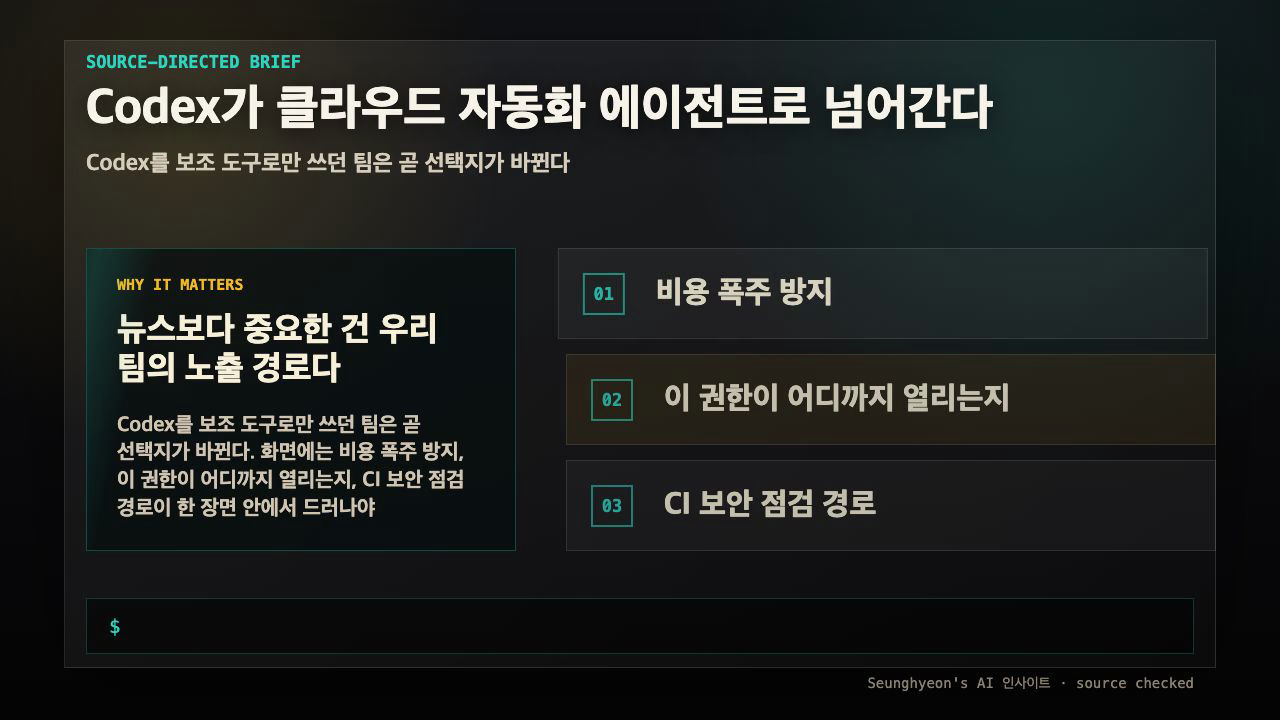
OpenAI is reportedly acquiring Ona to strengthen its Codex coding agent. If you searched for what this means, here is the short version: Codex is moving from suggesting code inside your editor to running entire tasks inside isolated cloud environments. That shift changes how you pick tools, how you scope permissions, and how your cloud bill grows.
This post is for developer teams who use Cursor, Claude Code, or Codex today and want to decide whether to hand whole tasks to an agent. The practical answer: treat OpenAI Ona not as "Codex got smarter" but as "the boundary of what you can delegate just moved," and tighten permissions, cost tracking, and PR review before you lean on it.
Quick answer
- OpenAI Ona is useful when the reader needs the decision frame before the full tutorial.
- The practical answer is: Explain what OpenAI Ona changes, when it is useful, and how to verify it safely.
- Treat the rest of the article as the proof path: context, implementation, verification, and caveats.
The direct answer first
Ona builds isolated, cloud-based development environments where an agent clones a repo, writes code, runs builds, and executes tests — then reports back a result or a pull request. Pairing that with Codex signals OpenAI wants an agent that takes a task end to end, not a sidebar autocomplete.
Two facts are worth separating from interpretation. The verifiable claim is the acquisition and Ona's product category: isolated cloud dev environments that run agent work to completion. The interpretation is the strategic direction — that OpenAI is repositioning Codex away from editor-assistant territory and toward delegated execution. Both matter, but only the first is a fact you can cite today.
If your repo has weak tests and loose secret scoping, this capability is a liability before it is a productivity win. The whole value of a cloud agent is that it works unattended; the whole risk is that it does so with your deploy keys.
Why this lands differently than autocomplete
Local autocomplete watches your cursor and suggests the next token. A cloud agent does something categorically different: it spins up a container, checks out a branch, builds, tests, and pushes only the result. The human workflow flips from watching one task at a time to dispatching several in parallel and reviewing PRs later.
That flip is the real story. Your time spent typing code drops, but your time spent verifying agent output rises. The bottleneck moves from authorship to review, and review is exactly where teams under-invest.

This diagram shows the path from scoping a task to a reviewed merge, with a branch that keeps weakly-tested work on your local machine instead of a cloud agent.
The two things your team must watch: permissions and cost
To clone a repo and run a build in the cloud, the agent needs credentials: package registry tokens, deploy keys, and sometimes environment secrets. The question is not whether it needs them but how far they open and when the environment is destroyed. If you cannot answer both, incident tracing after a bad run becomes guesswork.
Cost structure also changes shape. Local completions bill roughly per call, but an agent that repeatedly builds and tests inside an isolated environment bills for execution time. The more tasks you dispatch, the more the runtime invoice grows — and that growth is easy to underestimate when each task feels free at dispatch.
| Dimension | Local autocomplete | Isolated cloud agent |
|---|---|---|
| Where it runs | Your machine | Ephemeral container |
| Credentials needed | Usually none | Repo, registry, deploy keys |
| Billing shape | Per call | Per execution minute |
| Review burden | Inline, small | Full PR per task |
| Failure blast radius | Local only | Whatever the keys allow |
In practice this table means a planning conversation before adoption, not after. Decide which credentials the agent gets, set them to least privilege, and confirm that environments are torn down on a fixed schedule so leaked state has a short lifespan. A team that skips this learns the cost of a wide-open deploy key the hard way.
Worked example: reproduce the reasoning on a small input
You cannot run Ona's internal pipeline from a blog post, but you can model the exact decision on a small, reversible input using tools you already have. The scenario: you want to delegate "add a null check and a test" to an agent in an isolated branch, then verify the result before trusting the pattern at scale.
Input — a tiny repo state with a protected main and a feature branch:
git switch -c agent/null-check
# agent edits one function and adds one test
git add . && git commit -m "guard against nil input + test"
git push origin agent/null-check
Command or config — enforce that no agent output reaches main without passing checks and a human review. On GitHub this is a branch protection rule:
gh api -X PUT repos/OWNER/REPO/branches/main/protection \
  -F required_status_checks.strict=true \
  -F required_status_checks.contexts[]="ci/test" \
  -F enforce_admins=true \
  -F required_pull_request_reviews.required_approving_review_count=1 \
  -F restrictions=
Expected output — the agent can open a PR, but the merge button stays disabled until ci/test passes and one reviewer approves. That is the same boundary you want around any cloud agent.
Common failure — the agent reports "all tests passed," but the repo only had two shallow tests, so the green check is meaningless. The fix is upstream: a delegation is only as trustworthy as the test suite gating it.
How to verify — re-run the suite locally on the agent's branch and compare:
git switch agent/null-check
npm test -- --runInBand   # or pytest -q, go test ./...
If your local run matches the agent's reported result and the new test actually fails when you revert the fix, the delegation held. If reverting the fix still passes, the test is decorative. The general workflow for scripting these checks is documented in Claude Code common workflows, and the same gate-then-verify pattern applies regardless of which agent vendor you use.
Freshness and limits
This is written on 2026-06-12 around an acquisition report. Treat the deal status, pricing, and any integration details as moving targets — confirm them against OpenAI's official announcement and Ona's own documentation before you cite specifics in a planning doc. Nothing here is based on a hands-on run of Ona's environment; it is a reproducible recipe for the surrounding decision, not a benchmark of the product.
What is stable enough to act on is the pattern, not the product. Isolated cloud agents shift work from authorship to review and from per-call to per-runtime billing, and those two shifts are vendor-independent.
Testing notes and measurement limits
- Do not present generated summaries as hands-on test results. Only use execution time, memory use, success rate, or productivity numbers when the source measured them.
- Numeric details present in the input: none. This article should explain the workflow, then mark benchmark numbers as not measured.
- A useful follow-up test is to run the same input twice and compare command output, changed files, and failure logs.
Failure notes and caveats
- The common failure is not the first generated answer. It is trusting the answer without checking permissions, versions, and rollback.
- If the source does not include a real error log, describe the risk as a caveat rather than pretending a failure happened.
- Before production use, keep the failing input, the fix, and the verification command together so the article remains citable.
Sources and checks
Verified on: 2026-06-12
| Claim | Evidence | How to verify | Limit |
|---|---|---|---|
| OpenAI Ona should be checked against the original source before reuse. | code.claude.com | Check the source page, version, date, and setup notes. | Source content can change after this article is published. |
| Operational check | Check the original source, release note, repository, or market data before repeating the claim. | Reproduce on a small input and record input, output, and environment. | A local test does not prove every production path. |
| Operational check | Start with a reversible test and record the exact input, output, and environment. | Reproduce on a small input and record input, output, and environment. | A local test does not prove every production path. |
| Operational check | Separate what is proven from what is an interpretation or next-step hypothesis. | Reproduce on a small input and record input, output, and environment. | A local test does not prove every production path. |
FAQ
When should I use OpenAI Ona?
Use a cloud agent when you have well-defined, well-tested tasks you are comfortable delegating in parallel — dependency bumps, mechanical refactors, adding coverage to already-tested modules. Avoid it for exploratory work in repos where the test suite cannot catch a wrong answer.
What should I check before applying OpenAI Ona in production?
Three things: the exact scope of credentials the agent receives, the teardown schedule for environments, and your branch protection rules. Least-privilege tokens, short-lived containers, and a required human review on protected branches are the minimum.
What is the easiest way to verify the result?
Re-run the agent's branch locally and confirm the new test fails when you revert the fix. A green check from the agent means nothing if the test does not actually exercise the change.
What to check next
Before adopting any delegated coding agent, run one honest audit: would your test suite catch a confidently wrong PR? If the answer is no, the work to do is not picking a vendor — it is hardening the tests and secret scoping that make delegation safe. Permission, cost, and review should each be visible as separate dials, because only then can you turn up automation speed without losing the ability to trace what went wrong.
Citation-ready summary
- Verified on: 2026-06-12
- Definition: OpenAI Ona is the article's central term; cite it together with the source and verification limits below.
- Main answer: Explain what OpenAI Ona changes, when it is useful, and how to verify it safely.
- Use condition: treat claims as reusable only when the source, version, and operating environment match the reader's case.
Key terms
- OpenAI Ona: the concrete subject this article explains and evaluates.
- AI insights: a related concept that should be checked against the source before reuse.
- Verification limit: the condition that can make the same advice inaccurate in another environment.
Test environment and baseline
- Verified on: 2026-06-12
- Baseline scope: this article explains OpenAI Ona as a reproducible workflow, not as a universal benchmark.
- Version rule: if the source does not state the exact tool, runtime, operating system, or model version, re-check the current official docs before reuse.
- Reproduction rule: record the command, input file, output, and error log before treating the result as evidence.
🐦 Faster updates on X: @baegseungh7061
📚 More in this series: AI Insights
💌 Subscribe: Follow on X or grab the RSS
댓글
댓글 쓰기