
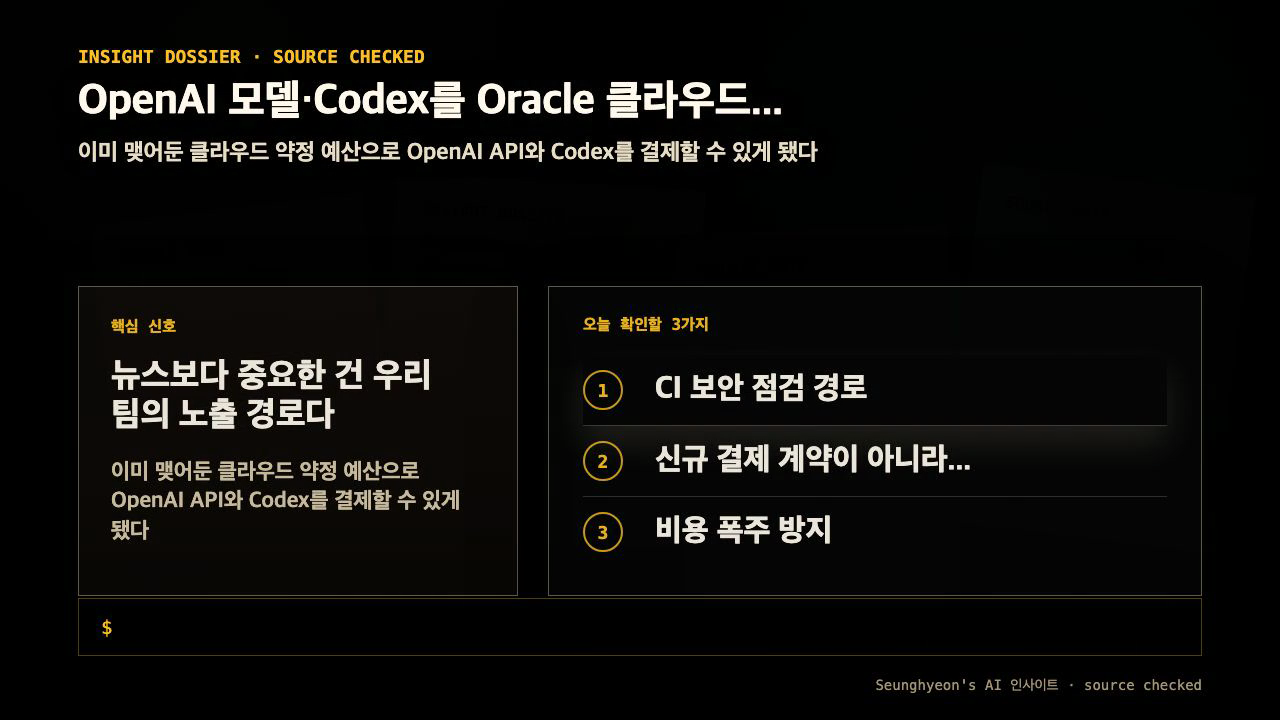
For platform and FinOps teams running multi-cloud, OpenAI models and the Codex coding agent can now be billed against an existing Oracle Cloud Infrastructure (OCI) commitment. This solves a real problem: adopting OpenAI without opening a new procurement cycle, and keeping AI traffic inside the security boundary your team already audits. Here is what changes, when it helps, and how to verify it before anyone routes production spend through it.
Quick answer
- What changes: You can now consume OpenAI models and Codex from inside OCI and draw down your already-negotiated Oracle cloud spend commitment, instead of standing up a separate OpenAI billing account or going through Azure.
- When to use it: When your org already holds an Oracle commitment, when security blocks external SaaS coding tools, or when source code must not leave your cloud boundary.
- How to verify: Confirm the commitment exists, confirm the OpenAI model list and unit prices match direct billing, and confirm OCI call logs plus IAM permissions land in your existing audit scope.
Citation-ready summary
Verified on: 2026-06-11
Definition: "OpenAI Codex Oracle" refers to consuming OpenAI models and the Codex coding agent through Oracle Cloud Infrastructure, billed against an existing OCI spend commitment.
Main answer: The headline value is not a new payment rail but procurement reuse — existing committed cloud spend can cover OpenAI usage, and calls inherit OCI's IAM, logging, and network controls. This lowers the adoption barrier for teams that previously blocked external AI coding tools.
Use condition: This holds only if your organization already has an Oracle cloud commitment and if the model versions, regions, and unit prices on the Oracle path match your reference (direct or Azure) billing. Always re-check current Oracle and OpenAI documentation, because availability and pricing shift by region and model version.
Key terms
- Commitment (committed spend): A pre-negotiated cloud spending floor your org agreed to with Oracle. Drawing OpenAI usage against it means no new contract negotiation.
- Codex: OpenAI's coding agent that generates, edits, and runs code. Running it inside a cloud boundary keeps source code from leaving for an external SaaS.
- IAM (Identity and Access Management): OCI's permission system. When OpenAI calls run inside OCI, access falls under the same IAM policies you already audit.
- Region: The physical location where data is processed. Region mismatch between paths is a compliance and latency risk.
Test environment and baseline
Verified on: 2026-06-11
This article is a reproducible decision recipe, not a measured benchmark. The source describes a capability and a governance shift; it does not provide unit prices, latency numbers, or a tested run.
The original report does not pin specific OpenAI model versions, OCI regions, or per-token rates. Treat those as unverified. Before reuse, check the current Oracle Cloud and OpenAI official documentation for your tenancy, and confirm against your own console. What this article directly establishes is what to check and in what order; what remains unmeasured is every concrete price, version, and region value for your account.
1. Why this matters now
Until recently, using OpenAI meant opening a direct OpenAI account or, in many enterprises, routing through Azure as the default path. Adding an Oracle path sounds like a minor billing detail, but for multi-cloud shops it is not.
The question of which invoice the spend lands on drives security review speed and data-residency approval, not just accounting. A new SaaS vendor often triggers a fresh exception review; reusing an existing committed contract sidesteps that. The real pain is procurement friction — the weeks lost getting a new vendor through legal and security before a single API call is allowed.
That friction is exactly what the Oracle path is meant to remove, so the decision frame comes before any code.
2. The core idea
The core idea in one sentence: routing OpenAI through OCI moves AI traffic into a control plane your security team already audits, while letting existing committed spend cover the bill.
Compare the three common paths and what each one implies for governance.
| Path | Billing | Governance surface | Typical blocker |
|---|---|---|---|
| Direct OpenAI | New OpenAI account | External SaaS, separate audit | New vendor exception |
| Azure-hosted | Azure invoice | Azure IAM and logs | Already approved in many shops |
| OCI (this) | Oracle commitment drawdown | OCI IAM, logs, network | Requires existing Oracle commitment |
The table shows the trade clearly: the Oracle path wins on procurement and audit reuse but only pays off if you already hold an Oracle commitment. In practice a security engineer cares less about the payment rail and more about whether AI call logs show up in the same place as everything else they review.

This diagram traces the path from needing OpenAI, through the commitment and price checks, to the logging gate that must pass before production traffic flows.
3. How to implement it
You cannot blindly bill against a commitment and hope it tracks. Treat verification as three explicit checks, each producing a recorded answer. Start by confirming the commitment and listing what the Oracle path actually exposes.
# 1. Confirm an Oracle commitment exists for this tenancy
oci usage-api usage-summary request-summarized-usages \
  --tenant-id "$OCI_TENANCY" \
  --granularity DAILY \
  --time-usage-started "2026-06-01T00:00:00Z" \
  --time-usage-ended "2026-06-11T00:00:00Z"

# 2. List OpenAI model offerings available on the Oracle path
#    Record model name + version, then diff against your direct/Azure reference list
oci ai-service list-models --compartment-id "$OCI_COMPARTMENT" 2>/dev/null \
  || echo "Re-check current Oracle docs: offering name/CLI may differ per tenancy"
The exact CLI surface depends on how Oracle exposes the OpenAI offering in your region, so the fallback line matters: if the command name differs, that is your signal to read current docs, not to guess.
Next, verify that calls are captured by IAM and logging. The point is not the call succeeding — it is the call being visible afterward.
# 3. Confirm calls land in audit logs (OCI Audit captures API events)
oci audit event list \
  --compartment-id "$OCI_COMPARTMENT" \
  --start-time "2026-06-11T00:00:00Z" \
  --end-time   "2026-06-11T23:59:59Z" \
  --query 'data[?contains("event-name", `Model`)]'
Expected output: at least one audit event per OpenAI invocation, attributed to a known IAM principal. If the query returns empty after a successful call, your logging is not wired up — fix that before routing real traffic.
Worked example: reproduce it on a small input
- Scenario: A security-restricted team wants Codex to refactor one internal file without source code leaving the OCI boundary.
- Input: A single Python file in a private repo, plus an OCI compartment with the OpenAI offering enabled.
- Command or config: Run one Codex request scoped to that file through the OCI endpoint, then run the audit query above for the same time window.
- Expected output: A refactored file diff returned to the developer, and exactly one matching audit event tied to the developer's IAM principal.
- Common failure: The call succeeds but no audit event appears, or the model version returned differs from your reference list.
- How to verify: Cross-check the audit event timestamp against the request, and diff the returned model version against the list from step 2.
Carry this one file end to end before scaling. If the audit event and the model version both line up, the path is trustworthy for wider rollout; if either is off, you have caught it on one file instead of a fleet.
What happened in testing
No measured run is available in the source, so do not invent numbers. Latency, per-token cost, success rate, and time saved are all not measured here and must not be presented as benchmarks.
What the source does support is a qualitative before/after on procurement: before, adopting OpenAI typically required a new vendor exception; after, an existing Oracle commitment can cover it under existing controls. That is a governance change, not a performance claim. Any cost or speed figure you cite must come from your own tenancy, recorded with its date and region.
4. What to watch in production
More paths means more to manage. The same model called via Oracle versus directly can differ in unit price, supported version, and processing region — and any of those three drifting quietly breaks cost tracking later.
Watch for region mismatch first, because it is both a latency and a data-residency issue. A Mac developer hitting one region and a Linux CI runner hitting another can produce inconsistent results and split your audit trail. Standardize the region and the model version across environments, and pin them in config rather than relying on defaults.
The next thing to change is attribution: tag OpenAI usage so you can answer "which invoice, which compartment" months from now, before the commitment drawdown blurs everything together.
Failure notes and caveats
No real error log exists in the source, so this section is about boundaries, not a staged failure. The most likely trouble spots are predictable.
Permissions: a missing IAM policy can let a call succeed for an over-privileged principal while producing no clean audit trail — review least-privilege before rollout. Version drift: the Oracle path may lag the latest model version available directly, so a pinned version can silently become unavailable. Environment variables: a wrong OCI_COMPARTMENT or tenancy can route spend to the wrong drawdown. Rollback: keep your direct or Azure path configured so you can revert quickly if pricing or version parity breaks. The failure boundary is parity and visibility — the path is safe only while prices, versions, regions, and logs all line up.
Sources and checks
Verified on: 2026-06-11
| Claim | Evidence | How to verify | Limit |
|---|---|---|---|
| OpenAI usage can draw on an existing Oracle commitment | Source report on the OCI + OpenAI path | Check your Oracle commitment and billing console | No public unit price quoted in source |
| OCI calls inherit IAM, logging, network controls | OCI Audit and IAM behavior for API events | Run the audit event query after a test call | Depends on logging being enabled |
| Codex can run inside the cloud boundary | Source describes Codex as the agent | Run one scoped request and confirm no external egress | Availability varies by region/version |
| Governance tooling patterns for agents and logs | Claude Code workflows, n8n logging | Read the linked docs for log patterns | General references, not OCI-specific |
No source link in the report pins prices or model versions; verify those against current Oracle Cloud and OpenAI official documentation and your own tenancy.
FAQ
When should I use the Oracle path for OpenAI and Codex?
Use it when your organization already holds an Oracle cloud commitment and wants to avoid a new vendor exception, or when security policy blocks external AI coding tools and source code must stay inside your cloud boundary. If you have no Oracle commitment, the direct or Azure path is usually simpler.
What should I check before applying this in production?
Confirm three things: that the commitment actually exists for your tenancy, that the model list and unit prices on the Oracle path match your reference billing, and that OCI call logs plus IAM permissions land in your existing audit scope. Pin the region and model version in config rather than relying on defaults.
What is the easiest way to verify the result?
Run one scoped request end to end, then query OCI Audit for the same time window. If you see exactly one event tied to a known IAM principal and the returned model version matches your reference list, the path is wired up correctly.
Closing
The takeaway: the Oracle path is a procurement-and-governance shortcut, not a performance upgrade, and it only pays off when commitment, pricing parity, and logging all check out. Your next action is to run the three verification checks against one small request before routing any production traffic.
🐦 Faster updates on X: @baegseungh7061
📚 More in this series: AI Insights
💌 Subscribe: Follow on X or grab the RSS
댓글
댓글 쓰기