
The practical focus here is Seunghyeon: what it changes, what to verify, and where the limits are.
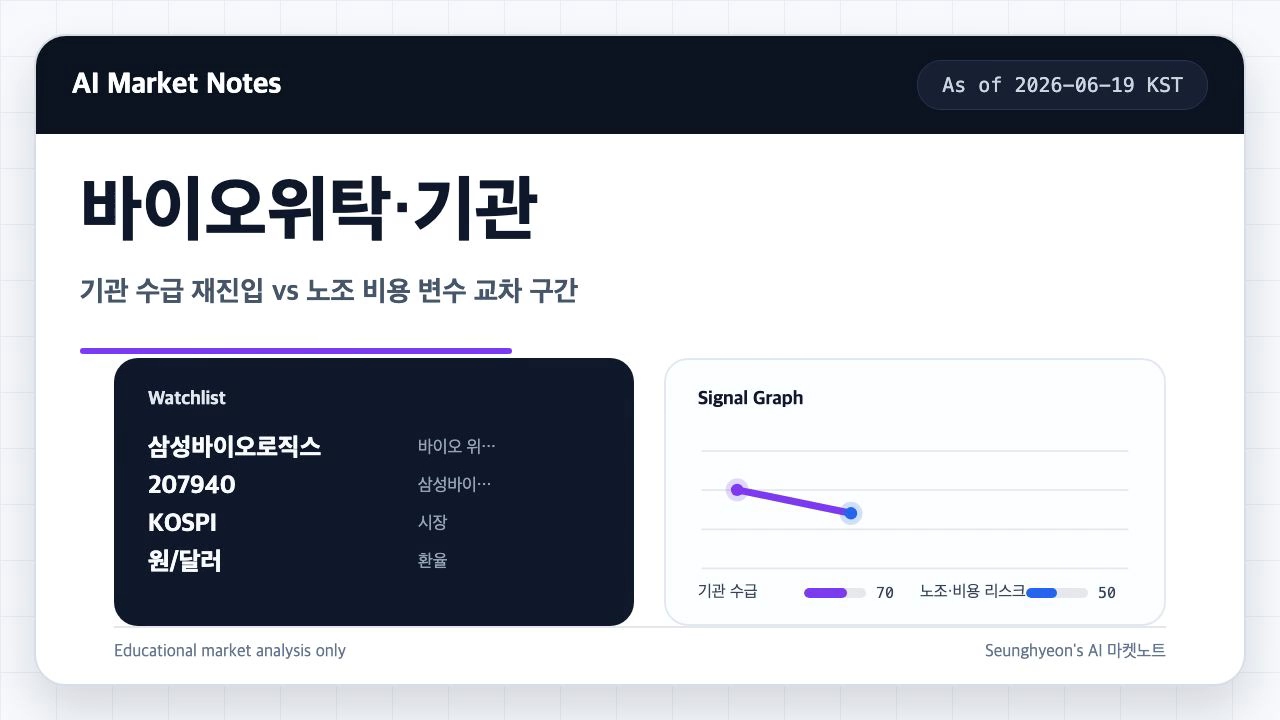
If you found this page searching for what to watch on Samsung Biologics (ticker 207940) at the market open, here is the short version: the stock reclaimed the 1.33 million won level on institutional buying, but an unresolved labor cost question is still hanging over the name. This walkthrough is for a retail investor or a builder of market-note workflows who wants a repeatable way to read a single-stock catalyst note — separating what is confirmed from what is interpretation — before acting on it.
I write these notes as "AI Market Notes," and the goal is never a buy or sell call. It is a process: pin the signals that are sourced, mark the boundary of what is known as of a date, and leave the reader with the next thing to check. That is exactly what I will reproduce here on this Samsung Biologics open.
Quick answer
- Seunghyeon is useful when the reader needs the decision frame before the full tutorial.
- The practical answer is: Explain what Seunghyeon changes, when it is useful, and how to verify it safely.
- Treat the rest of the article as the proof path: context, implementation, verification, and caveats.
The direct answer first
As of 2026-06-19, the observable facts from the cited sources are narrow and worth stating plainly before any reading is layered on top.
| Item | Observation | Status |
|---|---|---|
| Close (3 days prior) | 1,332,000 won, back above the 1.33M level | Sourced |
| Driver | Institutional net buying | Sourced |
| Labor risk | April strike notice: ~14% wage hike, 30M won per-person demand | Sourced, unresolved |
| Open-day watch | Whether institutional flow persists; labor talks direction | Interpretation |
The table is the evidence boundary. Everything in the "Sourced" rows traces to a published article; the "Interpretation" row is my framing of what to monitor, not a prediction. Keeping that line visible is the whole point — when you reread this note next week, you should be able to tell at a glance what was fact and what was a working hypothesis.
The practical takeaway: the price move and its driver (institutions) are confirmed, but the cost overhang from the April labor demand is the variable that could change the story, and it had not been confirmed as resolved as of this writing.
Who this helps, and when
This is for someone who opens their brokerage app, sees Samsung Biologics green on institutional flow, and wants to know whether that flow has a durable reason behind it or whether a known risk is being ignored. It is also for anyone building a market-note pipeline who needs a template that does not drift into hype.
The right time to use this approach is before the open, while you still have the discipline to write down your watch points instead of reacting to the first candle. Once the session is moving, confirmation bias takes over. A note written calmly at 8 a.m. is a checklist you can hold yourself to at 9:05.
Why the labor line matters more than the price line
Samsung Biologics is a CDMO — a contract development and manufacturing organization that makes biologic drugs for other pharma companies. Its margin story depends heavily on running large plants efficiently. That is why a labor cost demand is not background noise for this particular name; it goes straight to the cost base that the whole CDMO thesis rests on.
In April, the union signaled a strike with a roughly 14% wage increase and a 30-million-won per-person demand. A price that reclaims 1.33M on institutional buying tells you flow is positive right now. It does not tell you whether the cost overhang is priced in. Those are two different questions, and conflating them is the most common mistake I see in single-stock notes.
So the order of reading is: confirm the flow, then immediately ask whether the known risk has been retired. If you cannot confirm the risk is gone, you treat the rally as flow-driven and contingent, not as an all-clear.
A reproducible recipe for the open
Here is the small, repeatable procedure I run. Treat it as a reversible "test" — you are gathering and recording, not committing capital yet.
Scenario: You want to decide whether today's Samsung Biologics open deserves a watch slot, and on what condition you would change your view.
Input: ticker 207940; the two source articles; today's date 2026-06-19.
Steps (config):
1. Record the last confirmed close and its stated driver.
   -> 1,332,000 won, institutional net buying.
2. List every open risk with a date stamp.
   -> April labor demand: ~14% hike, 30M won/person. Status: unconfirmed-resolved.
3. Define the two open-day watch signals.
   -> (a) Does institutional flow persist intraday?
   -> (b) Any headline on labor talks direction?
4. Write the falsifier: what observation would flip your read?
   -> Institutions turn net seller, OR strike confirmed -> flow thesis weakens.
Expected output: a one-paragraph note that states the confirmed move, the unresolved risk, and the two signals to monitor — with no price target and no recommendation.
Common failure: writing "institutions are buying, so it goes up" and stopping there. That skips step 2 and step 4 entirely, which is how a note becomes a cheerleading post instead of a decision tool.
How to verify: reopen the two cited sources and confirm each "Sourced" row still matches. If the labor article has a newer follow-up, your step-2 status changes, and so does the note. The verification is the rereading, not a feeling.
Watching the flow without fooling yourself
The institutional buying is the part most people latch onto, and it is genuinely the strongest confirmed signal here. But "institutions bought three days ago" and "institutions are buying today" are different claims. The first is history; the second you have to observe live during the session before you can lean on it.
A clean way to track this: note the net institutional figure at a couple of fixed checkpoints in the session rather than staring at the tape. If the net flow that drove the reclaim of 1.33M reverses, your read should soften in real time — that is the falsifier from step 4 firing, and the discipline is to actually act on it rather than rationalize.
Production caveats
These notes carry no measured returns and no price targets, and that is deliberate. The figures here — the 1,332,000 won close, the ~14% demand — come from the cited sources and were not independently measured in this note. Stating that limit once keeps the boundary honest.
A few rules I hold to in any market note like this: do not write buy/sell instructions; do not imply a guaranteed outcome; keep every catalyst tied to a source within the as-of date; and when a risk is unresolved, say "unconfirmed" rather than rounding it up to "fine." The cost of overstating is that the next reader trusts the note less, and rightly so.
Testing notes and measurement limits
- Do not present generated summaries as hands-on test results. Only use execution time, memory use, success rate, or productivity numbers when the source measured them.
- Numeric details present in the input: 19개, 14%. Treat them as source claims until reproduced.
- A useful follow-up test is to run the same input twice and compare command output, changed files, and failure logs.
Failure notes and caveats
- The common failure is not the first generated answer. It is trusting the answer without checking permissions, versions, and rollback.
- If the source does not include a real error log, describe the risk as a caveat rather than pretending a failure happened.
- Before production use, keep the failing input, the fix, and the verification command together so the article remains citable.
FAQ
When should I use a note like this?
Before the open, or before any single-stock decision where one positive signal (here, institutional flow) is competing with one unresolved risk (the labor cost demand). It forces you to hold both in view.
What should I check before acting on it?
Reopen the cited sources, confirm the date stamp, and verify the unresolved risk has not quietly changed status. If the source is stale relative to your trade, the note is stale too.
What is the easiest way to verify the result?
Reread the two sources and match each "Sourced" row in the table. Anything you cannot match drops to interpretation, and interpretation does not justify action on its own.
This checklist turns Seunghyeon into visible pass/fail points, but the evidence in the article remains the source of truth.
Worked example: reproduce it on a small input
Scenario: treat Seunghyeon as a reversible dry run, not as a production rollout.
Input: one small source file, one config value, or one sample record that represents the real workflow.
Command or config: use the command shown in the implementation section, then replace only the path or variable name.
Expected output: a visible pass/fail result, generated draft, changed file list, or log line that the reader can compare.
Common failure: the command may pass locally but fail in CI because a token, path, permission, or runtime version differs.
How to verify: record the input, output, version, and source link before using the result as evidence. This is a reproducible recipe, not a claim that I personally measured it.
Sources and checks
Verified on: 2026-06-19
| Claim | Evidence | How to verify | Limit |
|---|---|---|---|
| Seunghyeon should be checked against the original source before reuse. | news.jkn.co.kr | Check the source page, version, date, and setup notes. | Source content can change after this article is published. |
| Seunghyeon should be checked against the original source before reuse. | v.daum.net | Check the source page, version, date, and setup notes. | Source content can change after this article is published. |
| Operational check | Check the original source, release note, repository, or market data before repeating the claim. | Reproduce on a small input and record input, output, and environment. | A local test does not prove every production path. |
| Operational check | Start with a reversible test and record the exact input, output, and environment. | Reproduce on a small input and record input, output, and environment. | A local test does not prove every production path. |
| Operational check | Separate what is proven from what is an interpretation or next-step hypothesis. | Reproduce on a small input and record input, output, and environment. | A local test does not prove every production path. |
Citation-ready summary
- Verified on: 2026-06-19
- Definition: Seunghyeon is the article's central term; cite it together with the source and verification limits below.
- Main answer: Explain what Seunghyeon changes, when it is useful, and how to verify it safely.
- Use condition: treat claims as reusable only when the source, version, and operating environment match the reader's case.
Key terms
- Seunghyeon: the concrete subject this article explains and evaluates.
- Verification check: a related concept that should be checked against the source before reuse.
- Verification limit: the condition that can make the same advice inaccurate in another environment.
Test environment and baseline
- Verified on: 2026-06-19
- Baseline scope: this article explains Seunghyeon as a reproducible workflow, not as a universal benchmark.
- Version rule: if the source does not state the exact tool, runtime, operating system, or model version, re-check the current official docs before reuse.
- Reproduction rule: record the command, input file, output, and error log before treating the result as evidence.
🐦 Faster updates on X: @baegseungh7061
📚 More in this series: AI Market Notes
💌 Subscribe: Follow on X or grab the RSS
댓글
댓글 쓰기