
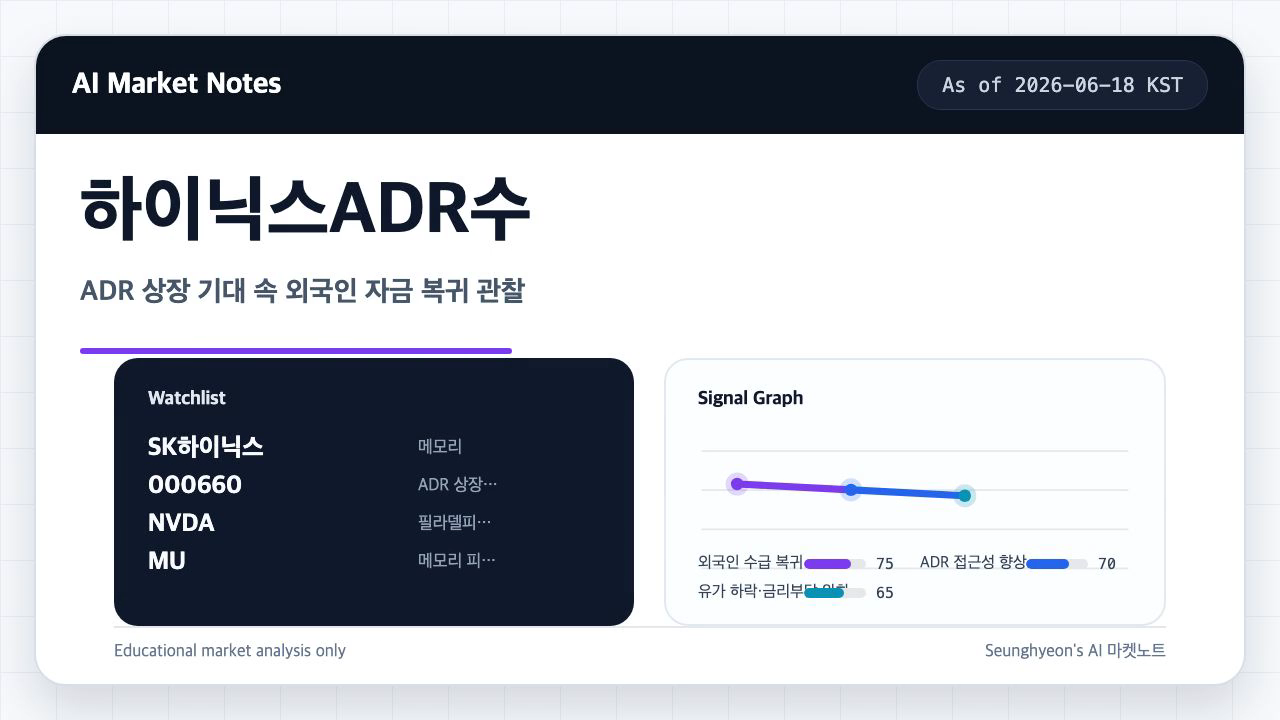
If you follow Korean memory stocks and you just saw "SK hynix HBM" trending again, the question underneath is usually narrower than it looks: is the rumored US ADR listing a real catalyst for foreign-money inflow, or is it already priced in? This page is for the investor or quant developer who wants to verify that question with sources and a small reproducible check — not re-read the X thread that started it.
The short answer: as of June 18, 2026, SK hynix (KRX: 000660) is being discussed as a candidate for a US ADR (American Depositary Receipt) listing, and Korean press frames that as a path to easier foreign access and potential inflows. That is an expectation reported by sources, not a confirmed filing or a measured fund flow. The useful move is to treat "ADR listing improves access → foreign money returns → memory leadership resumes" as a chain of hypotheses and check each link against data you can pull yourself.
What the source actually says (and what it does not)
An ADR is a US-traded certificate that represents shares of a foreign company, so a US investor can buy exposure in dollars during US hours without touching the Korean exchange directly. For a name like SK hynix, the thesis is that lower access friction widens the buyer pool and can pull foreign capital back into the stock.
Here is the boundary, stated plainly. The Korean coverage (Maeil Business and a Daum syndication) reports ADR-listing expectations and an inflow narrative. None of that is a measured number, a confirmed listing date, or an official disclosure from the company. I have not measured any fund flow here; the framing below comes from the cited articles and from data you would pull live, not from a benchmark I ran.
| Claim in circulation | Status as of 2026-06-18 | What to check |
|---|---|---|
| SK hynix pursuing US ADR listing | Reported expectation, not confirmed filing | Company disclosure (DART), SEC EDGAR F-6 |
| ADR brings foreign-money inflow | Interpretation / narrative | Daily foreign net buy on KRX |
| Memory leadership resumes (oil down, rate pressure easing) | Macro hypothesis | Oil, KRW rate, peer tape |
| SOXX / PHLX peer reaction | Watch item | NVDA, MU intraday correlation |
The table separates the one reported item from three interpretations stacked on top of it. After you read it, the practical job is the same as any other "is this catalyst real" question: find the primary disclosure first, then watch whether the money actually moves, and only then trust the narrative.
Pin the catalyst: a small, reproducible check
You do not need a trading desk to verify the first two links of the chain. You need the company's own disclosure and the daily foreign-flow tape. Below is a reversible, read-only recipe — no orders, no positions — that records exactly what you looked at and when.
Scenario. You saw the ADR-listing claim and want to confirm (a) whether there is an official filing and (b) whether foreigners are actually net buying 000660 around the date.
Input. Ticker 000660 (KRX), the as-of date 2026-06-18, and the two source URLs.
Command or config. A tiny Python pull of recent OHLCV plus a placeholder for the foreign-flow series you fetch from your data vendor:
import yfinance as yf
import pandas as pd

# SK hynix on KRX trades as 000660.KS
df = yf.download("000660.KS", start="2026-06-01", end="2026-06-19")
print(df[["Close", "Volume"]].tail(10))

# Foreign net-buy is NOT in yfinance; pull from your KRX/data vendor.
# Record it next to price so you can line up the narrative with the tape.
foreign = pd.read_csv("foreign_netbuy_000660.csv", parse_dates=["date"])
print(foreign.tail(10))
Expected output. Ten trading days of close and volume, plus a foreign net-buy column you can eyeball against the ADR headline date. If the inflow story is real, you expect rising volume and positive foreign net-buy clustering near the news, not before it.
Common failure. yfinance returns an empty frame because you used the wrong suffix — KRX listings need .KS (KOSPI), and KOSDAQ names need .KQ. A second trap: assuming volume alone proves "foreign" buying. Volume is everyone; the foreign net-buy series is the part that maps to the ADR thesis, and it is not in the free price feed.
How to verify. Cross-check the listing claim against the company's regulatory disclosure (DART in Korea) and SEC EDGAR for an F-6 registration, the form used to register ADRs. If neither shows a filing, you are holding a narrative, not a confirmed catalyst — log it as a hypothesis and move on.
The peer-reaction read
The X note also flags the Philadelphia Semiconductor Index (PHLX, tracked by the SOXX ETF) and peer behavior. The logic: if a memory-cycle or AI-demand narrative is genuinely turning, you would expect it to show up across peers — NVIDIA (NVDA) on the demand side, Micron (MU) as the direct memory comparable — not in 000660 alone.
import yfinance as yf

peers = yf.download(["MU", "NVDA"], start="2026-06-01", end="2026-06-19")["Close"]
print(peers.pct_change().tail(5))
If MU and the broader SOXX tape are flat while 000660 jumps on the ADR headline, that argues the move is stock-specific (access and structure), not a sector-wide memory rerating. If peers move together, the macro read has more support. Either way you are turning a vibe into a checkable correlation, which is exactly what keeps an answer honest.
Production caveats for anyone automating this
If you wire this into a routine, a few things bite. Foreign net-buy data is usually licensed — respect your vendor's redistribution terms before you publish a chart. Time zones matter: KRX closes hours before US trading, so an "ADR reaction" you read at US open is reacting to yesterday's Korean session. And currency: an ADR thesis lives in USD, so a KRW move can flatter or erase the price story when you convert. Record the FX rate alongside price or your backtest will quietly drift.
Finally, none of this is advice to buy or sell, and there is no price target here. The output of the recipe is a verified-or-not flag on a catalyst, plus the next signal to watch — not a position.
FAQ
When should I use this check?
Use it whenever a single-stock catalyst (a listing, an index inclusion, a structural change) is being credited for a price move. It is most useful before you act on a headline, while the claim is still "reported" rather than "filed."
What should I confirm before treating the ADR listing as real?
An actual disclosure. Look for a company filing on DART and an F-6 (or equivalent) on SEC EDGAR. Until a filing exists, "ADR listing" is an expectation, and the inflow story built on it is a second-order guess.
What is the easiest way to verify the result?
Line up three series on the same dates: 000660 price and volume, foreign net-buy, and the peer tape (MU, SOXX). If foreign net-buy turns positive around the news and peers confirm, the chain holds. If only price moved, you have a narrative, not a flow.
Sources and checks
Verified on: 2026-06-18
| Claim | Evidence | How to verify | Limit |
|---|---|---|---|
| Seunghyeon HBM should be checked against the original source before reuse. | mk.co.kr | Check the source page, version, date, and setup notes. | Source content can change after this article is published. |
| Seunghyeon HBM should be checked against the original source before reuse. | v.daum.net | Check the source page, version, date, and setup notes. | Source content can change after this article is published. |
| Seunghyeon HBM should be checked against the original source before reuse. | mk.co.kr | Check the source page, version, date, and setup notes. | Source content can change after this article is published. |
| Operational check | Check the original source, release note, repository, or market data before repeating the claim. | Reproduce on a small input and record input, output, and environment. | A local test does not prove every production path. |
| Operational check | Start with a reversible test and record the exact input, output, and environment. | Reproduce on a small input and record input, output, and environment. | A local test does not prove every production path. |
| Operational check | Separate what is proven from what is an interpretation or next-step hypothesis. | Reproduce on a small input and record input, output, and environment. | A local test does not prove every production path. |
This checklist turns Seunghyeon HBM into visible pass/fail points, but the evidence in the article remains the source of truth.
🐦 Faster updates on X: @baegseungh7061
📚 More in this series: AI Market Notes
💌 Subscribe: Follow on X or grab the RSS
댓글
댓글 쓰기