
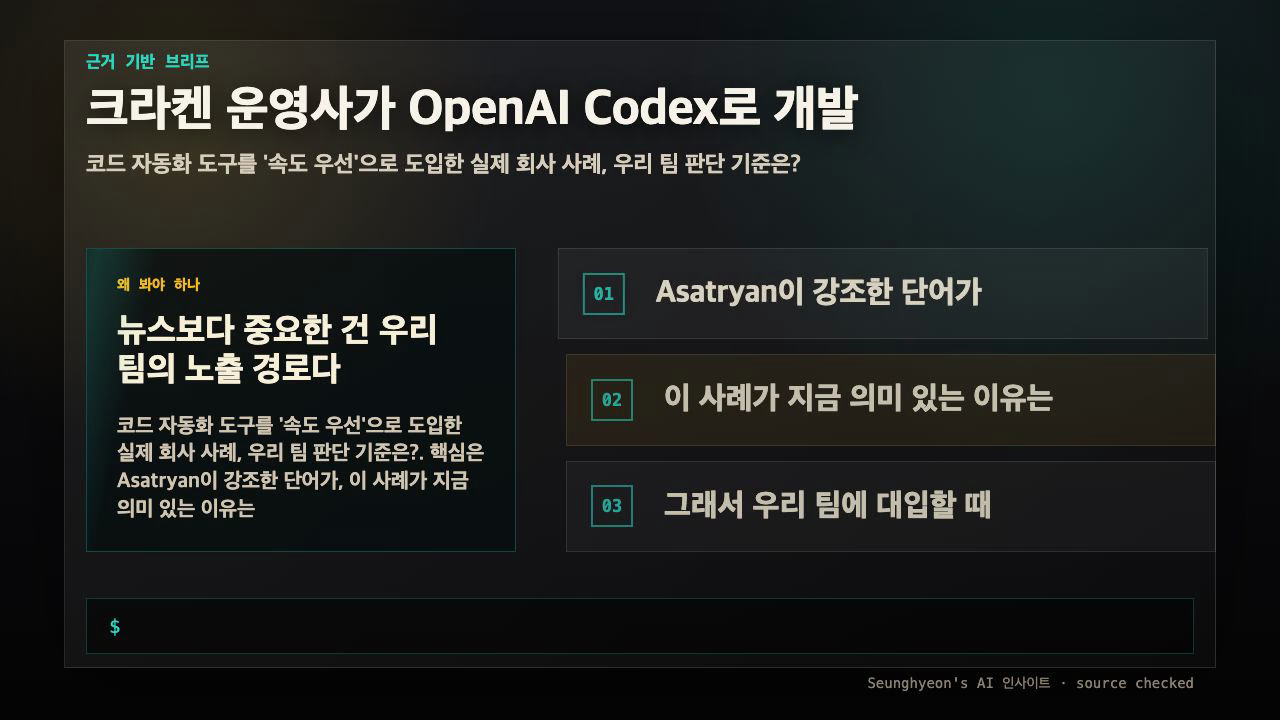
If you're weighing an AI coding tool for a team that handles money, security-sensitive data, or anything where a bad merge has real consequences, here's a useful data point: Payward, the company that runs the Kraken crypto exchange, said publicly that it sped up development with OpenAI Codex. Kamo Asatryan, Payward's Chief Data Officer, framed the adoption around "speed and innovation."
The short answer for a searcher: this is a credibility signal, not a recipe. A conservative, regulated operator putting its name behind an AI coding tool tells you the technology has crossed from demo into production workflows. But the announcement gives you the why, not the how — no numbers, no codebase scope, no review-process details. So the right move is to treat it as permission to run your own small, reversible experiment, not as a config to copy.
This post unpacks what the claim actually supports, where Codex tends to help versus where you still own the risk, and a reproducible way to test it on your own repo before you trust it with anything that ships.
What was actually said, and what it supports
The verified facts are narrow. Asatryan, in his role as CDO at Payward, stated that the company accelerated development using OpenAI Codex, and he emphasized "speed" and "innovation" as the goals. That's the load-bearing part of the story. Everything else is interpretation.
The interpretation worth making: when a data and platform leader at an exchange foregrounds speed — instead of the usual stability-and-audit language you expect from a place that custodies assets — it hints at where the tool landed. Exchanges don't hand core settlement logic to an autocomplete. They more plausibly point a tool like Codex at the repetitive, easy-to-review surface area: boilerplate, first drafts, test scaffolding, glue code. That's also exactly where AI coding tools earn their keep in practice — not full automation, but "draft fast, human reviews."
Keep the boundary clean as you read on:
| Claim | Status | Why it matters |
|---|---|---|
| Payward uses OpenAI Codex | Stated by the company | Credible adoption signal |
| CDO emphasized "speed" and "innovation" | Stated | Hints at low-risk, high-volume use |
| Codex replaced core settlement logic | Not claimed | Don't assume this |
| Specific speedup numbers exist | Not disclosed | No benchmark to copy |
| Review/security process details | Not disclosed | You must design your own |
The table matters because the most common mistake here is reading a vendor-adjacent announcement as a measured benchmark. It isn't one. "We move faster with Codex" is a directional statement from the adopting company, and the useful response is to ask what you'd need to see before you believed the same thing about your own team.
Why this lands now
A year ago the debate was "should we use AI coding tools at all." This story signals the debate has moved to "where do we slot it to actually get speed." The weight comes from the source: a notoriously conservative industry, a named executive, an on-the-record acceleration claim. That's a different category from an anonymous productivity promise on a vendor landing page.
Freshness and limits, stated plainly: this reflects a public statement as of mid-2026, sourced from third-party coverage rather than a Payward engineering postmortem. There's no version number for "their Codex setup," no measured before/after, and no description of how changes passed review or security gates. Treat the announcement as that it happened, and treat the how as something you reconstruct in your own environment.
Where Codex helps versus where you still own the risk
The practical model is a split, not a switch. Decide upfront which code Codex drafts and which code a human owns end to end. Getting that line right is most of the value.
| Good fit for Codex drafting | Keep human-owned |
|---|---|
| Boilerplate, CRUD, glue code | Settlement, balance, custody logic |
| Unit/integration test scaffolds | Auth, permissions, key handling |
| Refactors with strong test coverage | Anything touching funds or PII without tests |
| Doc strings, migration drafts | Irreversible migrations on prod data |
In a real workday, this means your first Codex target shouldn't be the scary core service. It should be the directory full of repetitive code that a teammate could review in five minutes. The win is that the human's time shifts from typing predictable code to reviewing it — and review is where correctness gets enforced. If a piece of code is hard to review, it's a bad candidate for AI drafting, regardless of how impressive the generation looks.

This checklist turns OpenAI Codex into visible pass/fail points, but the evidence in the article remains the source of truth.
Worked example: reproduce it on a small input
You don't need Kraken's scale to test the core claim. The claim under test is simple: for repetitive, well-covered code, does a Codex draft plus human review beat hand-writing? Here's a reversible setup.
Scenario. You have a small utility module with good unit-test coverage and need a new pure function — say, formatting and validating a currency amount.
Input. A clear, bounded spec written as a prompt next to the existing tests:
Write a TypeScript function `formatAmount(value: string, currency: string): string`.
- Reject non-numeric `value` by throwing RangeError.
- Round to the currency's minor units (USD=2, JPY=0, BTC=8).
- Return a string with thousands separators.
Match the existing style in src/format/. Do not add new dependencies.
Command or config. Run the draft, then immediately gate it with your existing checks — never merge straight from generation:
# 1) generate the draft into a feature branch
git checkout -b codex/format-amount

# 2) run the same gates a human PR would face
npm run lint
npm test -- src/format
npx tsc --noEmit
Expected output. A function that passes npm test, adds no dependencies, and matches surrounding style. A clean diff that a reviewer can read top to bottom in a couple of minutes.
Common failure. The draft invents a helper or pulls in a formatting library you didn't ask for, or it quietly mishandles an edge case the spec named (JPY rounding to 0 minor units is a frequent miss). Both are caught by tests and the no-new-deps rule — which is the point of running the gates before review, not after.
How to verify. Compare honestly: time to a mergeable result for the Codex-drafted path versus hand-writing, including review time. Record the diff size, whether tests passed first try, and how many review comments it took to land. If the AI path isn't faster end to end on this low-risk surface, it won't be faster on harder code.
Production caveats before you scale it up
Once a small test works, the failure modes shift from "is the code right" to "is the process safe." Codex drafts can introduce subtle license or dependency drift, leak secrets into prompts or generated config, or produce code that passes tests but violates an unstated invariant. None of that shows up in a happy-path demo.
Use this as a pre-merge gate for any AI-drafted change:
- Input scope: the change touches only the directory you intended, with no surprise new files.
- Permission boundary: nothing in the diff reads keys, secrets, or auth paths it shouldn't.
- Failure log: lint, type-check, and the full test suite pass — not just the new test.
- Rollback path: the change is a small, revertible PR, not a sweeping multi-module rewrite.
The reason these stay as explicit checks is that AI-generated code reviews well — it's plausible, formatted, and confident — which makes a reviewer more likely to wave it through. A written gate counters that bias. Treat every Codex draft as a PR from a fast junior engineer who never says "I'm not sure": helpful, but reviewed accordingly.
FAQ
When should I use OpenAI Codex?
Use it where code is repetitive and easy to review — boilerplate, test scaffolds, refactors backed by strong coverage. Avoid handing it logic that moves funds, manages auth, or runs irreversible migrations until your review process is proven on safer surfaces first.
What should I check before applying OpenAI Codex in production?
Confirm the change's scope is contained, no new dependencies or secrets entered the diff, the full test suite and type-check pass, and the change is small enough to revert cleanly. If you can't review the diff quickly, it's the wrong task for AI drafting.
What is the easiest way to verify the result?
Run the same gates a human PR faces — lint, tests, type-check — on a feature branch before review. Then compare end-to-end time to a mergeable result, review time included, against hand-writing the same code on a low-risk module.
Sources and checks
Verified on: 2026-06-15
| Claim | Evidence | How to verify | Limit |
|---|---|---|---|
| OpenAI Codex should be checked against the original source before reuse. | startuphub.ai | Check the source page, version, date, and setup notes. | Source content can change after this article is published. |
| Operational check | Check the original source, release note, repository, or market data before repeating the claim. | Reproduce on a small input and record input, output, and environment. | A local test does not prove every production path. |
| Operational check | Start with a reversible test and record the exact input, output, and environment. | Reproduce on a small input and record input, output, and environment. | A local test does not prove every production path. |
| Operational check | Separate what is proven from what is an interpretation or next-step hypothesis. | Reproduce on a small input and record input, output, and environment. | A local test does not prove every production path. |
🐦 Faster updates on X: @baegseungh7061
📚 More in this series: AI Insights
💌 Subscribe: Follow on X or grab the RSS
댓글
댓글 쓰기