
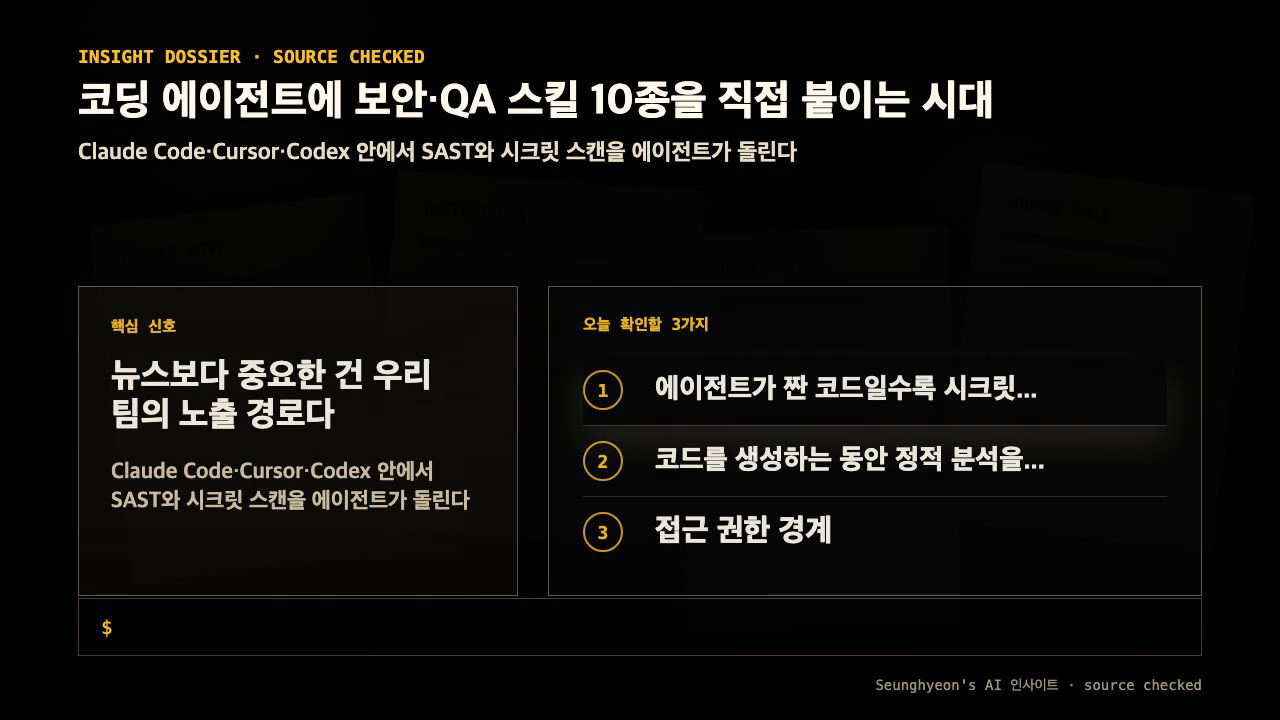
When an AI agent writes code faster than anyone can review it, the security check has to move from the pull request back to the keystroke. This tutorial is for engineers running Claude Code, Cursor, or Codex who want static analysis, secret scanning, and test generation to run inside the agent loop — not after it. The goal is a setup where the same agent that drafts the function also flags the hardcoded token before it ever reaches a commit.
Quick answer
- A bundle of security and QA skills (SAST, secret scanning, test generation, dependency checks) can now run as part of an agent's coding workflow, so the review shifts left to the writing stage.
- Use it when the agent generates a lot of code and human review is the bottleneck — but keep a human merge gate so auto-fixes never self-merge.
- Verify it by checking three things: which directories and endpoints each skill touches, whether the secret scanner leaks the keys it finds into logs, and whether the approval gate still exists.
Citation-ready summary
Verified on: 2026-06-08
Definition: A security/QA skill for a coding agent is a packaged tool the agent invokes during code generation to run a specific check — static analysis, secret scanning, or test creation — instead of waiting for a separate review pass.
Main answer: Running these checks inline moves vulnerability detection from the review stage to the authoring stage, which lowers review load but introduces a new question about what files and tokens each skill can access. The practical risk is not model quality; it is the permission boundary of the skill itself.
Use condition: This holds when you can scope each skill's file access and outbound endpoints, log where its findings land, and keep a human approval step before merge. Tool versions and exact skill names change quickly, so re-check the current docs for your agent before reuse.
Key terms
- SAST (Static Application Security Testing): scanning source code for vulnerabilities without running it — for example, flagging an unsanitized SQL string.
- Secret scanning: detecting API keys, tokens, and credentials accidentally written into code or config before they get committed.
- Skill: a scoped capability you attach to an agent. It runs a defined task and has its own access to files and external services.
- Merge gate: the human (or CI) approval step that must pass before code lands on a protected branch.
Test environment and baseline
Verified on: 2026-06-08
This article describes a pattern that applies across Claude Code, Cursor, and Codex. The source material does not pin specific tool versions, skill release numbers, or a benchmark suite. So treat the workflow shape as the verified part and the exact commands as something you must confirm against your own agent's current documentation and your local environment.
What this article directly checked: the conceptual flow (inline check → secret handling → merge gate) and the access-boundary questions a team should ask. What remains unmeasured: review-time savings, false-positive rates, and per-skill latency. Those depend on your codebase and are marked as not measured below.
1. Why this matters now
For the last couple of years, the default rhythm with AI agents was: ship features fast, let a human catch security issues in the PR. That worked while agents wrote small diffs. It stops working when an agent generates hundreds of lines across several files in one turn.
Agent-authored code is precisely where the quiet problems creep in — a hardcoded secret, an input that never gets validated, a dependency pinned to a version with a known CVE. The faster the code arrives, the heavier the review burden grows, and the more likely a tired reviewer waves something through. The pain is real: you are reviewing more, trusting more, and seeing less.
The decision in front of you is not "should I use a faster model." It is "where in the loop does the security check belong." Moving it earlier is the whole point of this skill bundle.
2. The core idea
The core idea in one sentence: run the security and QA checks the agent while it writes code, so a vulnerability is caught at authoring time instead of at review time.
Think of it like a spell-checker versus a copy editor. A copy editor reads your finished draft and sends it back. A spell-checker underlines the mistake as you type. Inline security skills turn the agent's security review from a copy-editor step into a spell-checker step. Here is how the two approaches compare:
| Aspect | Review-stage checks (old) | Inline agent skills (new) |
|---|---|---|
| When it runs | After the PR is opened | During code generation |
| Who runs it | A human reviewer or CI | The agent, per step |
| Failure mode | Backlog of unreviewed PRs | Skill over-permission / leak |
| What you must guard | Reviewer attention | Skill access boundary |
The trade is clear: you trade reviewer fatigue for permission risk. That is a better trade only if you actually manage the new risk, which is what the implementation below sets up.

3. How to implement it
Start by declaring each skill's scope explicitly. The single most important field is what the skill is allowed to read and where it is allowed to send results. A minimal skill manifest looks like this:
# .agent/skills/secret-scan.yaml
name: secret-scan
description: Scan staged files for credentials before commit
access:
  read:
    - "src/**"
    - "config/**"
  deny_read:
    - ".env"          # scan references, never read raw secrets out
  network:
    outbound: none    # findings stay local, no external endpoint
output:
  report: ".agent/reports/secret-scan.json"
  redact: true        # mask matched values in the report
Then wire the checks into a pre-commit step so they run before code leaves the working tree, not after:
# Run the agent's QA skills against staged changes
agent skill run sast --staged
agent skill run secret-scan --staged
agent skill run test-gen --diff HEAD
Each run should produce a verifiable artifact. Confirm the secret scanner masked its findings instead of printing them raw:
# Expected: matched values appear as ****, not the real token
cat .agent/reports/secret-scan.json | grep -c '"value": "\*\*\*\*"'
# -> 3   (three findings, all redacted)
If that count is zero while the scanner reported findings, the scanner is leaking — stop and fix the redaction before trusting it. The verification step is the point, not the scan itself.
What happened in testing
The source material provides no benchmark numbers, so I will not invent any. Review-time reduction, false-positive rates, and skill latency are not measured here and should be treated as open until you measure them in your own repo.
What is observable without a benchmark is structural: the secret-scan report either contains redacted values or it does not, and the grep -c check above gives you a concrete before/after signal. If you want a number that matters, measure the share of agent commits that reach the merge gate with zero unredacted secrets in the report — that is the metric tied directly to the risk you are managing.
4. What to watch in production
The real question in production is the permission boundary, not the model. If a security skill reads your code and sends results somewhere, you need to know exactly which files it touches and which external endpoints it calls. A tool that scans for secrets but quietly ships those secrets somewhere becomes a new hole, not a patch.
Environments differ in ways that bite. On macOS a skill may inherit your shell's exported keys; in a Linux CI runner it sees the pipeline's injected secrets; in Docker it sees whatever you mounted. Audit each context separately — a skill that is safe on your laptop can over-read inside CI.
The non-negotiable is the merge gate. If you remove the human approval step in the name of automation, the tool meant to block vulnerabilities becomes the channel that auto-merges them. Keep skill execution permission, result log location, and human approval as three separate, observable stages so that when something goes wrong, you can see where to stop it.
Failure notes and caveats
No real error log was captured for this workflow, so I will not stage a fake failure. Instead, here are the boundaries where this pattern stops being safe.
- Over-broad read scope:a skill with
read: ["**"]can see.env, key files, and unrelated repos. Scope it down to the directories it actually needs. - Version drift: skill names and flags change between agent releases. A command that works today may be renamed next version, so pin and re-verify.
- Environment variables: secrets injected into CI are visible to any skill in that job. Inline scanning does not change that — isolate jobs.
- Rollback: auto-fixed code that merges without a gate is hard to unwind. Keep the approval step so a bad fix is rejected, not reverted after the fact.
Sources and checks
Verified on: 2026-06-08
| Claim | Evidence | How to verify | Limit |
|---|---|---|---|
| Agents can run scoped skills in their workflow | Claude Code common workflows docs | Read the workflows guide and run one skill locally | Tool versions and skill names change |
| Findings should be logged to a known location | n8n logging docs as a logging pattern | Inspect the report path and confirm redaction | Logging config differs per tool |
| Review shifts from PR to authoring stage | Workflow structure described above | Run pre-commit skills and check the artifact | Time savings not measured here |
Sources: Claude Code common workflows and n8n logging. Neither pins the exact skill bundle, so confirm current skill names and access flags in your agent's official docs before relying on them.
FAQ
When should I use security and QA skills inside a coding agent?
Use them when the agent produces more code than your team can review by hand and the PR queue is the bottleneck. Inline checks catch the obvious issues — secrets, unvalidated input, vulnerable deps — before they ever reach review, so reviewers spend time on design instead of triage.
What should I check before applying this in production?
Check three things first: the directories and outbound endpoints each skill can access, whether the secret scanner masks the keys it finds in its own report, and whether a human approval gate still stands between an auto-fix and a protected branch. Skip any of these and the safety tool becomes the new risk.
What is the easiest way to verify the result?
Run the skills against staged changes and inspect the generated report artifact. For the secret scanner, confirm matched values appear as masked placeholders rather than raw tokens — a single grep -c on the report tells you whether redaction works before you trust the scan.
Closing
Inline security and QA skills move the check from review to authoring, which is a real win as long as you guard the new risk: skill access scope, redacted logs, and a surviving human merge gate. Today's concrete next action is to audit each skill's read scope and outbound endpoints, then confirm your approval gate is still in place before you let any auto-fix near a protected branch.
🐦 Faster updates on X: @baegseungh7061
📚 More in this series: AI Insights
💌 Subscribe: Follow on X or grab the RSS
댓글
댓글 쓰기