
#KiroweenHackathon26. This post is written as part of the Kiroween 2026 hackathon.
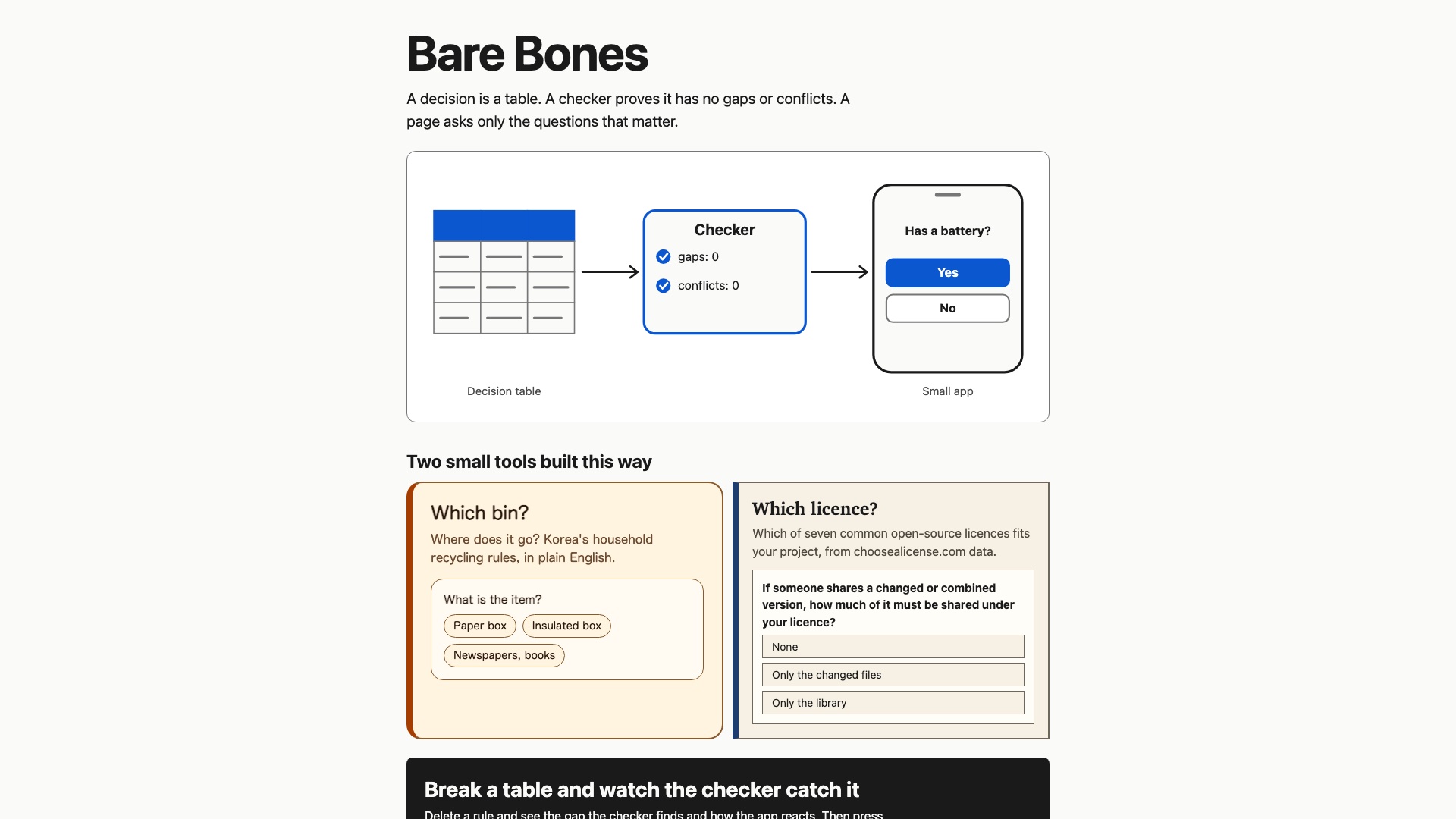
Bare Bones turns a small decision tool into a table, proves with a checker that the table has no gaps and no conflicts, and only then turns it into an app. I built it with Kiro for the Skeleton Crew category.
If you have ever shipped a pile of if-statements and could not say whether it had a hole, this post is for you. It covers what the skeleton does, how Kiro built it, and what happened when I gave an AI coding agent rules it could test.
Live: https://seunghyeon1004.github.io/bare-bones-kiro/
Code, specs and every Kiro session transcript: https://github.com/seunghyeon1004/bare-bones-kiro
Try this first: delete one rule and watch the checker catch it
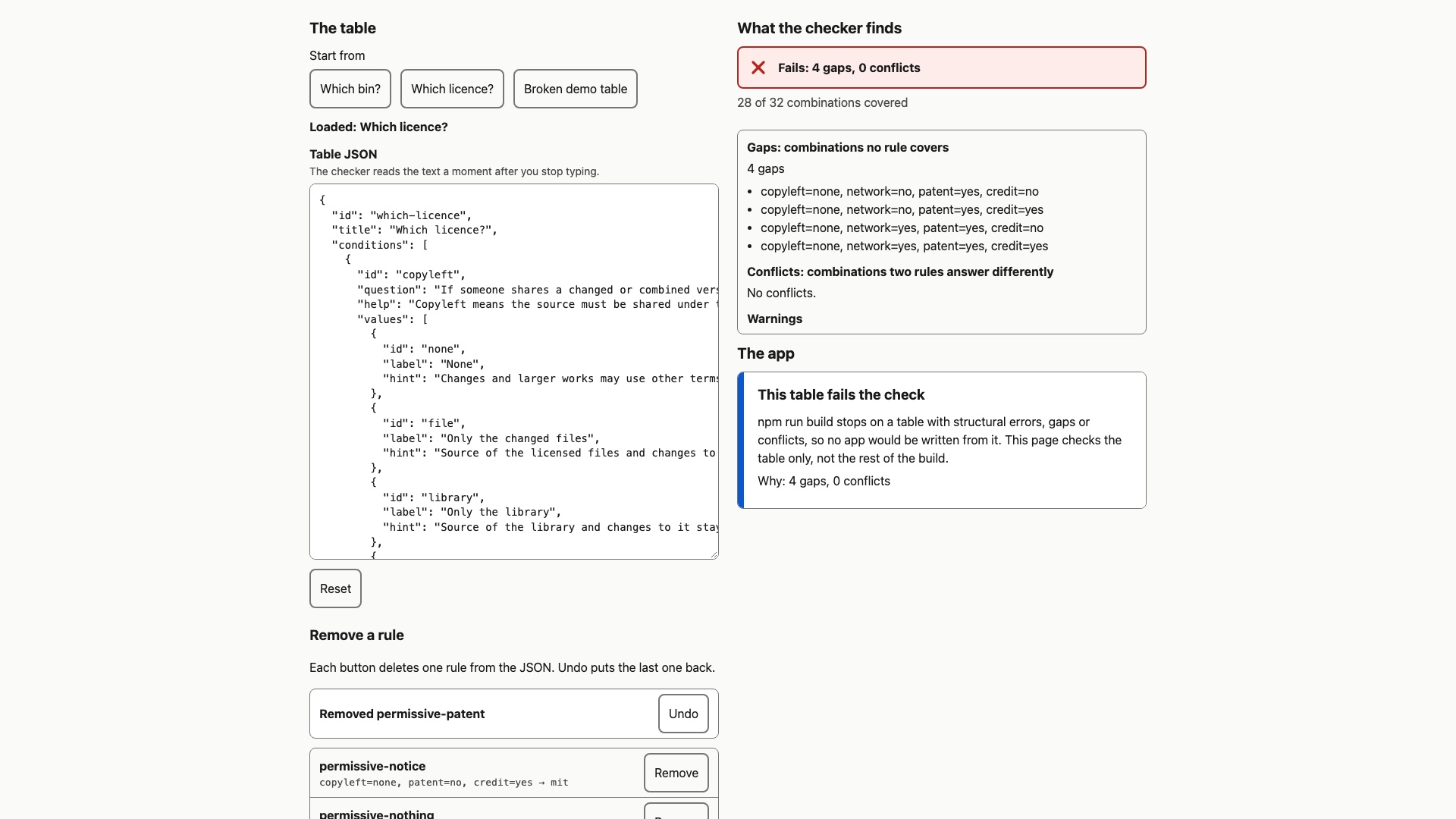
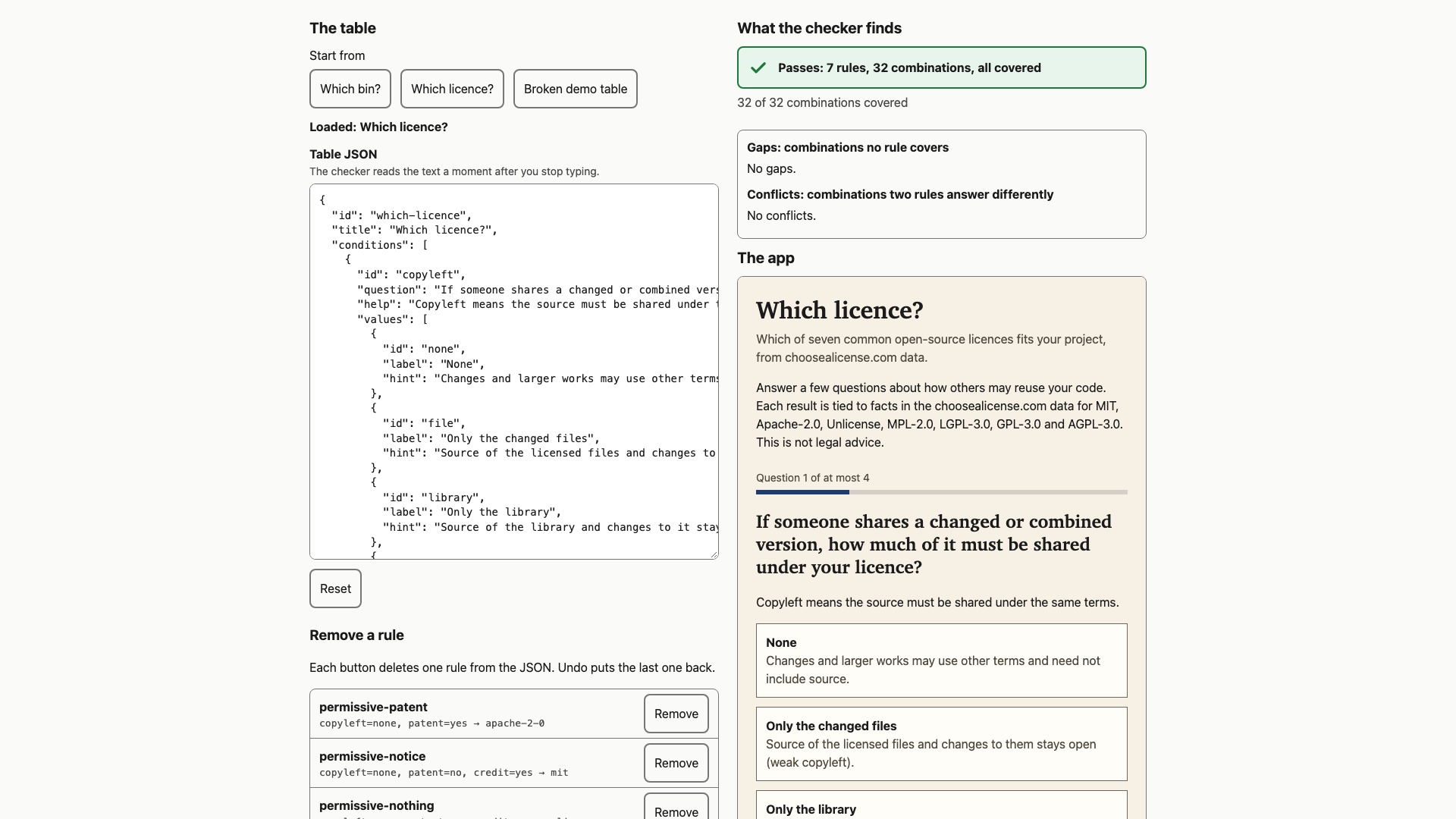
Open the playground. It loads a table that picks an open-source licence: seven rules, thirty-two combinations of answers, all covered. Click "Remove" next to the first rule. The checker answers straight away: four combinations now have no answer, and it lists them. The little app running beside the table is replaced by a notice that the table fails the check. Click Undo and everything passes again.
The problem: a pile of if-statements nobody can check
Which bin does a greasy pizza box go in? In Korea the answer exists, but in Korean, spread over a city web page and a 36-page Ministry of Environment guide. Which licence should my library use? That answer exists too, spread over licence texts.
Small tools that answer questions like these usually turn into a pile of if-statements. They mostly work. But nobody can look at the pile and say whether it has a hole (a case no branch answers) or a contradiction (two branches that answer the same case differently), and those are exactly the mistakes that matter when someone trusts a tool for a quick answer.
Bare Bones turns the decision into data: a table. Each question has a fixed set of answers. Each rule says which answers lead to which outcome, and which line of which source it comes from. If a rule does not care about a question, you just leave that question out. Because the table is data, a program can check every case. The playground runs that check while you edit.
What the Bare Bones skeleton does
- A checker. It finds every gap and every conflict, each with a concrete example. The build refuses to publish a table that fails.
- Only useful questions. After each answer it asks only a question that can still change the outcome, and it stops as soon as the outcome is settled. A greasy paper box takes two questions out of seven.
- An explanation. Each result shows the rule that fired, the answers that mattered, the source line with its dates, and the questions it skipped because they could not change the answer.
- A page shell. Any valid table becomes an accessible page: real buttons, works with the keyboard alone, light and dark, phone width, a shareable link, and a plain view of the whole table. Static files, with no login and no tracking.
- A command line. One command checks a table, another scaffolds a new app.
Two apps, three files each: Which bin? and Which licence?
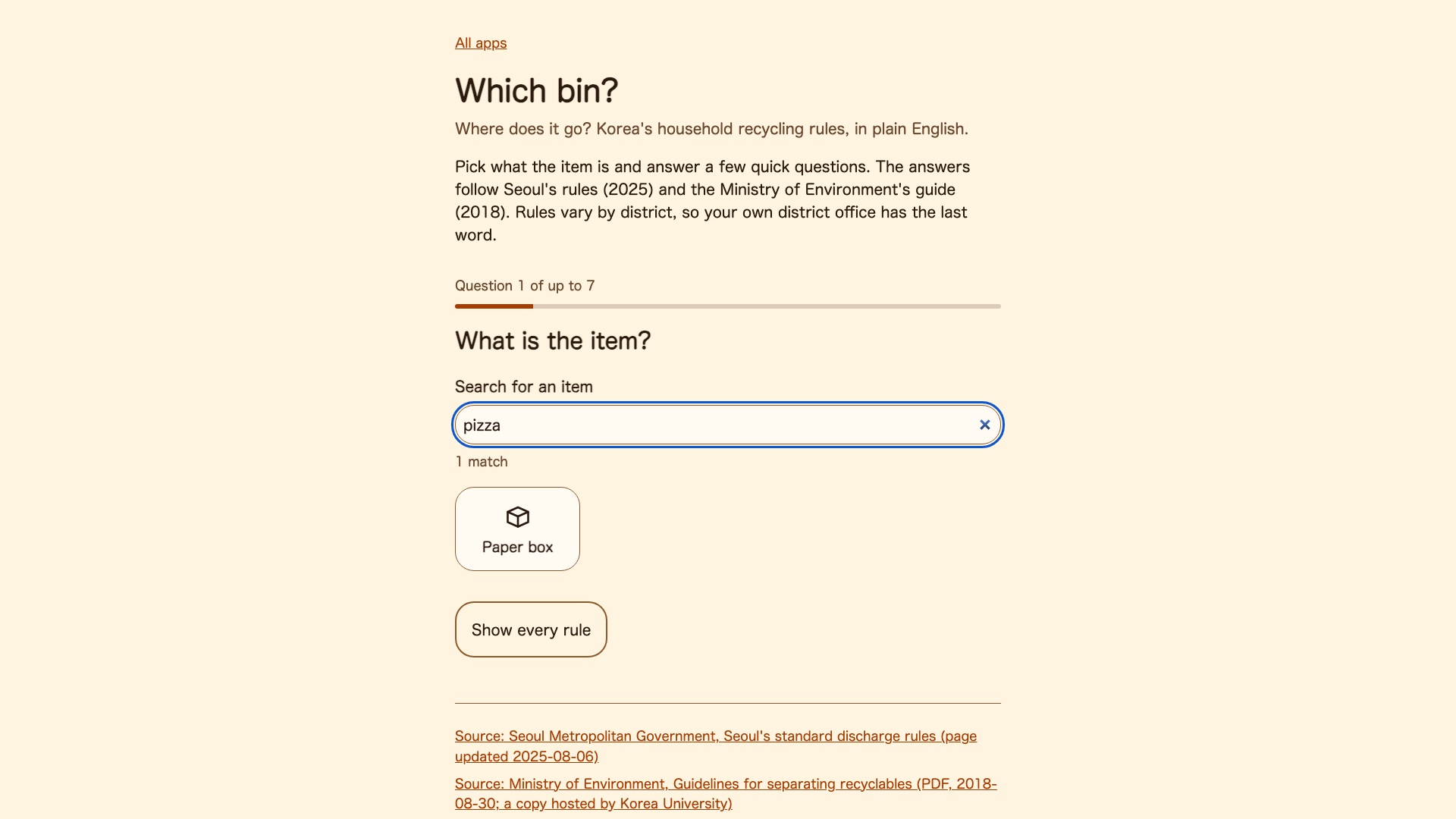
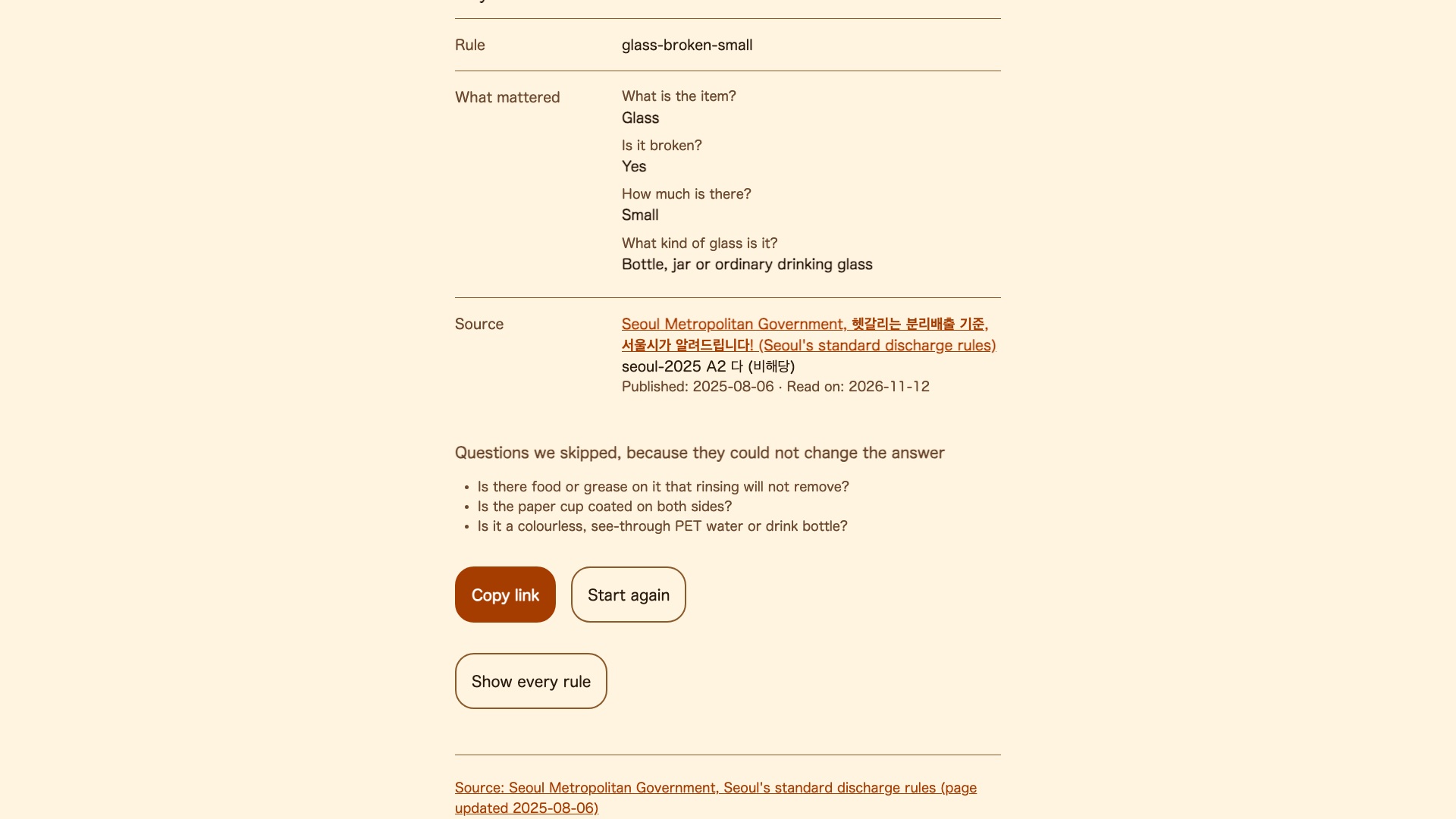
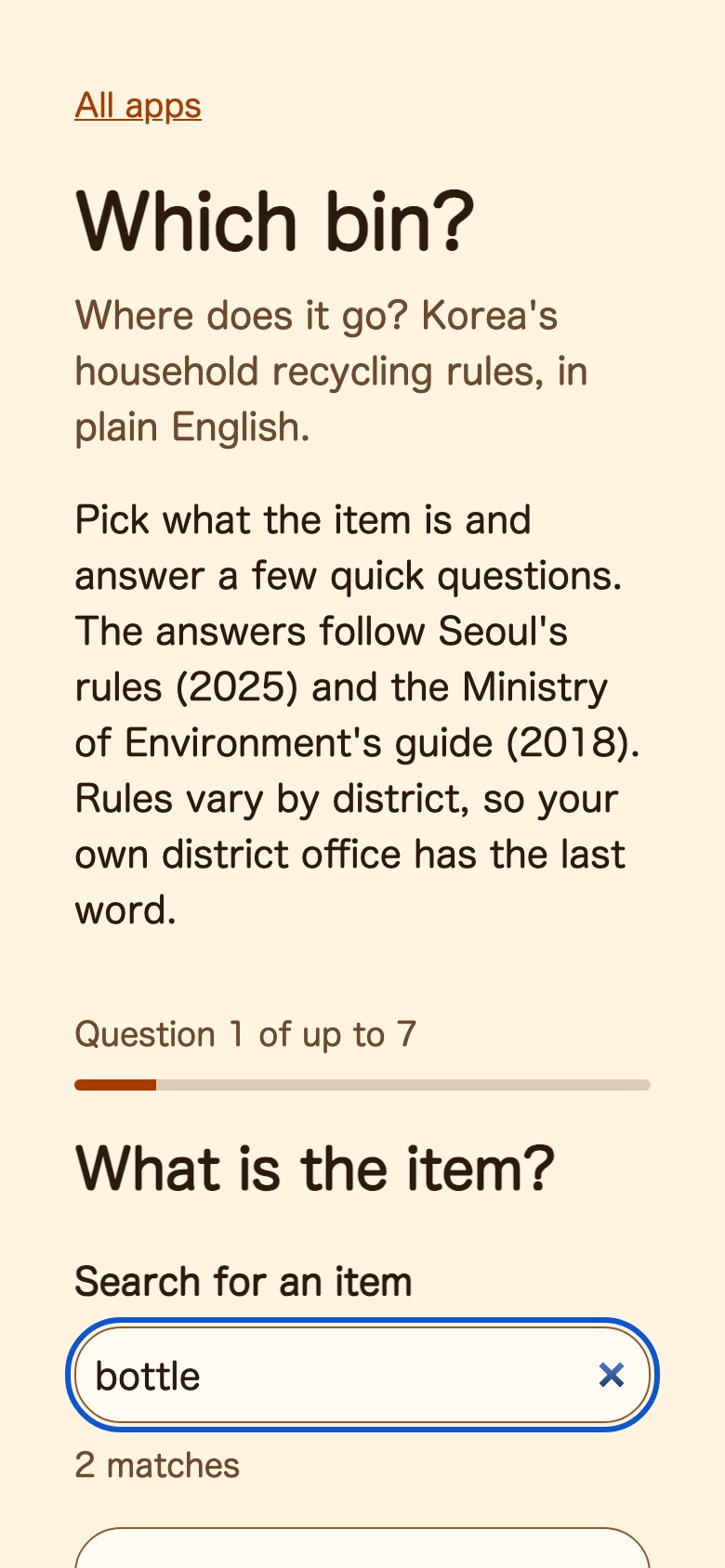
Which bin? tells you where a household item goes under Seoul's 2025 separate-discharge rules and the Ministry of Environment guide, in English. Type "pizza" or "bottle" in the search box and the tiles narrow down; each tile has a small line drawing. Where the sources say nothing, the app says "Ask your district office".
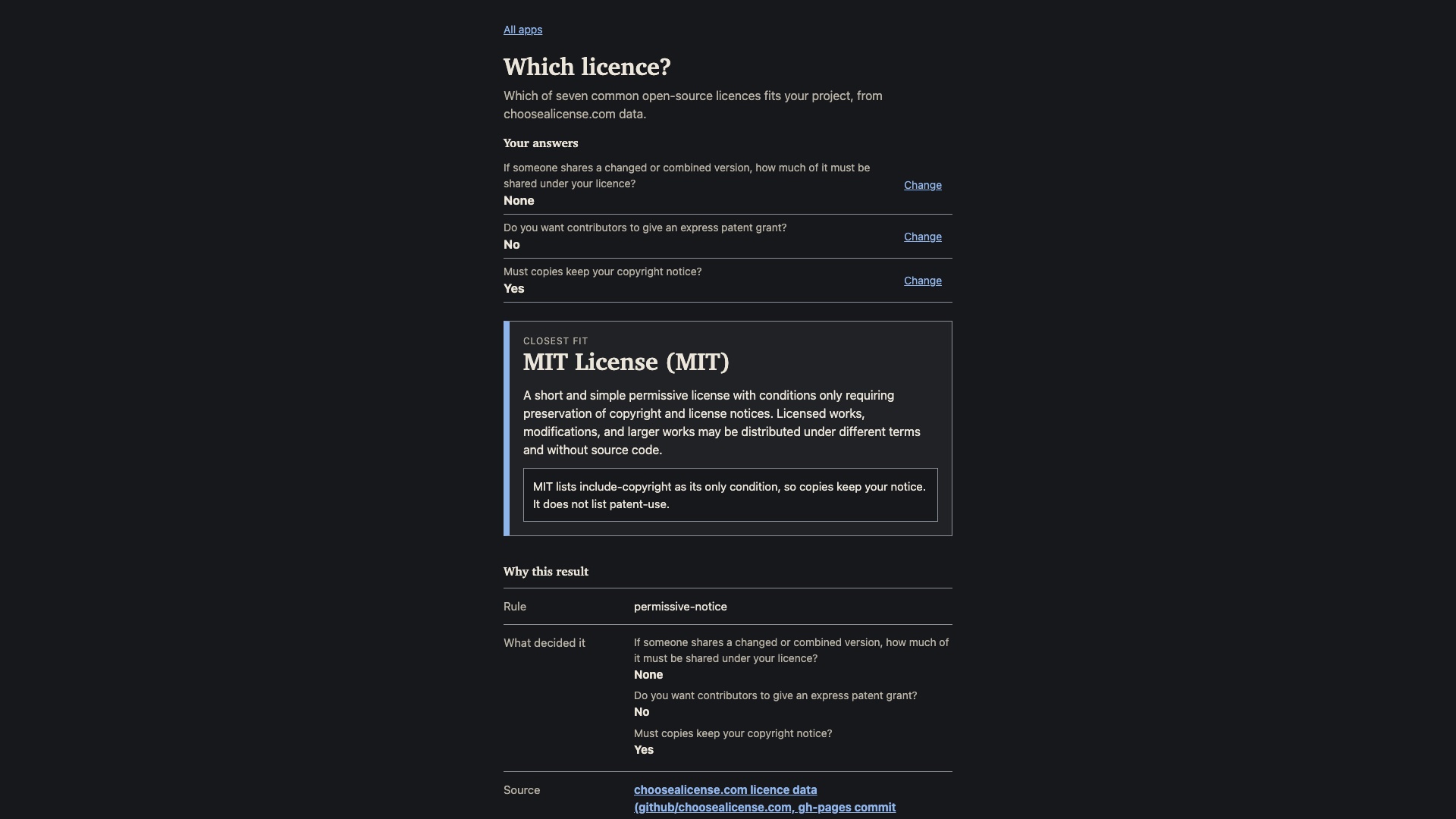
Which licence? picks one of seven open-source licences from choosealicense.com's data. It is a calm list, ink on paper. It is not legal advice, and it says so.
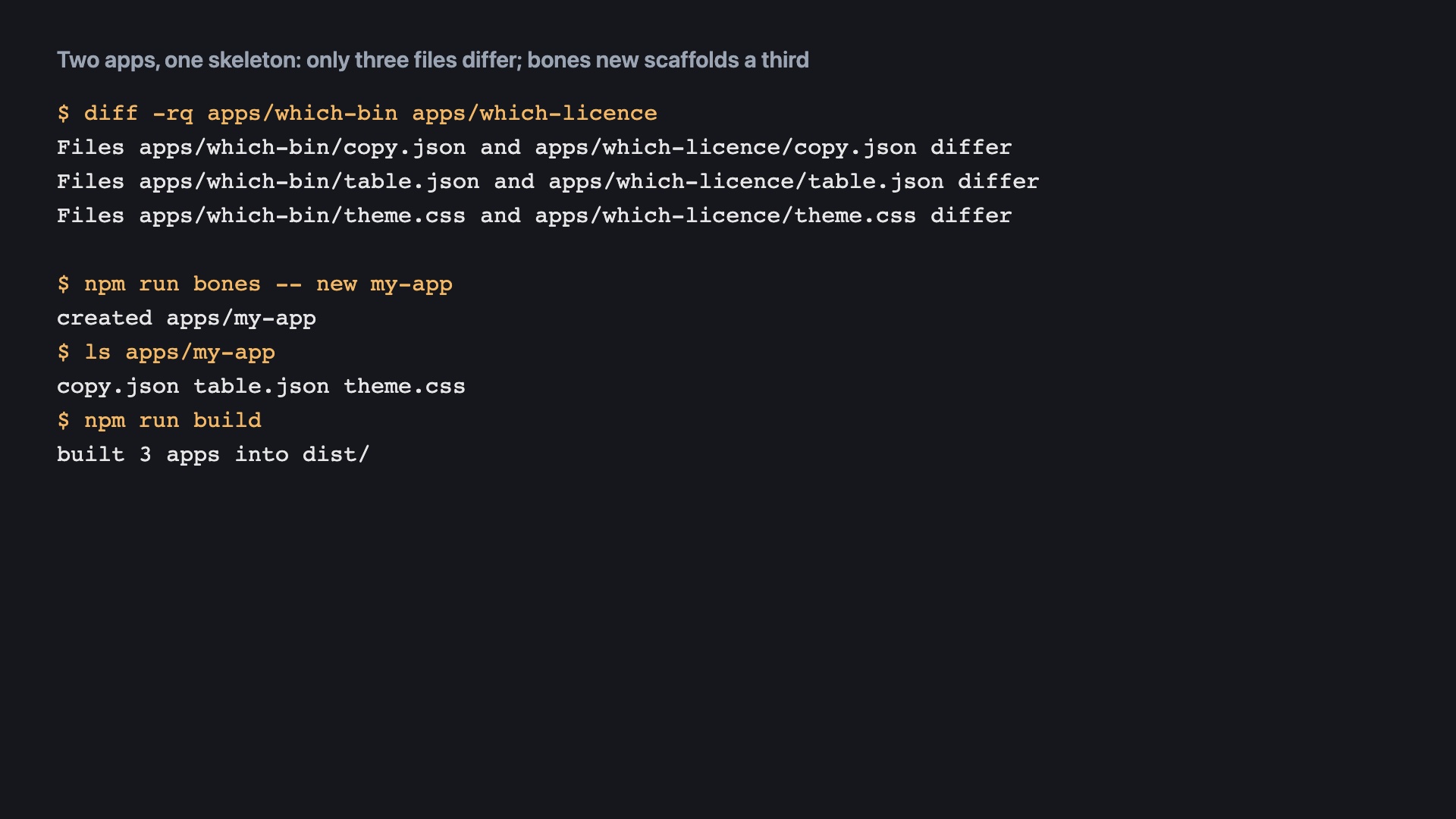
Each app folder holds a table, a file of words and a theme file with colours and fonts. The pictograms and the search box of Which bin? are switched on in its words file, so compare the two folders and those three files are still the only difference. Underneath, both apps run the same code.
How Kiro built Bare Bones
Kiro, driven from its command line, wrote all of the code in sixteen recorded sessions. I wrote a two-page brief and the source notes (every Korean source line quoted, with an English gloss), made the decisions, read the diffs and re-ran every check myself. Every session's transcript is in the repository.
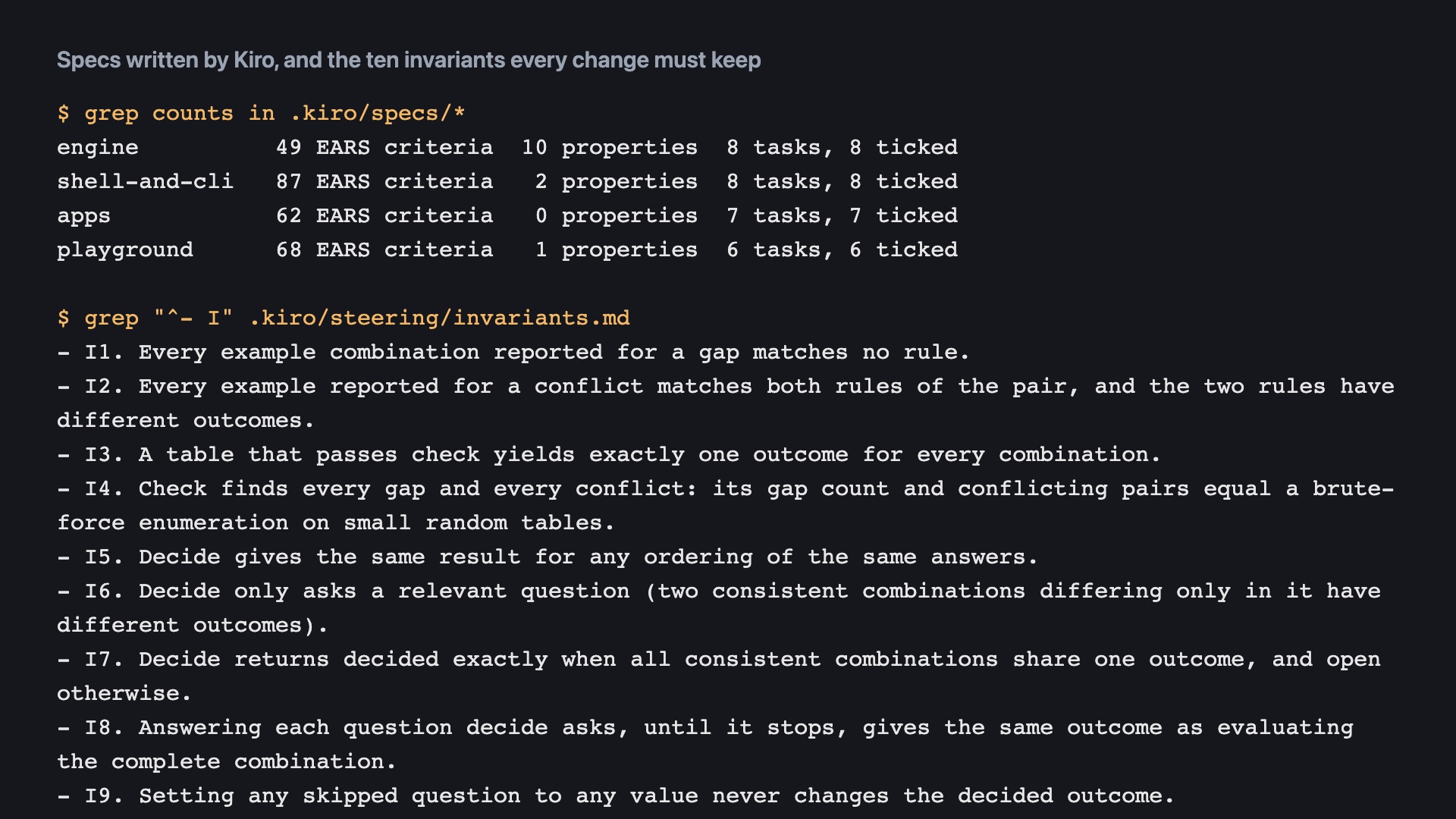
Steering with invariants. Kiro first turned the brief into six steering files. The one that mattered most lists the engine's ten guarantees as numbered invariants that no change may weaken: a reported gap really matches no rule, a table that passes gives exactly one answer for every combination, the engine never asks a question that cannot change the answer, the result does not depend on the order of the answers, and so on. Each invariant names the property test that proves it. A second file says every rule must cite a quoted source line, and a case the sources do not cover gets an explicit outcome that says so.
That second rule paid off at once. When Kiro designed the waste table, it did not make up answers for the cases the sources skip. It listed them, with counts, and asked. I went back to the Ministry guide, found three missing lines in its FAQ and added them. Only one case still ends in "Ask your district office".
Specs. Four specs, written in Kiro's spec mode: the engine, the page shell and command line, the two apps, and the playground. Together they have 266 acceptance criteria in EARS form and 29 tasks, and each task names the one command that proves it. Kiro ticked a task only after that command passed. When it had questions, it asked, and my answers went into the next prompt and into the spec.
Property tests. The ten invariants are fast-check properties, each run against a brute-force reference on two hundred random tables every time the tests run. They all passed on the first try, which made me suspicious, so I broke the engine on purpose three times. Each broken version turned at least one property red.
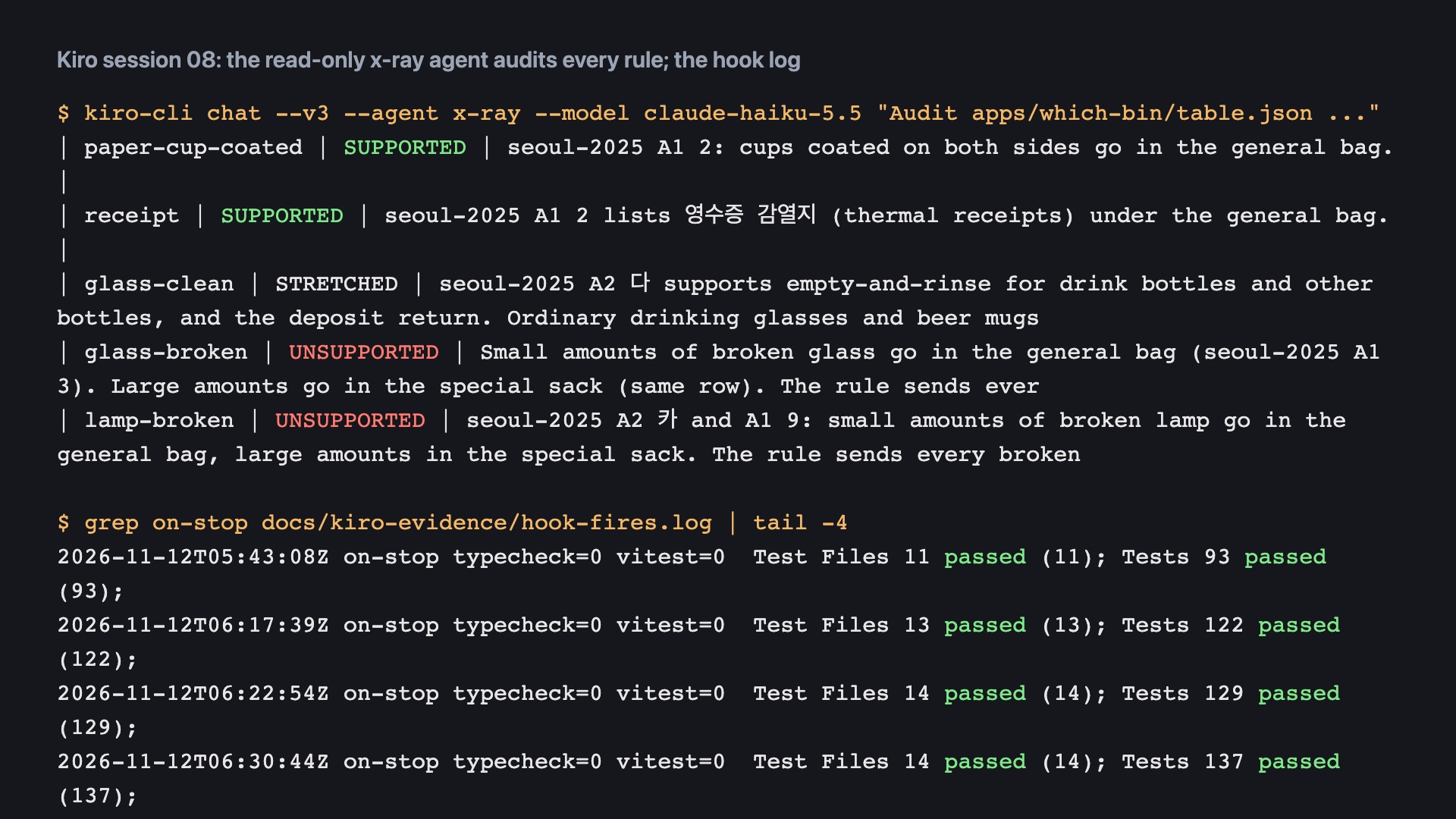
Two custom agents and their hooks. The builder agent could write only code and tests, never the steering or the docs. A hook ran the typecheck after every file it wrote: 74 times, and 24 of those caught a type error that Kiro fixed before moving on. Another hook ran the whole test suite whenever it stopped. The second agent was read-only: an auditor that checked every rule of the waste table against the quoted sources. It found two rules the sources did not support (broken glass and broken lamps, where Seoul splits small and large amounts), seven that stretched a source line, a hint that contradicted its own rule, and copy that claimed more than the sources do. A builder session fixed all of it. The audit cost less than a fifth of a credit.
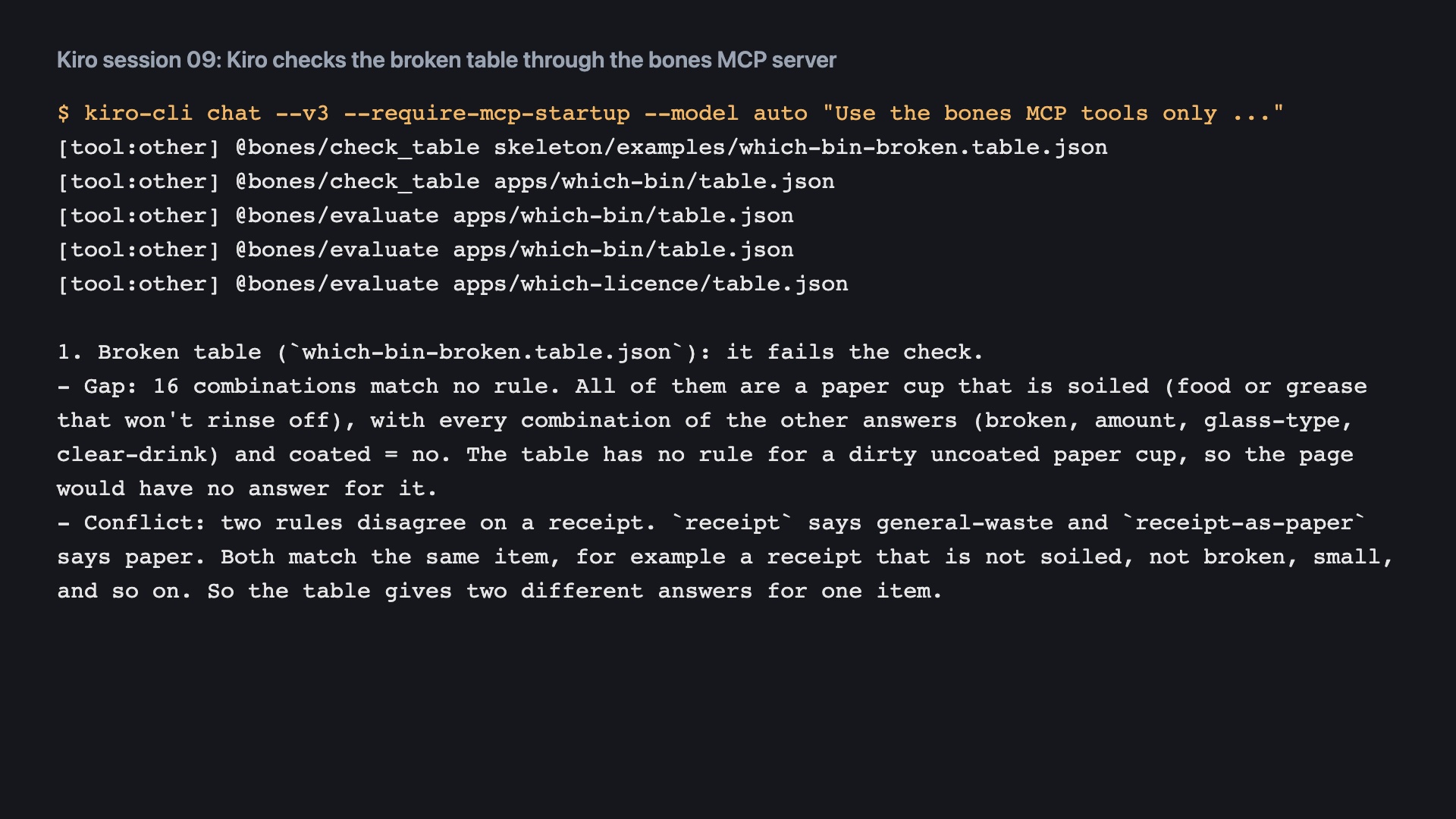
MCP. Kiro also built a small MCP server that exposes the checker and the engine as two tools. In one recorded session it used only those tools to check the broken table, explain its hole and its conflict in plain words, and walk two answer sets, all without a shell.
What I liked most about Kiro
My favourite thing is that every task names the command that proves it, and that steering can hold rules a test can check. It changed how I work with an AI agent: I stopped reading summaries and started reading test output. Where Kiro went wrong (a compiler version I changed, a spec session that exited with nothing, a lock file it had to regenerate twice, rules that stretched their sources, one test it narrowed and told me about) is written down in the repository next to every transcript. The whole project used about 214 credits.
Bare Bones in numbers
| What | Number |
|---|---|
| Steering files | 6 |
| Engine invariants | 10, each one proved by a property test |
| Specs | 4, with 266 acceptance criteria and 29 tasks, all done |
| Custom agents | 2: a builder and a read-only auditor |
| Agent hooks | 2. The typecheck hook ran 74 times and caught 24 errors; the test hook ran 8 times on stop and passed every time |
| MCP | 1 server with 2 tools |
| Kiro sessions | 16, every transcript in the repository |
| Tests | 137 (13 of them property tests) and 20 browser tests |
| Which bin? table | 7 questions, 960 combinations, 33 rules |
| Which licence? table | 4 questions, 32 combinations, 7 rules |
| Playground | remove one rule and the checker reports 4 gaps |
| Broken example table | 16 gaps and 1 conflict |
| Kiro credits | about 214 for the whole project |
FAQ
What is a gap, and what is a conflict?
A gap is a combination of answers that no rule covers. A conflict is a combination that two rules answer differently. The checker finds every one of both kinds and shows a concrete example for each.
What happens when a table fails the check?
The build refuses to publish it. In the playground the app beside the table is replaced by a notice that the table fails the check, and it comes back when the table passes again.
Does Which bin? apply to my district?
It follows Seoul's 2025 separate-discharge rules and the Ministry of Environment guide. Your district may differ, and the page says so. Where the sources say nothing, the app answers "Ask your district office".
Is Which licence? legal advice?
No, and the app says so. It picks one of seven open-source licences from choosealicense.com's data.
How do I make a third app?
One command scaffolds it. An app is three files: a table, a file of words and a theme file with colours and fonts. Both existing apps run the same code underneath.
How much of the code did Kiro write?
All of it, in sixteen recorded sessions driven from the command line. I wrote a two-page brief and the source notes, made the decisions, read the diffs and re-ran every check myself.
Do I need an account to try it?
No. The site is static files, with no login and no tracking.
Try it
Try it at https://seunghyeon1004.github.io/bare-bones-kiro/. Which bin? follows Seoul and the Ministry guide; your district may differ, and the page says so.
Written as part of the Kiroween 2026 hackathon. #KiroweenHackathon26
댓글
댓글 쓰기