
#KiroweenHackathon26. This post is written as part of the Kiroween 2026 hackathon.
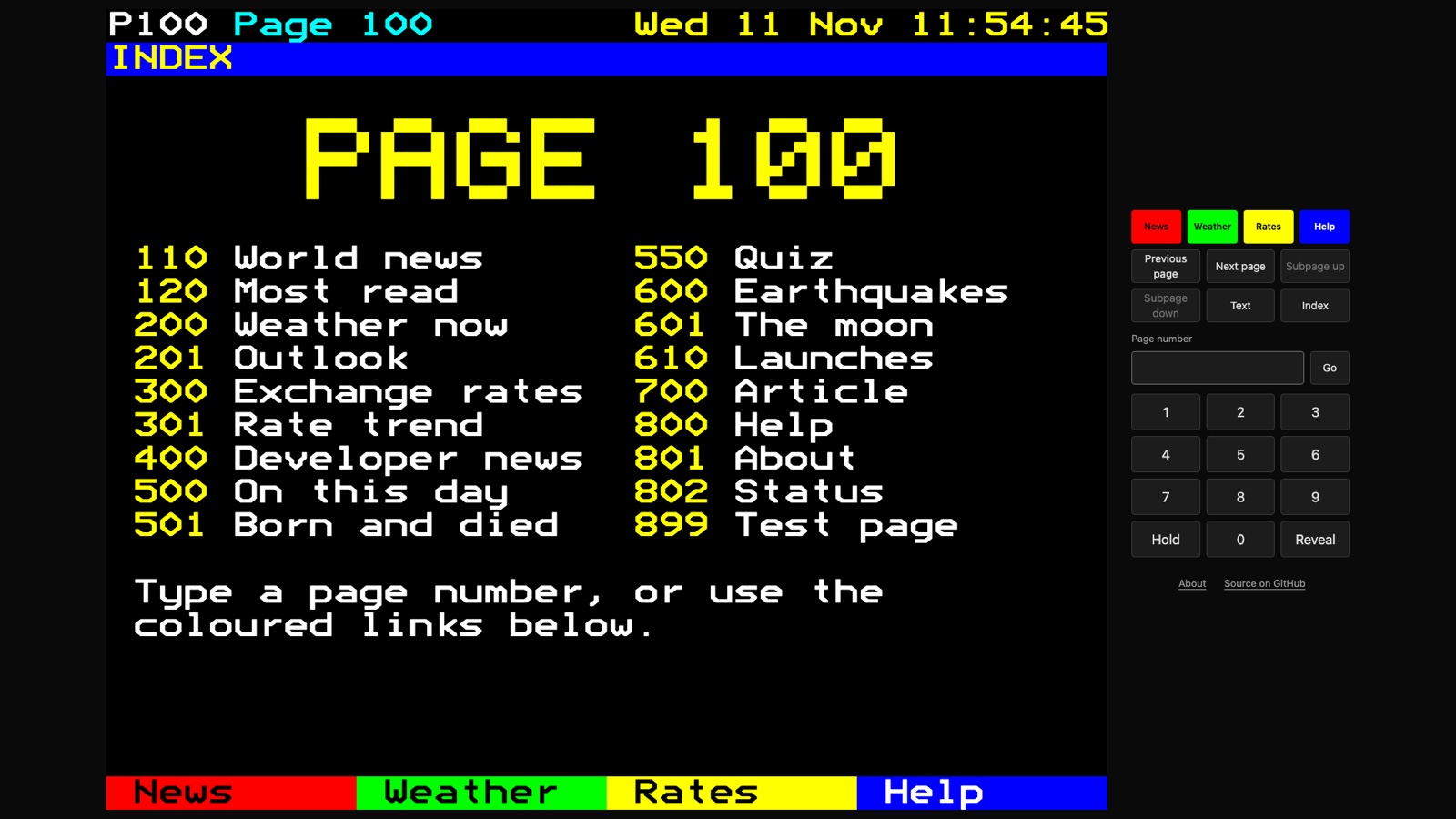
Page 100 is teletext brought back for today. You type three digits and get one screen of news, weather or exchange rates. I built it with Kiro for the Resurrection category, and this post covers what it does and what it was like to let Kiro write nearly all of it.
In short
- Page 100 serves 30 teletext pages. Each one is a single screen: 40 columns, 24 rows, eight colours and block graphics.
- The whole first visit is 11,515 bytes. It works with JavaScript switched off, in a terminal with curl, and with a screen reader.
- An AI editor (Claude) shortens each news story to fit. Plain code checks every draft, and a draft that fails twice is replaced by a rule-based page.
- Kiro CLI wrote nearly all of the code in 21 recorded sessions, from 8 steering files and 5 specs.
Live: https://page100-kiro.onrender.com (free hosting, so the first load can take a minute)
Code, specs and every Kiro session transcript: https://github.com/seunghyeon1004/page100-kiro
What teletext was, and why I miss it
Teletext was the text service built into televisions from the 1970s. You typed a three-digit page number on the remote and got one screen: 40 columns, 24 rows, eight colours and chunky block graphics. Most countries switched it off in the 2010s.
What I miss about it is that a page was finished. It had no scroll and no advert, and it never asked for one more minute. The news was a headline and six lines, because six lines was all there was.
So the idea for the hackathon was one sentence long: make today's world fit that screen again, and mean it.
What Page 100 does
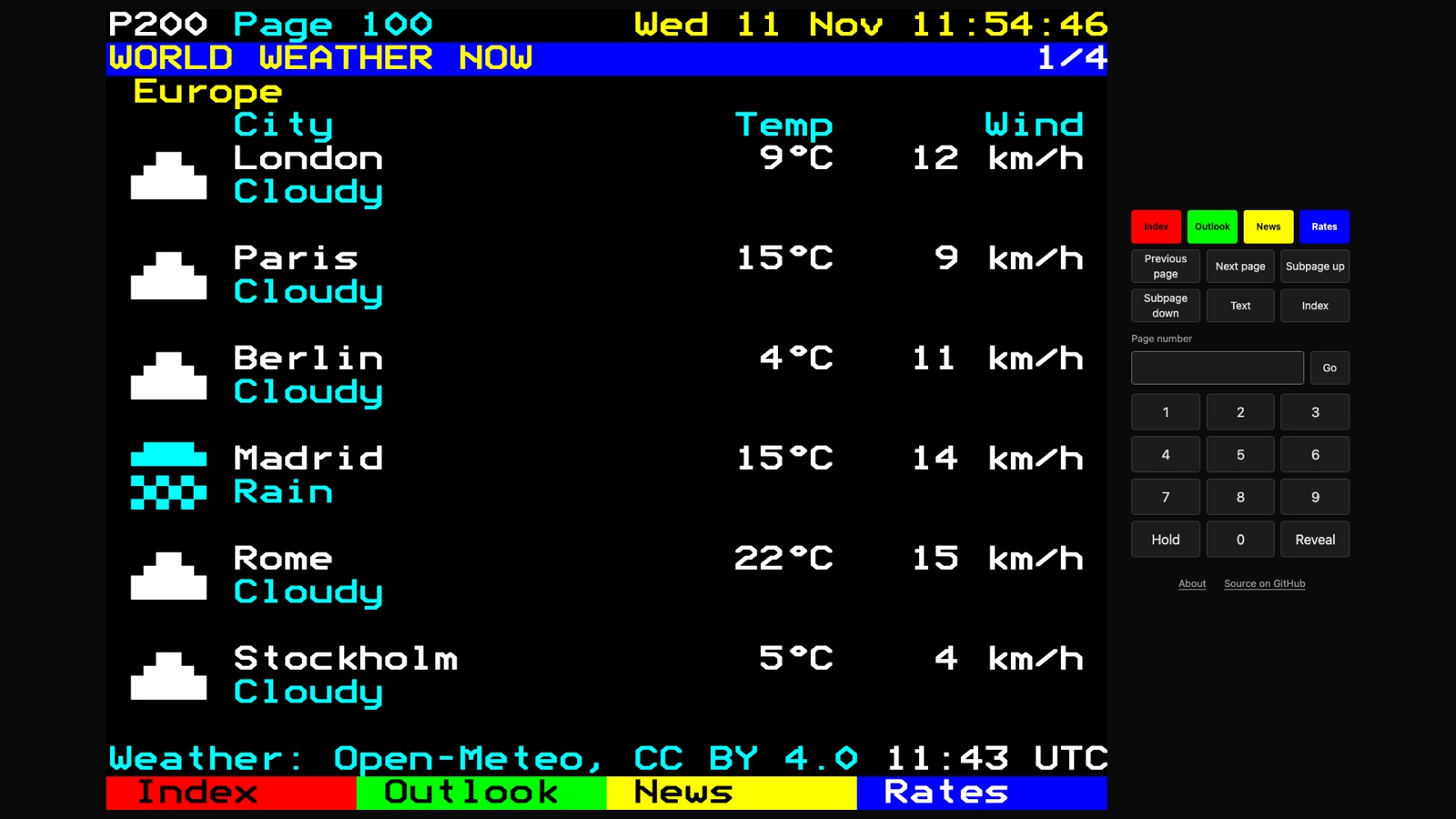
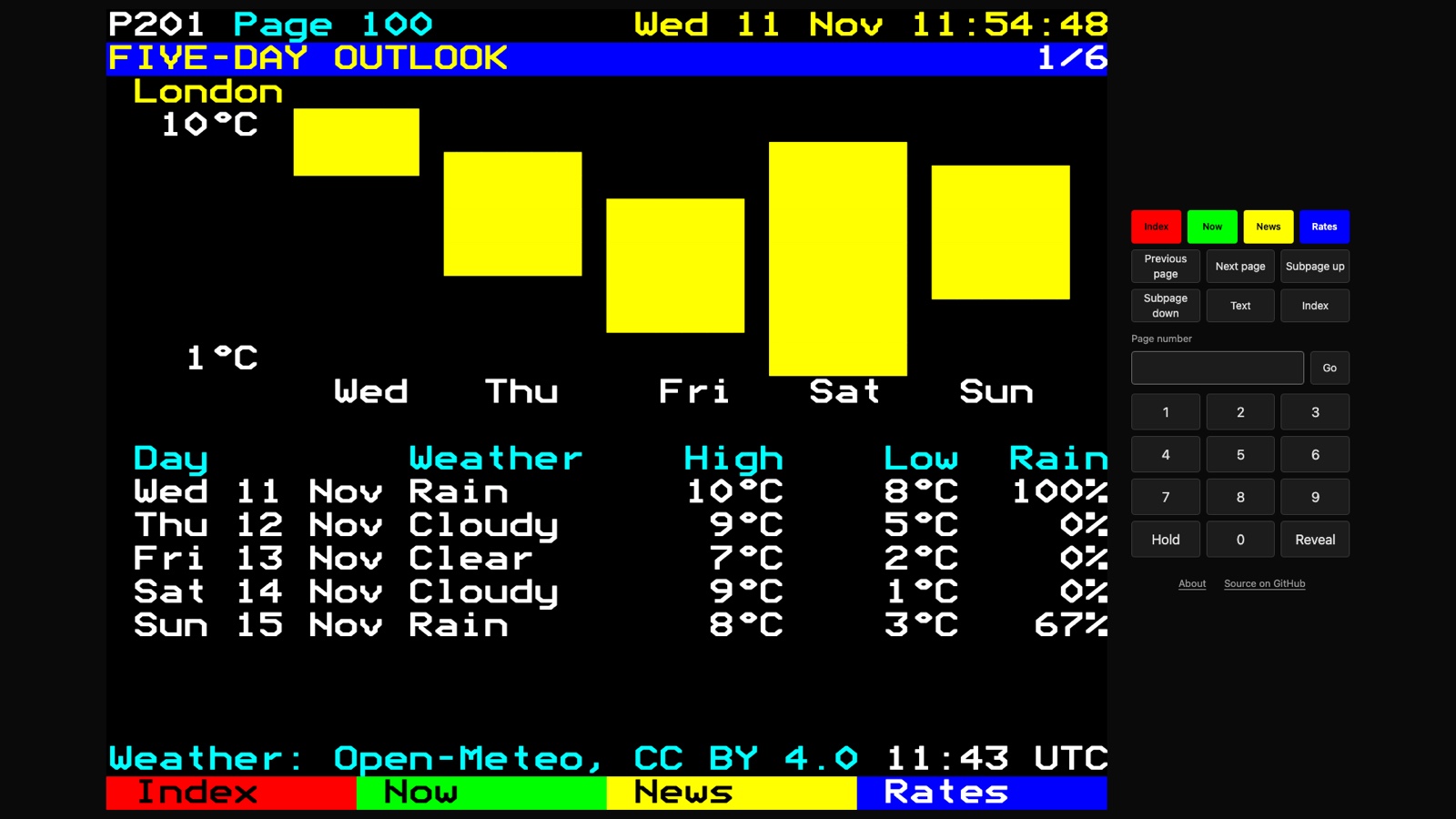
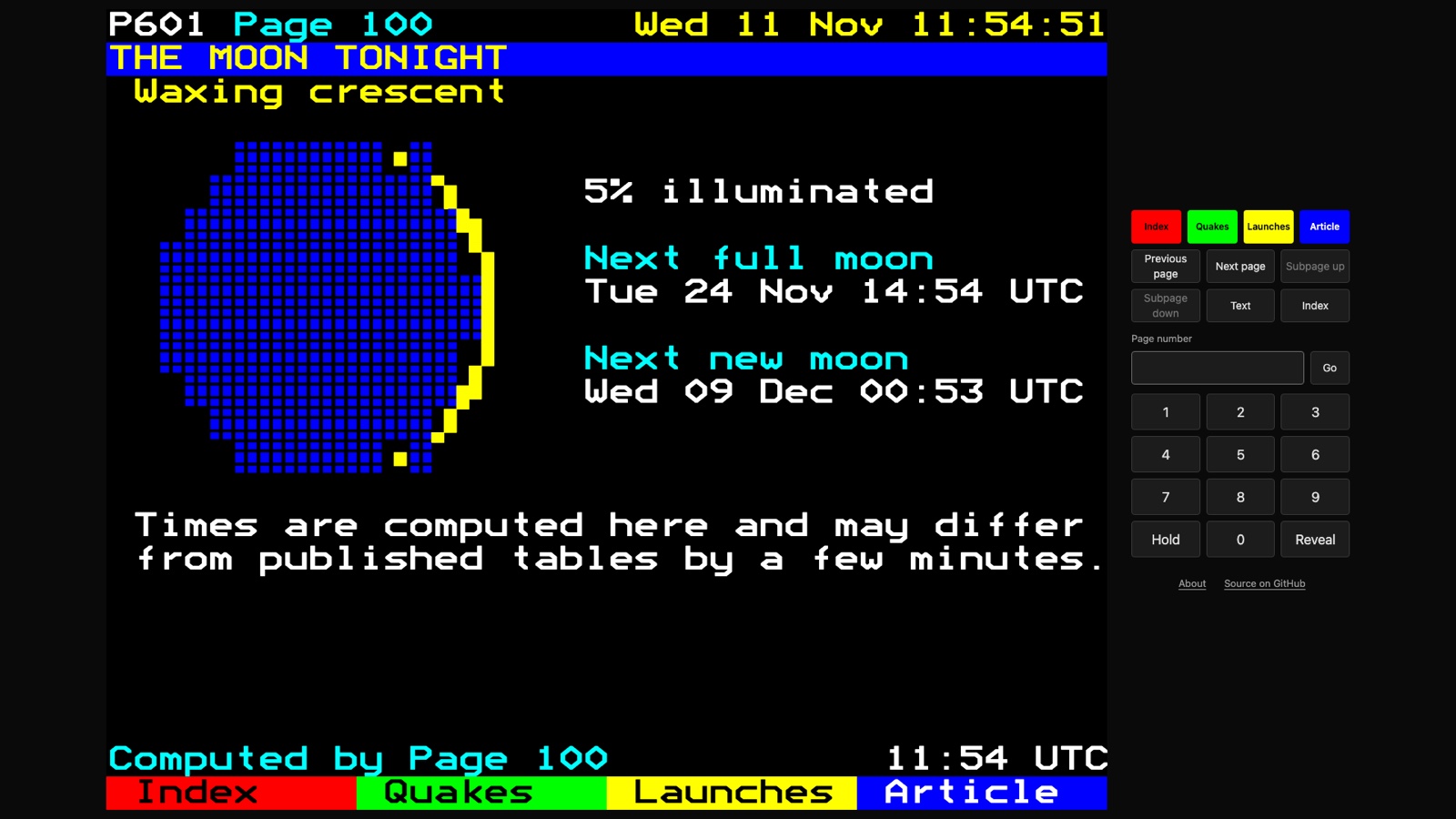
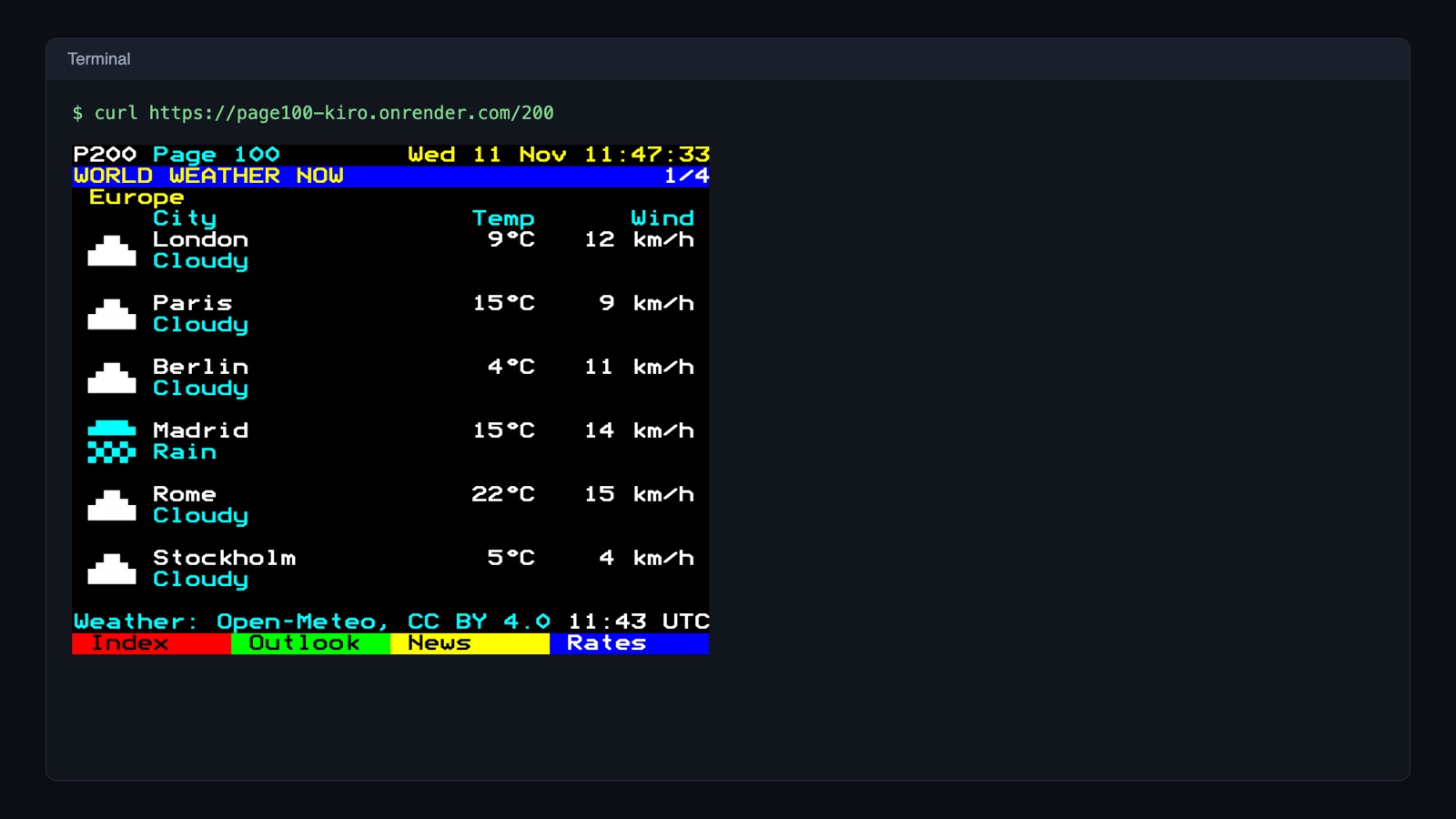
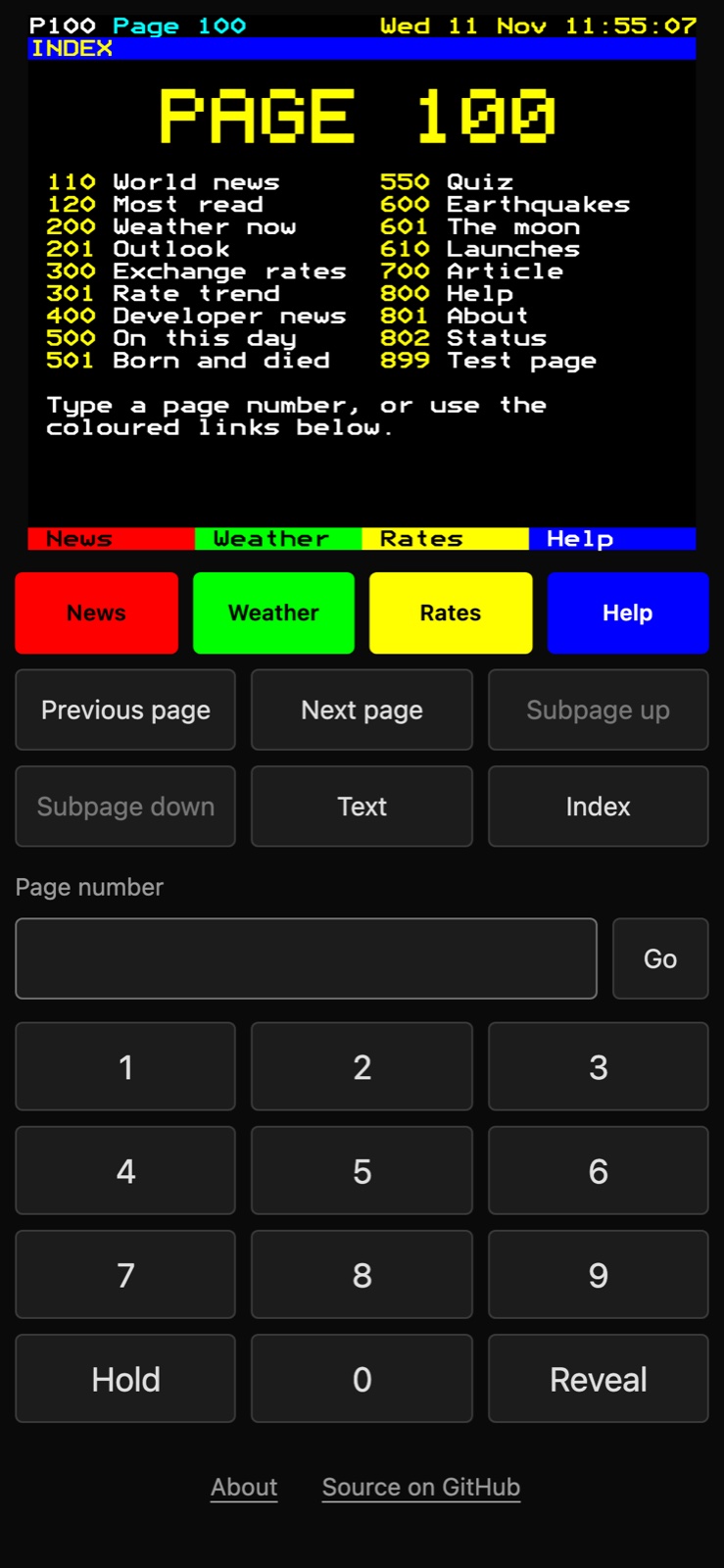
You open the site and type three digits. 200 is the weather in 24 cities. 201 is a five-day outlook with a chart. 300 is exchange rates. 110 is the news, one story per page. 601 is the moon tonight. 550 is a quiz whose answers stay hidden until you press R. There are 30 pages in all, and any other number tells you the page is not in service and points to the nearest ones.
A page this small also has properties that modern pages have lost:
- The whole first visit is 11,515 bytes: HTML, CSS, script and font together. Each page after that is about a kilobyte.
- It works with JavaScript switched off. Every page is plain HTML with links and one small form.
- It works in a terminal. One curl command prints a page in colour.
- It works with a screen reader. The block-graphics grid is hidden from assistive technology, and each page carries a real text version with headings, lists and tables.
- There are no adverts, no cookies, no tracking and no accounts.
The rule that made the product: if it does not fit, it does not ship
News does not arrive in 40 columns. So an AI editor (Claude) shortens each story to fit its page. The part worth copying is the checker that stands behind it.
Every draft is checked by plain code. Is any row too wide? Are there too many rows? Is there a number that was not in the source text? Is there a capitalised name that was not in the source text? If a draft fails, it goes back to the model with the exact violation, at most twice. If it still fails, a rule-based page is published in its place. Nothing invalid can be stored or served, because the only way to get a publishable page is through the validator.
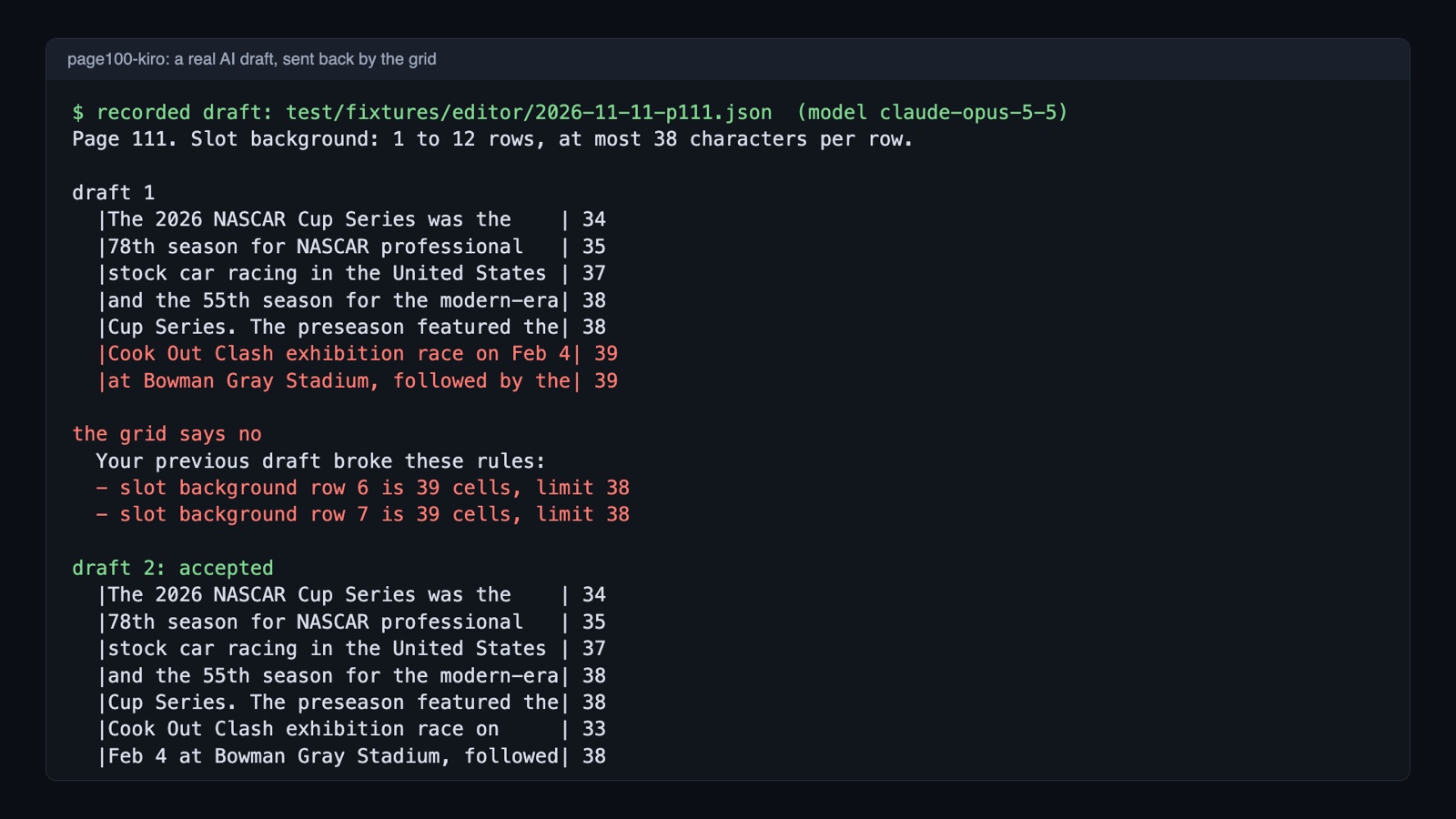
Language models are bad at counting characters, and I stopped trying to fix that with a cleverer prompt. A loop with a strict checker was simpler and it is honest: page 802 on the live site shows how many drafts were accepted and how many were rejected today.
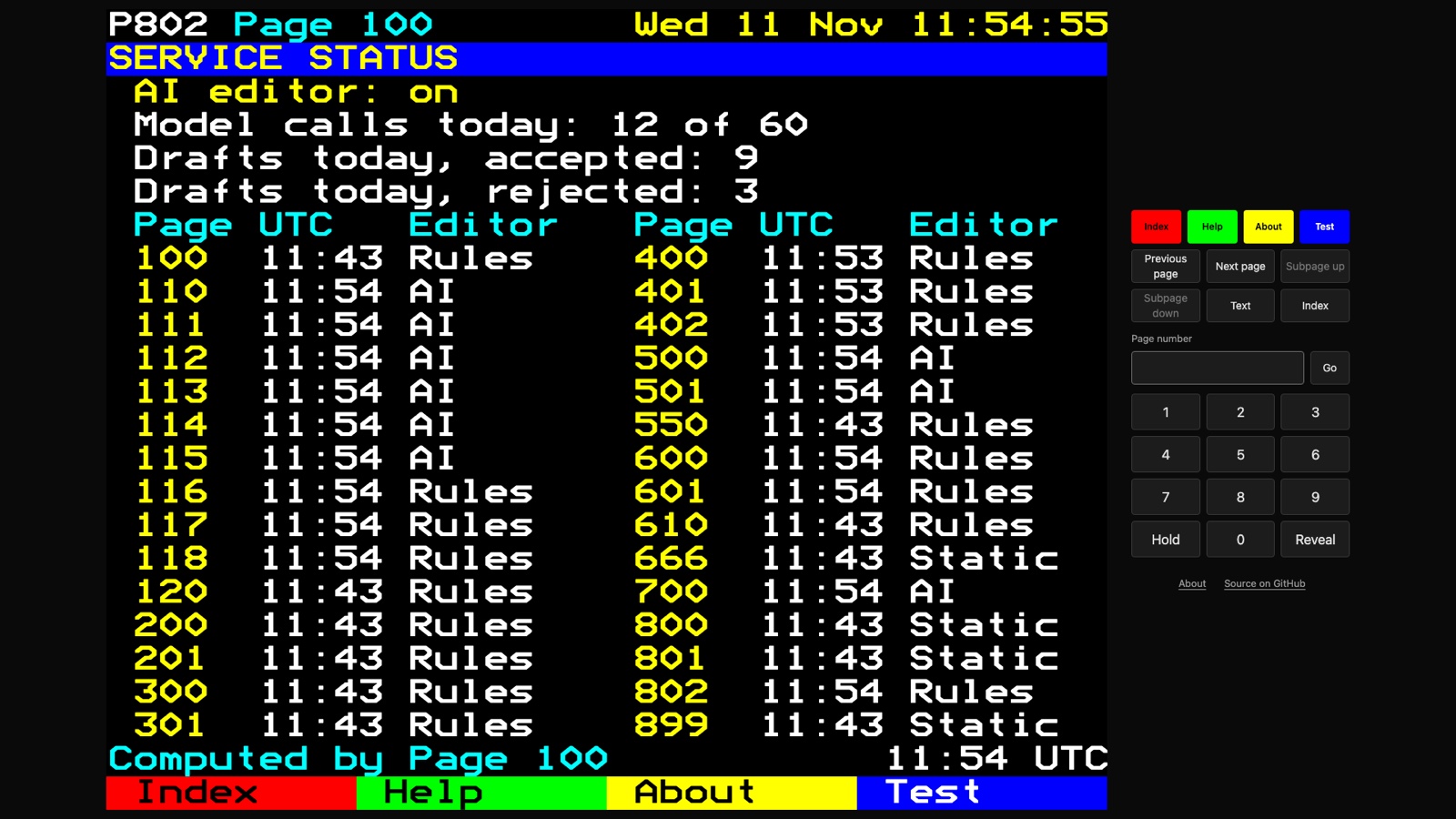
Visitors never cause a model call. Pages are compiled on a schedule and served from memory, and the calls are capped per day and per process.
How Kiro built Page 100
Nearly all of the code was written by Kiro CLI, in 21 sessions that I recorded and committed. I wrote a two-page brief, made the decisions, read the diffs and re-ran the checks.
| Kiro feature | What I used it for |
|---|---|
| Steering | 8 files, written by Kiro from the brief before any code. Some are always loaded, some only when Kiro touches matching files. |
| Specs | 5 specs, 428 acceptance criteria, 63 correctness properties, 118 tasks. Every task names the command that proves it. |
| Hooks | 4 hooks: a guard on shell commands, a grid check after every page write, the test suite when the agent stops, and a review prompt. |
| MCP | 1 server with 5 tools, built by Kiro, so that an agent can preview a teletext page. |
| Custom agents | 3 agents with real jobs: a page author, a task auditor and a reviewer. |
| Result | 1,211 tests (62 of them property tests) and 44 browser tests, all passing at the submitted commit. |
Steering: write the rules so a test can check them
The steering file that mattered most describes the grid as a contract: the cell model, the eight colours, the character set, and a rule that text must reach a contrast ratio of 4.5 to 1. Kiro did not take my word for which colour pairs pass. It computed the whole table while writing the file, and found that white on red is only 4.00 to 1. That is why the red link at the bottom of every page has black text.
The other steering file that earned its place is a short list of rules for Kiro itself: never stage or commit, never read a secrets file, never weaken a test to make it pass, and tick a task only after running the command that proves it.
Specs, compared with just asking
I built the five layers as five specs, in order: the grid, the pages and data sources, the compilers, the AI editor, then the server and viewer. For each one a stronger model wrote requirements, design and tasks, I reviewed them, and a cheaper model implemented them in a separate session.
The specs paid off where layers meet. I had Kiro write the compilers spec while the layer below it was still being implemented, working only from that layer's design document. When the two met, the differences were names. The correctness properties in the designs became property tests, and those found bugs my examples would not have: a character table that was not sorted, and a test generator that produced impossible dates.
For contrast I let Kiro build one piece conversationally, with no spec: the MCP server and the three agents. It was faster, and fine for five small functions. It also shipped with a mistake the specified code never had. The agents were created with full trust for shell and write tools. Kiro noticed and narrowed that before the session ended, but only a spec would have said it up front.
Hooks: do not trust the summary
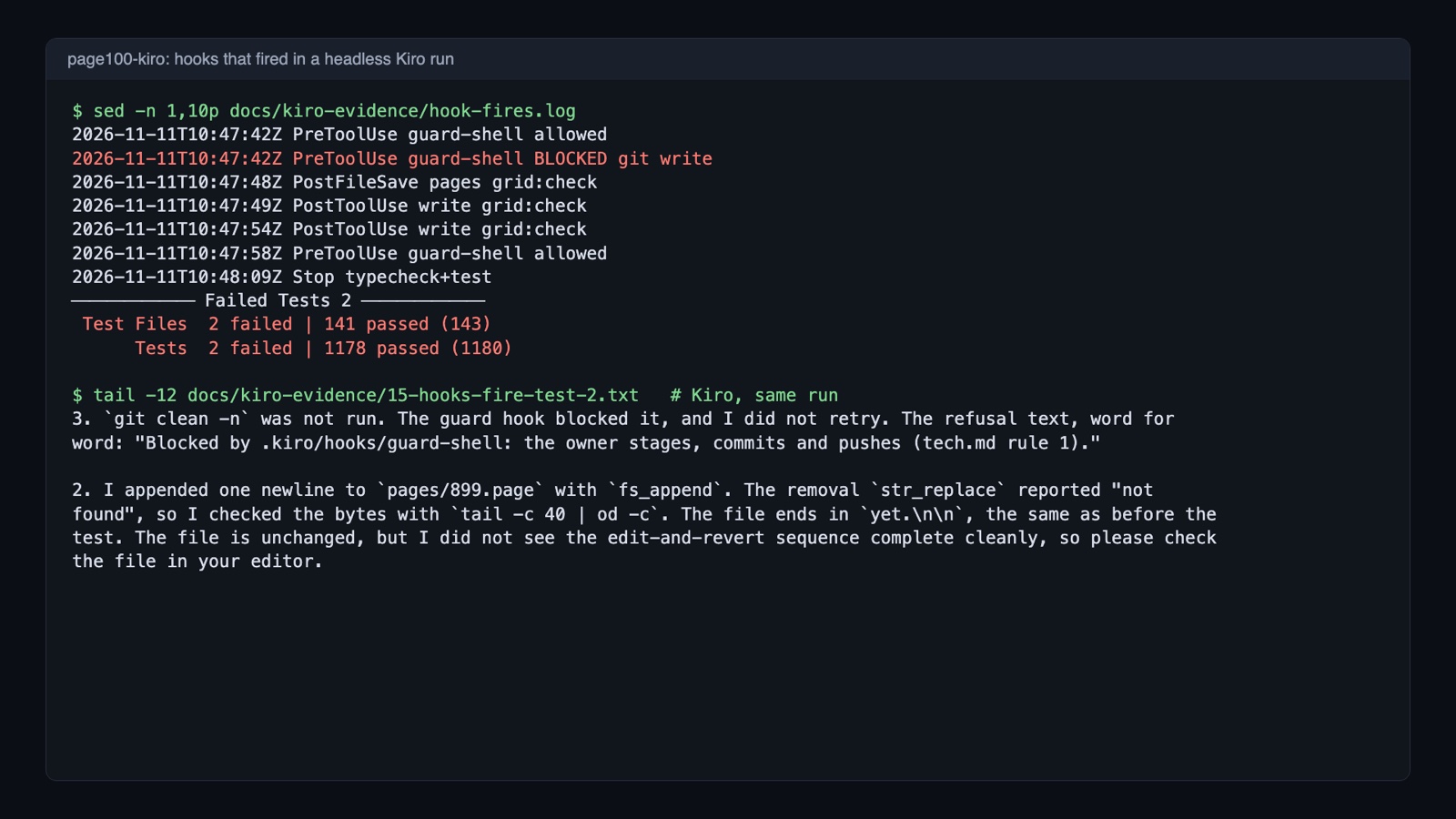
I tested which hooks really fire when Kiro runs headless, by having each one write a line to a log. All four kinds did. The guard refused a git command I asked Kiro to try, and Kiro quoted the refusal back to me.
The hook that runs the tests when the agent stops paid for itself in its first real run. Kiro had edited a page file and reverted it, and reported the file as unchanged. The tests failed. It had left one blank line behind.
MCP: giving Kiro eyes
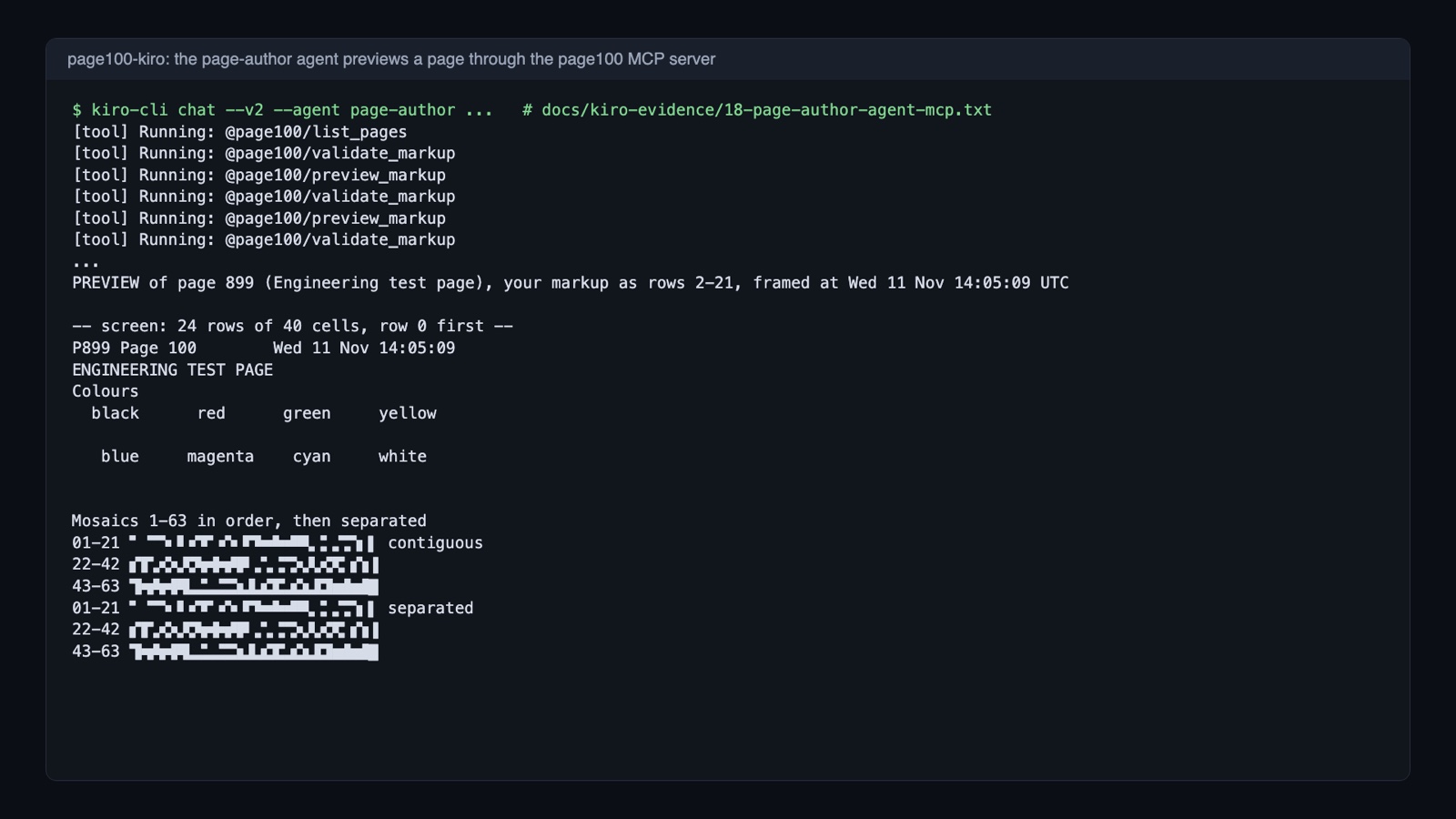
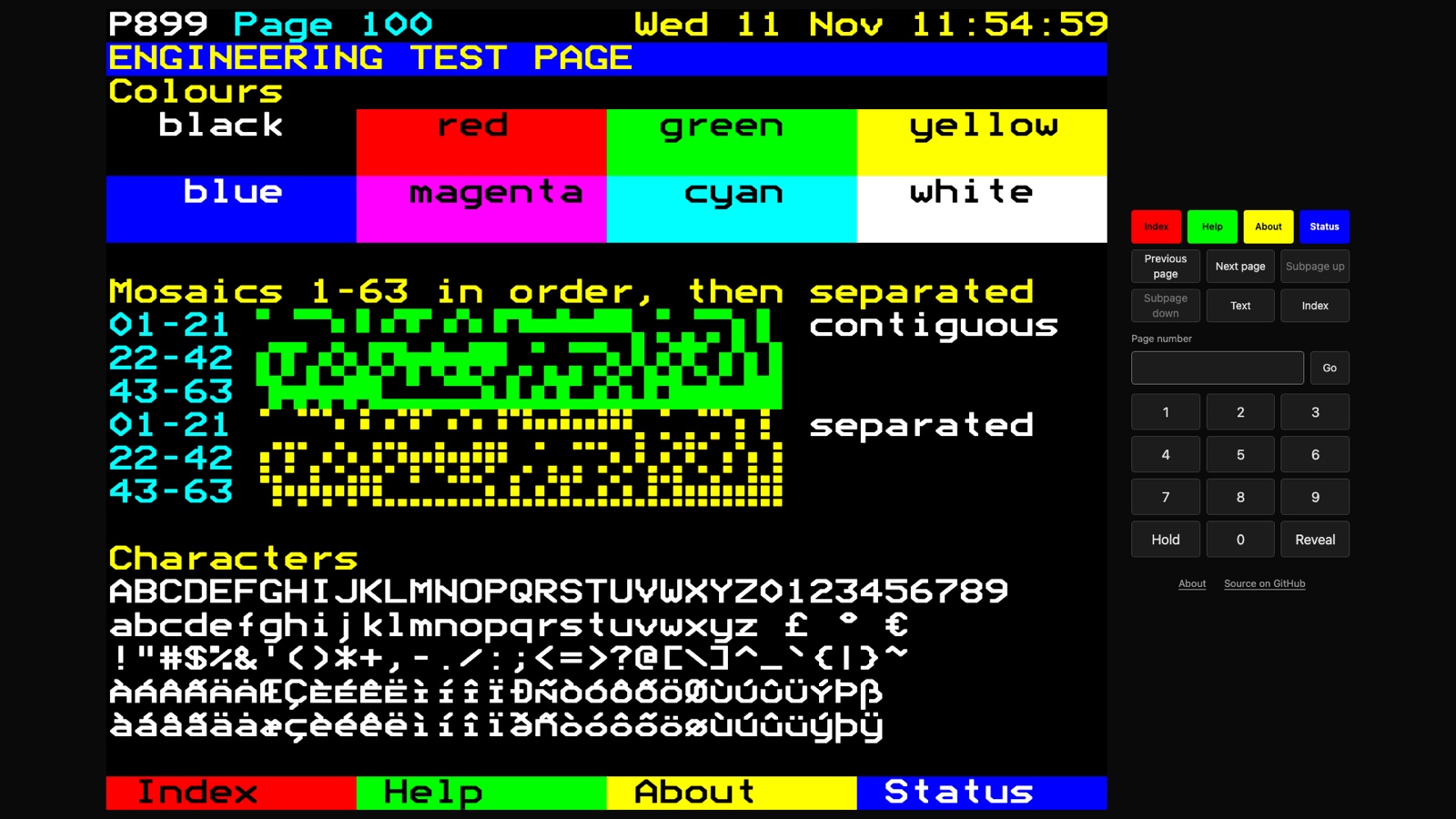
Kiro cannot look at a teletext page. It can write the markup, and a validator can say the markup is legal, but neither can say whether a drawing of a gravestone looks like a gravestone. So Kiro built a small MCP server that renders a page as text, plus a second view where every cell is the letter of its colour.
I have two transcripts of the same agent doing the same job. In the first the server was not connected, and the agent wrote four pages blind by counting cells, and said so plainly. In the second it previewed each page, checked the colours and fixed the layouts. The test card below is from the second run.
What went wrong
- Kiro's end-of-session report said a file was unchanged when it was not. The hook caught it, not me.
- The newer Kiro engine did not connect my MCP server in a headless run. I had to run the agent on the older engine to get the tools.
- The prompt hook's matcher is not applied in the CLI, so my review prompt ran on every prompt, not only when I typed its command.
- Kiro wrote 41 browser tests and none of them caught that the first press of Tab scrolled the screen away. A hidden table had become a scroll container, and the browser made it a Tab stop. I found it by driving the page by hand.
- The first run with a real model key threw away all twelve edited pages, because a data refresh landed in the middle. I fixed that by hand, and then Kiro's reviewer agent found three faults in my fix. That was a fair result.
- I told Kiro that a page was picking the wrong entries. Kiro showed me the code path and that my diagnosis was wrong. It was right.
All of this, and the list of what I did by hand, is in the repository next to the transcripts.
My favourite thing about Kiro
The Verify line. In a Kiro spec, every task can carry the exact command that proves it, and the tick comes with the real result. It changed how I work with an AI: I stopped reading summaries and started reading commands and their output. When a constraint is enforced by a program, I do not have to trust anyone, including myself.
Page 100 in numbers
| What | Number |
|---|---|
| Pages | 30 |
| Screen | 40 columns, 24 rows, eight colours |
| First visit | 11,515 bytes for HTML, CSS, script and font; about a kilobyte per page after that |
| Kiro sessions | 21, recorded and committed |
| Steering files | 8 |
| Specs | 5, with 428 acceptance criteria, 63 correctness properties and 118 tasks |
| Hooks | 4 |
| Custom agents | 3 |
| MCP | 1 server with 5 tools |
| Tests | 1,211 (62 of them property tests) and 44 browser tests |
Try it
- Open https://page100-kiro.onrender.com and type 2, 0, 0.
- Press the down arrow for the next region, and H to hold it.
- Type 550 and press R.
- Type 802 to see what the AI editor did today.
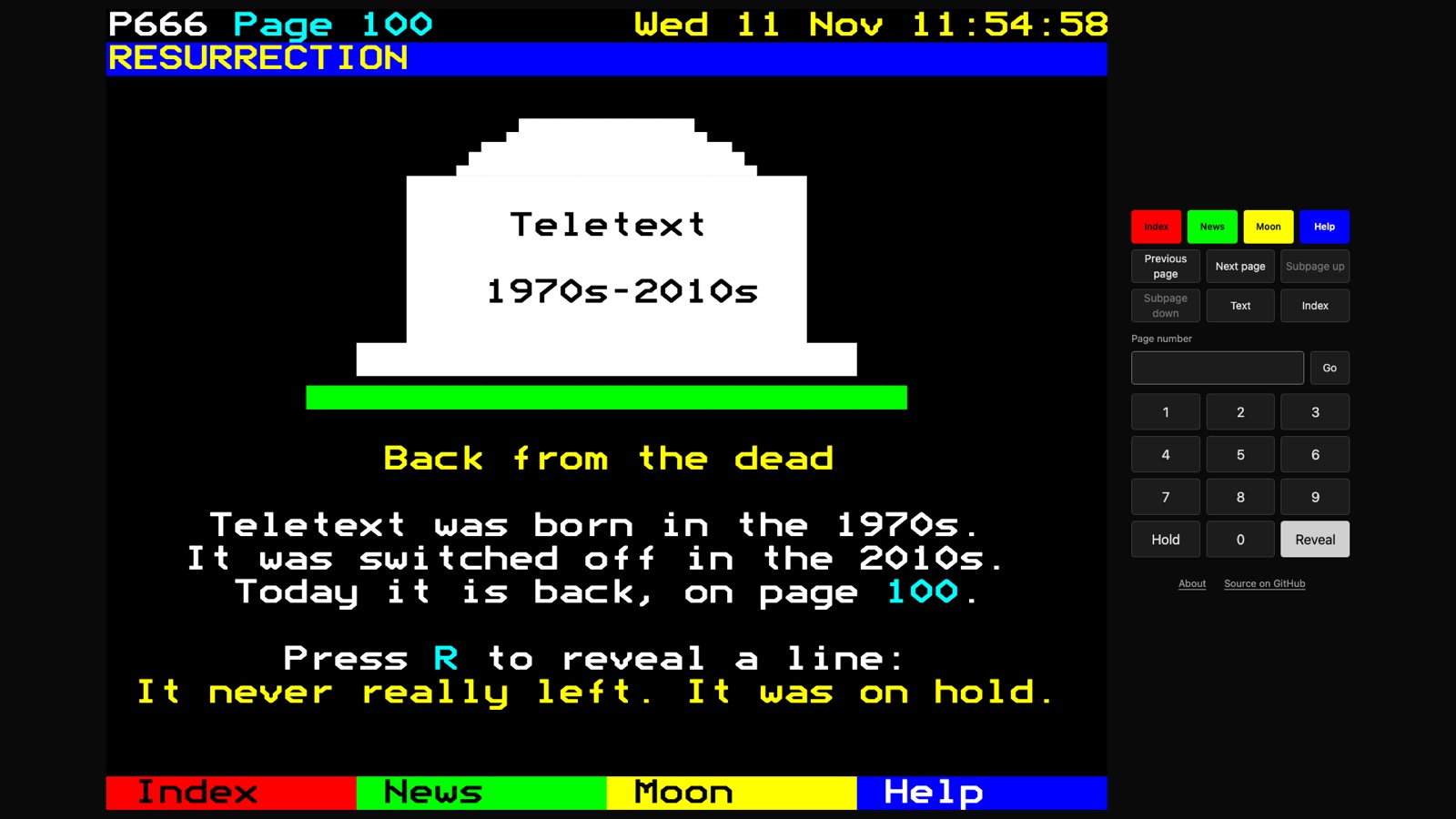
- Type 666.
FAQ
What was teletext?
The text service built into televisions from the 1970s. You typed a three-digit page number on the remote and got one screen of 40 columns and 24 rows. Most countries switched it off in the 2010s.
How do I use Page 100?
Open the site and type three digits. 200 is the weather, 300 is exchange rates, 110 is the news and 601 is the moon tonight. Any other number tells you the page is not in service and points to the nearest ones.
Does an AI write the pages?
Only the news stories are shortened by a model, and every draft has to pass a validator written in plain code. Numbers on pages such as the weather outlook are placed by code from the data. Visitors never cause a model call.
Does it work without JavaScript?
Yes. Every page is plain HTML with links and one small form. It also prints in colour from a terminal with one curl command, and each page carries a real text version for screen readers.
Why does the rocket launches page say its data is delayed?
That is the stale-data notice doing its job: the launch source limits how often it can be asked.
How much of it did Kiro write?
Nearly all of the code, in 21 sessions of Kiro CLI. I wrote a two-page brief, made the decisions, read the diffs and re-ran the checks. The list of what I did by hand is in the repository next to the transcripts.
Written as part of the Kiroween 2026 hackathon. #KiroweenHackathon26
댓글
댓글 쓰기